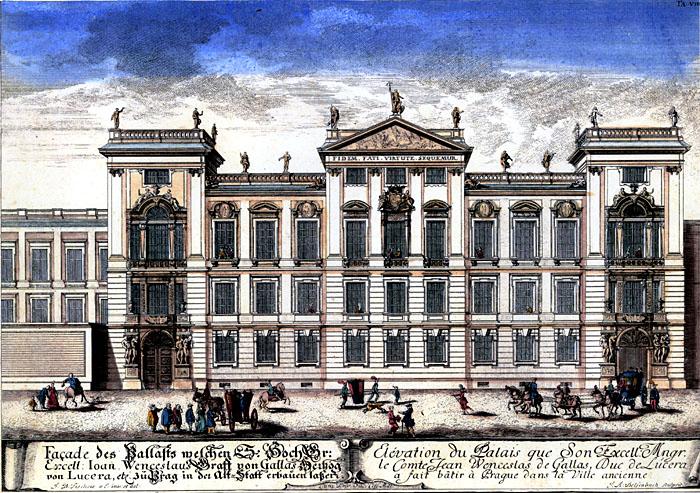
The Clam-Gallas Palace (Czech: Clam-Gallasovský palác) is a Baroque palace in Prague, the capital of the Czech Republic. The building is situated on the corner of Husova Street and Mariánské Square, in Prague's Old Town.

1. History

The palace was first designed by the imperial court architect Johann Bernhard Fischer von Erlach, from Vienna. It was built in 1714–18 by the Italian architect Domenico Canevale. During the rest of the 18th century, balls and concerts were held in the palace, and they were attended by noteworthy artists including Mozart and Beethoven. The palace was originally built for Count Johann Wenzel von Gallas, a Bohemian nobleman and diplomat. Subsequently, the Gallas family died out in 1757. At that point, the palace was inherited by Christian Philipp von Clam, son of Gallas' sister, which is how the Clam-Gallas family was created. The building is now owned by the City of Prague, which lends it to the Prague City Archives. In addition, since 2010, a multi-genre festival named "Opera Barocca" is regularly held (twice a year) in the palace premises. This festival is focused on historically informed performance of Baroque music, dance, theatre and carnival.

1. External links

Media related to Clam-Gallas Palace at Wikimedia Commons Official website History of the palace Clam-Gallas Palace – a gem of Baroque architecture in Prague – brief tourist info L'Opera Barocca – official pages of the festival

Nearby Places View Menu
Location Image
50 m

Apple Museum, Prague

The Apple Museum was a museum located in Old Town, Prague, Czech Republic. It showcased a collection of Apple memorabilia and products, and featured numerous visual and audio tributes to Steve Jobs. The collection included nearly every Apple product ever created. The museum was permanently closed in September 2020.
Location Image
57 m

Statue of Judah Loew ben Bezalel

The statue of Judah Loew ben Bezalel (Czech: Socha rabiho Löwa) is an outdoor sculpture by Ladislav Šaloun, installed at New City Hall in Prague, Czech Republic. A replica from 1914 by Ladislav Saloun is in the Maisel Synagogue in Prague. The replica has a plaque, which states that the statue’s theme is the Maharal’s death. His death is symbolized by the nude young girl holding out a rose “whose scent brings about his end”. There is a small dog on the statue’s other side, but no description of the meaning of the dog is given.
Location Image
66 m

Theatre Faculty of the Academy of Performing Arts in Prague

The Department of Dramatic Theatre (Czech: Divadelní fakulta Akademie múzických umění v Praze, abbreviated DAMU) is one of three departments at the Academy of Performing Arts in Prague (alongside the Film and TV school and the Department of Music). The academy was opened in 1945 immediately after the Second World War as a part of the newly created academy for the arts. The department's teachers have included prominent personalities in modern Czech theatre, such as Otomar Krejča, set designer František Tröster, Ivan Vyskočil, director Jiří Frejka, and Miroslav Haller. DAMU is a member of the European League of Institutes of the Arts (ELIA) and the European network on cultural management and policy (ENCATC).
Location Image
67 m

Slavonic Library in Prague

The Slavonic Library (Czech: Slovanská knihovna) in Prague is a publicly accessible specialised research library for the field of Slavic Studies. It is one of the largest and most important Slavic libraries in Europe. Since its foundation in 1924, it has been systematically complementing, processing and making accessible its collection of world research Slavic (mainly historical, philological and political-science) literature and selected original production of Slavic authors. Its depositories contain more than 850,000 volumes of library documents, a collection of maps, posters, visual and artistic materials, and numerous collections of special documents. The Slavonic Library provides library and information services concerning the political, economic and cultural life of the Slavic nations, their mutual relations and their relations to other nations in the past as well as the present. Documents can be studied in the library's public reading room, provided with free internet access, an extensive reference library and open-access shelving with a large number of volumes. The library processes and edits specialised bibliographies and publications in its field. It organizes cultural events, professional seminars, conferences and exhibitions. Following the decision of the International Committee of Slavists, it has fulfilled the function of the centre for recording and processing materials related to the international congresses of Slavists. The Slavonic Library is a section of the National Library of the Czech Republic but acts autonomously in professional library issues. It consists of departments for collection acquisitions, cataloguing and for services.