
Trinity Church (en français : « église de la Trinité ») est une église de confession épiscopalienne (Communion anglicane) située à l'intersection de Wall Street et de Broadway dans le sud de l'arrondissement de Manhattan, à New York.

1. Histoire et construction

En 1696, le gouverneur de la ville, Benjamin Fletcher approuva l'acquisition d'un terrain par la communauté anglicane pour la construction d'une nouvelle église. Le 6 mai 1697, la charte fut établie par Guillaume III d'Angleterre. L'octroi du terrain spécifiait un petit loyer annuel qui était dû à la couronne d'Angleterre. L'édifice est détruit durant le Grand Incendie de New York de 1776. L'actuelle Trinity Church est l'œuvre de l'architecte américain Richard Upjohn, qui l'a conçue dans un style néogothique. Elle fait partie des National Historic Landmark, par son architecture, mais aussi du fait de son rôle dans l'histoire de la ville de New York. Lors de la consécration de l'église le 1er mai 1846 (le jour de l'Ascension), sa flèche d'inspiration néogothique, surmontée par une croix dorée dominait le panorama urbain du sud de Manhattan. Trinity Church était ainsi un phare bienvenu pour les bateaux qui arrivaient dans le port de New York. Malgré la construction de nombreux gratte-ciel autour de l'église, Trinity Church a conservé des valeurs spirituelles très importantes dans le cœur de Manhattan et sert toujours de lieu de culte et de méditation pour les chrétiens[style à revoir].

1. Cimetière

Des personnalités de premier plan sont enterrées dans le cimetière qui entoure Trinity Church. On peut notamment citer le Père fondateur Alexander Hamilton ou Robert Fulton, l'inventeur du bateau à vapeur.

1. Divers sur Trinity Church

La chapelle Saint-Paul, qui est rattachée à la paroisse de Trinity Church est le plus ancien bâtiment de la ville de New York à encore être utilisé de manière continue. Lors de son inauguration en 1846, Trinity Church était le bâtiment le plus élevé de New York avec une hauteur de 86 mètres jusqu'à la construction du New York World Building, qui atteignait 94 mètres en 1890. Le 9 juillet 1976, l'église a reçu la visite de la reine Élisabeth II. Le cimetière de Trinity Church reste le dernier cimetière encore utilisé dans Manhattan. Dans le film Benjamin Gates et le Trésor des Templiers de Jon Turteltaub (2004), le héros incarné par Nicolas Cage explore un réseau de salles sous l'église et finit par trouver le trésor des Templiers.

1. Galerie


1. Notes et références


1. Voir aussi

Architecture néogothique à New York Ancienne chapelle Saint John

1. Liens externes

(en) Site officiel Ressources relatives à l'architecture : Registre national des lieux historiques The Skyscraper Center Structurae Ressource relative à la musique : MusicBrainz

Portail du Registre national des lieux historiques Portail de l’architecture chrétienne Portail de l'anglicanisme Portail de New York

Lieux à Proximité Voir Menu
Location Image
32 m

Statue of John Watts

An outdoor bronze sculpture depicting U.S. Congressman John Watts by George Edwin Bissell is installed in the Trinity Church Cemetery outside Manhattan's Trinity Church, in the U.S. state of New York. It was erected by Watt's grandson, John Watts de Peyster, in 1893.
37 m

Trinity Church (Manhattan)

Trinity Church is a historic parish in the Episcopal Diocese of New York. The church is located at 89 Broadway opposite Wall Street, in the Financial District of Lower Manhattan in New York City. Known for its centuries of history, prominent location, distinguished architecture and bountiful endowment, Trinity's congregation is said to be "high church", its activities based on the traditions of the Episcopal Church and the worldwide Anglican Communion in missionary outreach, and fellowship. In addition to its main church, Trinity parish maintains two chapels: St. Paul's Chapel, also in Lower Manhattan, and the Chapel of St. Cornelius the Centurion on Governors Island. The Church of the Intercession, the Trinity Chapel Complex and many other of Manhattan's Episcopal congregations were once part of Trinity parish. Columbia University was founded on the church's grounds as King's College in 1754. The current church building is the third to be constructed for the parish, and was designed by Richard Upjohn in the Gothic Revival style. Trinity's first church was a single-story rectangular structure with tall steeple facing the Hudson River, which was constructed in 1698 and destroyed in the Great New York City Fire of 1776. After using St. Paul's Chapel, the parish's second church was built in the present location facing Wall Street and was consecrated in 1790. The third and current church was erected from 1839 to 1846 and was the tallest building in the United States until 1869, as well as the tallest in New York City until 1890. In 1876–1877 a reredos and altar were erected in memory of William Backhouse Astor Sr., to the designs of architect Frederick Clarke Withers, who extended the rear. The church is adjacent to the Trinity Churchyard, a burial ground, one of three used by the parish. Besides its church and two chapels, Trinity manages real estate properties with a combined worth of over $6 billion as of 2019. Trinity's main church building is a National Historic Landmark as well as a New York City designated landmark. It is also a contributing property to the Wall Street Historic District, a NRHP district created in 2007.
43 m

Rector Street station (IRT Sixth Avenue Line)

The Rector Street station was on the demolished IRT Sixth Avenue Line in Manhattan, New York City. It had three tracks and two side platforms. It opened on June 5, 1878, served by trains from the IRT Sixth Avenue Line, and was one block east of Rector Street El Station on the IRT Ninth Avenue Line. In 1918, Brooklyn Rapid Transit Company built the Broadway Subway through Manhattan and added a station at Rector Street, which served as competition for the 6th Avenue Line station. The el station closed on December 4, 1938. The next southbound stop was Battery Place on the IRT Ninth Avenue Line. The next northbound stop was Cortlandt Street.
Location Image
44 m

Rector Street station (BMT Broadway Line)
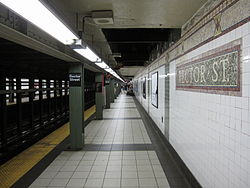
The Rector Street station is a local station on the BMT Broadway Line of the New York City Subway. Located at the corner of Rector Street and Trinity Place in Financial District, Lower Manhattan, the station is served by the R train at all times except late nights, when the N train takes over service. The W train also serves this station on weekdays.
Location Image
48 m

Rector Street station (IRT Broadway–Seventh Avenue Line)

The Rector Street station is a station on the IRT Broadway–Seventh Avenue Line of the New York City Subway. Located at the intersection of Rector Street and Greenwich Street in Financial District of Manhattan, it is served by the 1 train at all times. The station was built by the Interborough Rapid Transit Company (IRT) as part of the Dual Contracts with New York City, and opened on July 1, 1918. The station's platforms were lengthened in the 1960s, and the station was renovated after being out of service for a year in the aftermath of the September 11, 2001 attacks.