
Location Image

Rector Street station (BMT Broadway Line)

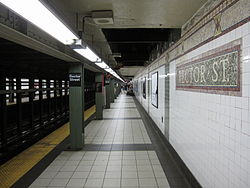
The Rector Street station is a local station on the BMT Broadway Line of the New York City Subway. Located at the corner of Rector Street and Trinity Place in Financial District, Lower Manhattan, the station is served by the R train at all times except late nights, when the N train takes over service. The W train also serves this station on weekdays.

1. History

The Rector Street station on the Brooklyn–Manhattan Transit Corporation (BMT)'s Broadway Line opened on January 5, 1918. The station's platforms originally could only fit six 67-foot-long (20 m) cars. In 1926, the New York City Board of Transportation received bids for the lengthening of platforms at nine stations on the Broadway Line, including the Rector Street station, to accommodate eight-car trains. Edwards & Flood submitted a low bid of $101,775 for the project. The platform-lengthening project was completed in 1927, bringing the length of the platforms to 535 feet (163 m). The city government took over the BMT's operations on June 1, 1940. The station was temporarily closed for six weeks after the September 11 attacks, reopening on October 27, 2001.

1. Station layout

Since the station is on a grade, there is a noticeable slant. The station has two side platforms, and there are no overpasses, underpasses, or mezzanines to connect the platforms within fare control. The station was overhauled in the late 1970s. The original trim lines were replaced with white cinderblock tiles, except for small recesses in the walls, which contain blue-painted cinderblock tiles. The staircases were repaired and new platform edges were installed. The blue cinderblock field contains the station-name signs and white text pointing to the exits. The renovation also replaced incandescent lighting with fluorescent lighting. The uptown platform maintains one old style sign while at the north end of the downtown/Brooklyn platform is an entire closed off portion of the platform. There are several (painted over) old style Rector Street mosaic signs on this platform. Directly to the south, the BMT Broadway Line curves southeast under the Cunard Building and Bowling Green Offices Building to reach the Whitehall Street station.

1. = Exits =

Each platform has its own platform-level fare controls. The full-time exit is at the north end of the station, at Rector Street and Trinity Place. The uptown platform contains a token booth and three street stairs: two to the northeast corner of the aforementioned intersection, and one to the southeast corner. The downtown platform is unstaffed and has four street stairs: two to the southwest corner and two to the northwest corner. Just south of the fare control for the downtown platform, there are two exit-only turnstiles leading to an exit-only stair to the western side of Trinity Place. At the extreme south end of the station, there is another street stair from the uptown platform to the northwest corner of Greenwich and Morris Streets, directly across from Elizabeth H. Berger Plaza and the entrance to the separate Rector Street station on the IRT Broadway–Seventh Avenue Line. The downtown platform is proposed to become ADA-accessible with the construction of an elevator leading from an easement in 50 Trinity Place to the downtown platform. The elevator's installation was required per zoning regulations, which mandated that the developers of 77 Greenwich Street (also known as 42 Trinity Place) fund transit improvements at the station. However, whether the elevator will be installed has been unknown since April 2020 due to various lawsuits involving the MTA and FIT Investment Corp (the developer for 50 Trinity Place).

1. Nearby points of interest

65 Broadway American Stock Exchange Building Cunard Building Empire Building Robert and Anne Dickey House Trinity Church

1. Image gallery


1. References


1. External links

nycsubway.org – BMT Broadway Line: Rector Street Station Reporter — N Train Station Reporter — R Train Rector Street entrance from Google Maps Street View entrance near Brooklyn Battery Tunnel from Google Maps Street View Platforms from Google Maps Street View

Nearby Places View Menu
4 m

Rector Street station (IRT Sixth Avenue Line)
The Rector Street station was on the demolished IRT Sixth Avenue Line in Manhattan, New York City. It had three tracks and two side platforms. It opened on June 5, 1878, served by trains from the IRT Sixth Avenue Line, and was one block east of Rector Street El Station on the IRT Ninth Avenue Line. In 1918, Brooklyn Rapid Transit Company built the Broadway Subway through Manhattan and added a station at Rector Street, which served as competition for the 6th Avenue Line station. The el station closed on December 4, 1938. The next southbound stop was Battery Place on the IRT Ninth Avenue Line. The next northbound stop was Cortlandt Street.
Location Image
32 m

Rector Street station (IRT Broadway–Seventh Avenue Line)

The Rector Street station is a station on the IRT Broadway–Seventh Avenue Line of the New York City Subway. Located at the intersection of Rector Street and Greenwich Street in Financial District of Manhattan, it is served by the 1 train at all times. The station was built by the Interborough Rapid Transit Company (IRT) as part of the Dual Contracts with New York City, and opened on July 1, 1918. The station's platforms were lengthened in the 1960s, and the station was renovated after being out of service for a year in the aftermath of the September 11, 2001 attacks.
Location Image
36 m

Trinity Court Building

Trinity Court Building, also known as Trinity Commons, is a structure at 68–76 Trinity Place, between Rector and Albany Streets, in the Financial District of Lower Manhattan in New York City. It replaces a building on the site with the same name, constructed in 1927. The 1927 building, in turn, had been erected to replace a structure built in 1879. Trinity Church, which owns the site, had its offices and preschool in the 1927 building. In 2015, the church faced a choice of a $33 million renovation to bring it up to code, or to replace it with a new building at a cost of about $35 million. The vestry decided on the latter and tore the structure down. In its place, it planned to construct a new building with an address of 68-74 Trinity Place. Originally, 310,000 square feet (29,000 m2) of primarily luxury condominiums with a modern glass facade was planned. Due to community opposition the plans were changed, with a smaller commercial building incorporating community-friendly uses. The new design also uses bronzed aluminum to better fit in with the church and a preserved footbridge from the previous building, and incorporates stained glass and terra cotta embellishments salvaged form the 1927 edifice. The third building, known as Trinity Commons, topped out in 2018 and opened in 2021.
Location Image
54 m

Empire Building (Manhattan)

The Empire Building is an office building and early skyscraper at 71 Broadway, on the corner of Rector Street, in the Financial District of Manhattan in New York City. It was designed by Kimball & Thompson in the Classical Revival style and built by Marc Eidlitz & Son from 1897 to 1898. The building consists of 21 stories above a full basement story facing Trinity Place at the back of the building and is 293 feet (89 m) tall. The Empire Building is a New York City designated landmark and is listed on the National Register of Historic Places (NRHP). It is also a contributing property to the Wall Street Historic District, NRHP district created in 2007. The Empire Building's articulation consists of three horizontal sections similar to the components of a column—namely a base, shaft, and capital—and has a facade of gray granite at its base and white granite on the upper stories. It is one of the earliest skyscrapers built on pneumatic caissons and one of the oldest such buildings that remain standing. The building contains an interior steel frame structure with a curtain-walled facade. The top stories contain a loggia on the facade as well as a large metal cornice above the 20th floor. There are numerous band courses, balconies, and arched windows along the facade. The original Empire Building was a brownstone structure constructed in 1859. Though the politician and real estate developer Orlando B. Potter had acquired the brownstone in 1884, he died prior to the current building's construction. The present Empire Building was ultimately developed by his children as a 20-story structure. The Empire Building was the home of United States Steel Corporation from the company's 1901 founding to 1976, and U.S. Steel owned the building between 1919 and 1973. The Empire Building's 21st floor was constructed between 1928 and 1930 to designs by John C. Westervelt. The building was converted to apartments in 1997.