

 English
 Français

Fog Lane Park
Fog Lane Park is a public urban park located in the Withington and Didsbury areas of Manchester, England. The park provides a green oasis within the urban environment and offers a variety of recreational facilities and community spaces.
Nearby Places View Menu

560 m
Wilmslow Road bus corridor
The Wilmslow Road bus corridor is a 5.5 miles (8.9 km)-long section of road in Manchester that is served by a large number of bus services. The corridor runs from Parrs Wood to Manchester city centre along Wilmslow and Oxford Roads, serving Didsbury, Withington, Fallowfield and Rusholme.
Several frequent routes combine to operate along the northern section, providing access to the University of Manchester, Manchester Metropolitan University (MMU), the Royal Northern College of Music (RNCM), Manchester Royal Infirmary (MRI) and Christie Hospital.

610 m
Burnage railway station
Burnage railway station serves the suburb of Burnage in south Manchester, England. It is a stop on the Styal Line between Manchester Piccadilly, Manchester Airport and Wilmslow. It caters mainly for commuter traffic, with regular services between Crewe, Manchester Airport and Manchester Piccadilly.
680 m
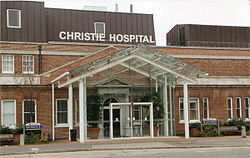
The Christie
The Christie, formerly known as Christie Hospital and The Christie Hospital and Holt Radium Institute, is a specialist National Health Service (NHS) single site cancer centre in Manchester, United Kingdom. The hospital is managed by The Christie NHS Foundation Trust, which as of 2024 had a turnover of £472 million and around 3,500 staff. Its work is supported by The Christie Charity.
The hospital was established in 1890 by Richard Copley Christie, after whom, along with his wife Mary, it is named. Initially situated off Oxford Road in Manchester, the centre moved to a purpose-built facility in Withington in 1932 and became part of the NHS in 1948.

787 m
Church of St Nicholas, Burnage
The Church of St Nicholas, Kingsway, Burnage, Manchester, is a Modernist church of 1930–2 by N. F. Cachemaille-Day, Lander and Welch. It was enlarged in 1964 with a bay on the west side, also by Cachemaille-Day. Pevsner describes the church as "a milestone in the history of church architecture in England". The church was designated a Grade II* listed building on 10 October 1980.
St Nicholas is one of a relatively small group of Modernist churches in England, and one of the earliest. It is "of brick, high, sheer and sculptural, with a German-inspired passion for brick grooves and ribbing, both vertical and horizontal." The building cost £11,600. The interior was plainly furnished, "the walls bare, the windows clear, but the ceiling is coffered in blue, red and gold".
In 2001–3, the church underwent significant conservation, at a cost of over 1 million pounds. The conservation included a re-ordering of the interior to provide additional meeting space, and offices, including the insertion of a "striking glass circular meeting room", designed by Anthony Grimshaw Associates from Wigan. "The church's spatial complexity is not spoiled, but rather added to", by "hanging the meeting room above head height".