Le Crewe Alexandra Football Club est un club anglais de football basé dans la ville de Crewe, dans le Cheshire. Surnommé The Railwaymen à cause de la connexion entre la ville et l'industrie ferroviaire, il évolue en EFL League Two (quatrième division anglaise) et joue ses matchs à l'Alexandra Stadium. Le club est fondé en 1877, et est nommé d'après la Princesse Alexandra. Il est membre fondateur de la Football League Second Division en 1892, mais n'y reste que quatre années. Depuis la réintégration dans la Football League en 1921, ils sont restés dans les divisions inférieures d'Angleterre. Le seul trophée notable du club est le Football League Trophy gagné en 2013. Durant les dernières décennies, le club a été associé à Dario Gradi, qui a été entraîneur entre 1983 et 2007 et détient le record de l'entraîneur à avoir tenu son poste le plus de temps de toute l'histoire du football anglais après être resté 24 ans responsable de Crewe. Il revient à son poste entre 2009 et 2011. Gradi était connu pour se focaliser sur le développement des jeunes joueurs. Des joueurs notables sont passés par l'académie du club, tels que les anciens joueurs internationaux Rob Jones, Neil Lennon, Danny Murphy, Seth Johnson et Dean Ashton.

Nearby Places View Menu
Location Image
36 m

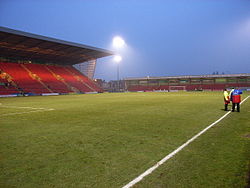
Gresty Road

Gresty Road, also known as the Alexandra Stadium and currently known as the Mornflake Stadium for sponsorship reasons, is a football stadium in Crewe, Cheshire, England. It is the home ground of Crewe Alexandra and has an all-seated capacity of 10,153.
131 m

Alexandra Recreation Ground

The Alexandra Recreation Ground, also known as Nantwich Road, was a multi-sport venue in Crewe in England. Opened in 1877, it was the home ground of Crewe Alexandra for 19 years, and also hosted an FA Cup semi-final and the 1886-87 Welsh Cup final, both in 1887, and an England home match in 1888.
Location Image
262 m

Crewe railway station

Crewe railway station serves the railway town of Crewe, in Cheshire, England. It opened in 1837 and is one of the most historically significant railway stations in the world. It is a major junction on the West Coast Main Line and serves as a rail gateway for North West England. It is 158 miles (254 km) north of London Euston and 243 miles (391 km) south of Glasgow Central. It is located at the point where the lines to Manchester Piccadilly and North Wales diverge from this route; it is the last major station before the branch to Liverpool Lime Street diverges. It is also served by lines to Stoke-on-Trent and Shrewsbury. Crewe station has twelve platforms and a modern passenger entrance containing a bookshop and ticket office. Passengers access the platforms via a footbridge, stairs and lifts. The platform buildings, which date from the 19th century, contain two bookshops, bars, buffets and waiting rooms. The last major expenditure on the station took place in 1984-1985 when the track layout was remodelled and the station facilities were updated.
Location Image
379 m

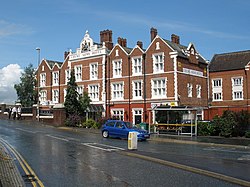
Crewe Arms Hotel

The Crewe Arms Hotel is a leisure facility in Nantwich Road, Crewe, Cheshire, next to Crewe railway station. It was for nearly 70 years the meeting place of Cheshire County Council.
Location Image
404 m

Crewe Diesel TMD

Crewe Diesel Depot is a former diesel-electric locomotive traction maintenance depot, formerly Crewe Diesel Traction Maintenance Depot or Crewe Diesel TMD, situated to the south of and visible from Crewe railway station. Built in 1958 by British Railways it was used as a maintenance facility for the diesel locomotives that were at the time replacing steam traction across the national rail network. Following the privatisation of British Rail depot ownership transferred to EWS, now DB Schenker and continued as a base for diesel traction, latterly becoming a facility for storing surplus rolling stock. In 2014 ownership transferred to Locomotive Storage Limited who have been and are continuing to renovate the site.