

 English
 Français
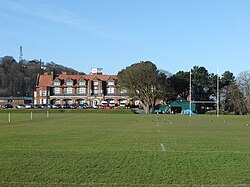
Scarborough College
Scarborough College is a private coeducational day and boarding school aged 3–18 years in Scarborough, North Yorkshire, England. It was founded in 1898 and opened in 1901. The school has been an International Baccalaureate (IB) World School since June 2006, offering it at sixth form in place of A-levels.
Nearby Places View Menu
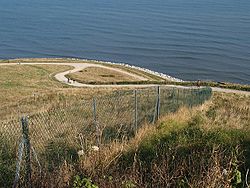
452 m
Holbeck Hall Hotel
The Holbeck Hall Hotel was a clifftop hotel in Scarborough, North Yorkshire, England, owned by the Turner family. It was built in 1879 by George Alderson Smith as a private residence, and was later converted to a hotel.
On 4 June 1993, 55 metres (180 ft) of the 70 metres (230 ft) hotel garden had disappeared from view, the beginning of a landslide which gradually became more severe. The landslip was first reported to the police, early in the morning, 4 June, by Peter Swales, who took an early morning walk on South Cliff putting green and noted the hotel was at risk of collapsing. He went straight to the police station and reported that the guests were in imminent danger.
Finally on 5 June 1993, after a day of heavy rain, parts of the building collapsed, making news around the world. The hotel's chimney stack collapsed live on television just as Yorkshire TV's Calendar regional news programme went on air covering the building's precarious condition. Richard Whiteley was presenting the item at the time of the collapse. The remainder of the building was demolished for safety reasons. One of the likely contributing causes of the landslide was the substantial rain in the two months before it occurred. The mud flow from the landslide protruded 135 metres (443 ft) beyond the high-water mark.
Landslides are a common problem in Scarborough and along the coast from Filey to Whitby.
In 1997, the hotel's collapse became the subject of a significant court case in English civil law (Holbeck Hall Hotel Ltd v Scarborough BC) when the owners of the hotel attempted to sue Scarborough Borough Council for damages, alleging that as owners of the shoreline they had not taken any practical measures at all to prevent the landslip – from soft, to hard engineering, nothing was done. The claim was rejected on the grounds that the council was not liable for the causes of the slip because it was not reasonably foreseeable. Reasonable foreseeability is a requirement for liability in negligence and nuisance in English and Welsh tort law.

562 m
Oliver's Mount
Oliver's Mount is an area of high ground overlooking Scarborough, North Yorkshire, England. It offers views over the town, a tribute monument to the war dead, camping and caravanning at selected times of the year, 10 football pitches, 1 rugby league pitch, in the past a small school, and a cafe, but may be primarily known for its motorcycle races. Oliver's Mount first held a motorcycle race in 1946, and continues to hold motorcycle circuit racing today, and also holds car rally and car hill-climb events. Cars have raced here twice, in 1955 and 1956.
In 2016 Oliver's Mount was the summit for the final classified climb on the third stage of the Tour de Yorkshire cycle race.
The site also houses the broadcasting transmitter which provides TV and radio services to Scarborough and the surrounding areas.
Oliver's Mount is named after Oliver Cromwell, as it was thought that he had sited guns there, although there is no evidence that Cromwell visited Scarborough during the Civil War. This name was in use by 1804; previously the hill was known as Weaponness, which now refers to the area of the town around Oliver's Mount and Filey Road, and one of the wards of the borough.

687 m
Scarborough War Memorial
Scarborough War Memorial is a war memorial at the north end of Oliver's Mount in the town of Scarborough in North Yorkshire. It is listed Grade II on the National Heritage List for England.
The memorial consists of a stone obelisk atop a square pedestal on a square mound. 11 steps lead up to the obelisk.
It was dedicated on 26 September 1923 in a ceremony attended by Councillor William Boyes and Reverend J. Wynwayd Capron. It was later rededicated on 12 November 1950.
The memorial names 241 individuals who died in World War II and 70 who died in the Korean War. The 53 civilians of Scarborough who were killed in World War I and the 42 civilians who died in World War II are also named.

765 m
St Edward the Confessor's Church, Scarborough
St Edward the Confessor's Church is a Catholic church in Scarborough, North Yorkshire, a town in England.
The first Catholic church in Scarbough was St Peter's. By the 1890s, the town had grown, and it was decided to establish chapels of ease in suburbs of the town. The first of these was St Edward the Confessor, in the South Cliff area of the town. Fundraising was slow, and work began in 1912, after a Mr Anderson from York donated £1,000. The building was designed by John Petch & Son, and was completed in 1914. It is in the neo-Byzantine style, described by Eugène Roulin as being "modernised with tactful taste". In 1968, the church was given its own parish, but it became a chapel of ease again in 1999.
The church is built of red brick with stone dressings, and has a pantile roof. It consists of a nave and sanctuary, porch and southwest tower. The tower is square in the lower stages and octagonal in its upper stage, with a tiled pyramidal roof. The windows have elaborate tracery, inspired by early Christian examples. The interior is simple, with a panelled dado, original oak pews, a stone altar with carvings of reindeer, and a stone reredos. There is a panelled canopy above the altar, and a wooden gallery at the west end.