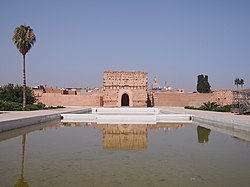
Les jardins de l'Agdal sont les plus anciens jardins de Marrakech, conçus au XIIe siècle sous le règne d'Abd el-Moumen, un souverain almohade. Ces jardins touchent au sud la zone du palais Dar El Makhzen. Les premiers arbres ont été plantés au XIIe siècle par les Almohades. La forme actuelle des jardins ainsi que les murs d'enceinte ne datent que du XIXe siècle. Les grenadiers, orangers et oliviers sont irrigués grâce à plusieurs réservoirs remplis d'eau du Haut Atlas. Au bord du Es Sala, le plus grand des bassins d'eau se trouve le Dar El Hana, un palais avec une terrasse panoramique d'où l'on peut admirer la chaîne du haut Atlas au-delà des jardins. Le mot Agdal dérive de la langue berbère et signifie «prairie clos». Aujourd'hui, les jardins de l'Agdal s'étendent sur plusieurs kilomètres au sud du Palais royal, ce jardin à la végétation plus varié que ceux de la Ménara, dispose de plusieurs pavillons. Le jardin de l'Agdal se trouve dans le périmètre du site de la médina de Marrakech inscrit au patrimoine mondial de l'UNESCO.

1. Références


1. Voir aussi

Marrakech Jardin Majorelle Jardins de la Ménara Jardin Arsat Moulay Abdessalam

Portail du jardinage et de l’horticulture Portail de Marrakech

Nearby Places View Menu
Location Image
2 m

Agdal Gardens

The Agdal Gardens (or Aguedal Gardens) are a large area of historic gardens and orchards in Marrakesh, Morocco. The gardens are located to the south of the city's historic Kasbah and its royal palace. Together with the medina of Marrakech and the Menara Gardens, the Agdal Gardens were listed by UNESCO as a World Heritage Site in 1985. The gardens contain several historic water reservoirs as well as several historic palaces and pavilions, including the Dar el-Hana and the Dar al-Bayda.
Location Image
1.1 km

Bab Ksiba

Bab Ksiba (Arabic: باب القصيبة, Bāb al-Quṣayyabah) is a gate in Marrakesh, Morocco. Bab Ksiba and another more famous gate further north, Bab Agnaou, served as entrances to the Kasbah (citadel) district in the southern part of the medina of Marrakesh, a UNESCO World Heritage Site.
Location Image
1.2 km

Barrima Mosque

The Barrima Mosque (also spelled Berrima Mosque; Arabic: مسجد بريمة) is a mosque in Marrakesh, Morocco, attached to the Kasbah (citadel) and Royal Palace (Dar al-Makhzen) of the city. It was built in the late 18th century by the Alawi sultan Muhammad ibn Abdallah.
Location Image
1.3 km

Kasbah of Marrakesh

The Kasbah of Marrakesh is a large walled district in the southern part of the medina of Marrakesh, Morocco, which historically served as the citadel (kasbah) and royal palace complex of the city. A large part of the district is still occupied by the official royal palace, the Dar al-Makhzen, which serves as the residence of the King of Morocco when he visits the city. The rest of the district consists of various neighbourhoods and monuments. It was founded by the Almohads in the late 12th century, with most of the construction carried out by Caliph Ya'qub al-Mansur (r. 1184–1199). Two of its most important surviving structures today, the Kasbah Mosque and the main gate of Bab Agnaou, date from al-Mansur's reign. The palace complex was neglected after the fall of the Almohads, but the Kasbah was restored and rebuilt by the Saadian dynasty in the 16th century, during the time of sultans Abdallah al-Ghalib and Ahmad al-Mansur, who created new palaces and extensive gardens. The Saadian Tombs and the ruins of the El Badi Palace date from this period. Abdallah al-Ghalib was also responsible for the creation of a Jewish quarter, the Mellah, adjoined to the Kasbah's eastern flank. Following another period of neglect and pillage, the palaces were rebuilt and redeveloped by the 'Alawi sultan Muhammad ibn Abdallah who gave the Royal Palace (Dar al-Makhzen) and its surroundings much of their present form. Today the kasbah is no longer a restricted district, apart from the royal palace, and is a popular tourist attraction in the city.
Location Image
1.5 km

El Badi Palace

El Badi Palace or Badi' Palace (Arabic: قصر البديع, lit. 'Palace of Wonder/Brilliance', also frequently translated as the "Incomparable Palace") is a ruined palace in Marrakesh, Morocco. It was commissioned by the sultan Ahmad al-Mansur of the Saadian dynasty a few months after his accession in 1578, with construction and embellishment continuing throughout most of his reign. The palace, decorated with materials imported from numerous countries ranging from Italy to Mali, was used for receptions and designed to showcase the Sultan's wealth and power. It was one part of a larger Saadian palace complex occupying the Kasbah district of Marrakesh. The palace was neglected after al-Mansur's death in 1603 and eventually fell into ruin with the decline of the Saadian dynasty. Its valuable materials, particularly marble, were stripped away and reused in other buildings throughout Morocco. Today, it is a significant tourist attraction in Marrakesh and serves as an exhibition space. Notably, the Minbar of the Kutubiyya Mosque is displayed here.