
The Barrima Mosque (also spelled Berrima Mosque; Arabic: مسجد بريمة) is a mosque in Marrakesh, Morocco, attached to the Kasbah (citadel) and Royal Palace (Dar al-Makhzen) of the city. It was built in the late 18th century by the Alawi sultan Muhammad ibn Abdallah.

1. Historical background

Sultan Muhammad ibn Abdallah (r. 1757–1790) did not choose a capital for his reign, but in practice he based himself in Marrakesh more than any other city. As a result, he carried a number of renovations and constructions within the royal citadel (the Kasbah and Dar al-Makhzen) of the city, including the restoration of the main Kasbah Mosque. He commissioned another mosque, the Barrima Mosque, reportedly because his son Maymun wanted a mosque that was closer to the palace. The mosque is located on the eastern edge of the royal palace grounds and the western edge of the old Mellah (Jewish quarter), near the city gate of the same name, Bab Berrima. It acted as an official royal mosque much like the Lalla Aouda Mosque did for Moulay Isma'il's kasbah and palace in Meknes.

1. Architecture

Compared to other Moroccan mosques, the Barrima Mosque's form and layout are unusual. Rather than a sahn, the mosque's large square courtyard, measuring 35 by 35 metres (115 by 115 ft), was referred to as a mechouar (an official royal square). Between this and the prayer hall was a vestibule alongside two waiting rooms for the sultan and government officials. The prayer hall, measuring 15 by 25 metres (49 by 82 ft), is smaller than the courtyard and does not follow the usual form of prayer halls in Moroccan mosques: instead of a hypostyle space with rows of arches, it is composed of a large square chamber covered by a cupola resting on 12 columns and of another rectangular space in front of the mihrab (niche symbolizing the direction of prayer). The wooden ceilings of the prayer hall are the most beautifully decorated aspect of the mosque. The mosque had three entrances, of which only the northern one was accessible to the common inhabitants outside the palace. The sultan had his own private entrance, accessible from the palace, which opened next to the mihrab inside the mosque. Its minaret is merely a small tower which does not surpass the height of the nearby walls of the palace (possibly an intentional design to avoid providing a view into the restricted grounds of the palace). The mosque was originally provided with an adjoining madrasa and an ablutions chamber (midha), but these were in ruins by the mid-20th century.

1. See also

List of mosques in Morocco

1. References


1. External links

Photo of the mosque in 1917 (mosque roof visible on the right), Patrimoines de Marrakech et de sa région

Nearby Places View Menu
Location Image
361 m

El Badi Palace

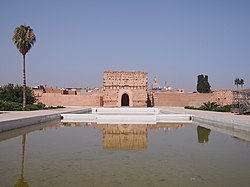
El Badi Palace or Badi' Palace (Arabic: قصر البديع, lit. 'Palace of Wonder/Brilliance', also frequently translated as the "Incomparable Palace") is a ruined palace in Marrakesh, Morocco. It was commissioned by the sultan Ahmad al-Mansur of the Saadian dynasty a few months after his accession in 1578, with construction and embellishment continuing throughout most of his reign. The palace, decorated with materials imported from numerous countries ranging from Italy to Mali, was used for receptions and designed to showcase the Sultan's wealth and power. It was one part of a larger Saadian palace complex occupying the Kasbah district of Marrakesh. The palace was neglected after al-Mansur's death in 1603 and eventually fell into ruin with the decline of the Saadian dynasty. Its valuable materials, particularly marble, were stripped away and reused in other buildings throughout Morocco. Today, it is a significant tourist attraction in Marrakesh and serves as an exhibition space. Notably, the Minbar of the Kutubiyya Mosque is displayed here.
Location Image
402 m

Kasbah of Marrakesh

The Kasbah of Marrakesh is a large walled district in the southern part of the medina of Marrakesh, Morocco, which historically served as the citadel (kasbah) and royal palace complex of the city. A large part of the district is still occupied by the official royal palace, the Dar al-Makhzen, which serves as the residence of the King of Morocco when he visits the city. The rest of the district consists of various neighbourhoods and monuments. It was founded by the Almohads in the late 12th century, with most of the construction carried out by Caliph Ya'qub al-Mansur (r. 1184–1199). Two of its most important surviving structures today, the Kasbah Mosque and the main gate of Bab Agnaou, date from al-Mansur's reign. The palace complex was neglected after the fall of the Almohads, but the Kasbah was restored and rebuilt by the Saadian dynasty in the 16th century, during the time of sultans Abdallah al-Ghalib and Ahmad al-Mansur, who created new palaces and extensive gardens. The Saadian Tombs and the ruins of the El Badi Palace date from this period. Abdallah al-Ghalib was also responsible for the creation of a Jewish quarter, the Mellah, adjoined to the Kasbah's eastern flank. Following another period of neglect and pillage, the palaces were rebuilt and redeveloped by the 'Alawi sultan Muhammad ibn Abdallah who gave the Royal Palace (Dar al-Makhzen) and its surroundings much of their present form. Today the kasbah is no longer a restricted district, apart from the royal palace, and is a popular tourist attraction in the city.
Location Image
412 m

Slat al-Azama Synagogue

The Slat al-Azama Synagogue or Lazama Synagogue (Hebrew: בית הכנסת צלאת אל עזמה; Arabic: كنيس صلاة العزامة) is a Jewish congregation and synagogue, located in Marrakesh, Marrakesh-Safi, Morocco. It is located in the historic Mellah (Jewish quarter) of the old city.
Location Image
473 m

Jewish cemetery, Marrakesh

The Miâara Cemetery (Hebrew: בית הקברות מערה) is the Jewish Cemetery of the city of Marrakesh, Morocco. It is the largest Jewish cemetery in the country.