The Slat al-Azama Synagogue or Lazama Synagogue (Hebrew: בית הכנסת צלאת אל עזמה; Arabic: كنيس صلاة العزامة) is a Jewish congregation and synagogue, located in Marrakesh, Marrakesh-Safi, Morocco. It is located in the historic Mellah (Jewish quarter) of the old city.

1. History

The synagogue was associated with Sephardic Jews who were expelled from Spain in 1492 (known as the Megorashim). The synagogue's foundation is likewise traditionally attributed to 1492, though one scholar has indicated that the exact year of establishment has not been verified. The Mellah district in which the synagogue is located was not created until 1557. In any case, the synagogue's current form dates from a more modern restoration. The building is still functioning as a synagogue today. On 8 September 2023, the synagogue and surrounding Jewish quarter were damaged by an earthquake. No casualties were reported.

1. Architecture

The synagogue is integrated into a larger building which consisted of a private house with a central courtyard (popularly referred to as a riad). This integration of a synagogue into a private home was typical of most synagogues in the Mellah of Marrakesh as well as in the Mellah of Fez. The synagogue itself has traditional Moroccan decoration such as zellij (mosaic tilework). The east side was renovated after the 1950s, with the addition of a wing for women (ezrat nashim), which is unique in Morocco where tradition dictates that women stay in a separate room at the entrance of the synagogue. The original wooden Torah ark has been replaced by a marble ark, which is located next to the eastern wall. Notes drawn in the 1950s by architect Yaacov Finkerfeld demonstrate that the space mentioned above did not exist for women and that the interior was divided into two naves by four columns. On the upper floor there is a yeshiva.

1. See also

History of the Jews in Morocco List of synagogues in Morocco

1. References


1. External links

Media related to Salat Al Azama Synagogue at Wikimedia Commons

Nearby Places View Menu
Location Image
165 m

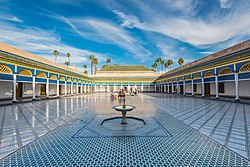
Bahia Palace

The Bahia Palace (Arabic: قصر الباهية) is a mid to late 19th-century palace in Marrakesh, Morocco. The palace was first begun by Si Musa, grand vizier under the Alawi sultan Muhammad ibn Abd al-Rahman, in the 1860s. It was expanded by his son Si Ba Ahmed ibn Musa, grand vizier of Sultan Moulay Abdelaziz, between 1894 and 1900. Today it is a well-known historic monument and tourist attraction in the city. The palace has an irregular layout comprising around 150 rooms organized around multiple internal courtyards and riad gardens. It is most notable for its decoration, particularly its painted wood ceilings, along with sculpted stucco and zellij tilework. The original grounds of the palace also encompassed a wider area with gardens, parks, stables, a mosque, and other annexes.
Location Image
221 m

Jewish cemetery, Marrakesh

The Miâara Cemetery (Hebrew: בית הקברות מערה) is the Jewish Cemetery of the city of Marrakesh, Morocco. It is the largest Jewish cemetery in the country.
Location Image
384 m

Dar Si Said

Dar Si Said (Arabic: دار السي سعيد) is a historic late 19th-century palace and present-day museum in Marrakesh, Morocco. It currently houses the National Museum of Weaving and Carpets.
Location Image
385 m

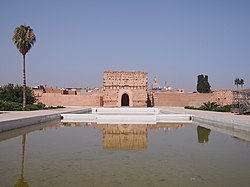
El Badi Palace

El Badi Palace or Badi' Palace (Arabic: قصر البديع, lit. 'Palace of Wonder/Brilliance', also frequently translated as the "Incomparable Palace") is a ruined palace in Marrakesh, Morocco. It was commissioned by the sultan Ahmad al-Mansur of the Saadian dynasty a few months after his accession in 1578, with construction and embellishment continuing throughout most of his reign. The palace, decorated with materials imported from numerous countries ranging from Italy to Mali, was used for receptions and designed to showcase the Sultan's wealth and power. It was one part of a larger Saadian palace complex occupying the Kasbah district of Marrakesh. The palace was neglected after al-Mansur's death in 1603 and eventually fell into ruin with the decline of the Saadian dynasty. Its valuable materials, particularly marble, were stripped away and reused in other buildings throughout Morocco. Today, it is a significant tourist attraction in Marrakesh and serves as an exhibition space. Notably, the Minbar of the Kutubiyya Mosque is displayed here.