
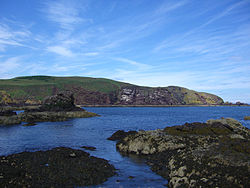
Le phare de St Abbs Head est un phare situé sur un promontoire rocheux dans le petit village de pêcheurs de St Abbs (Berwickshire), dans le comté des Scottish Borders au sud- est de l'Écosse. Ce phare est géré par le Northern Lighthouse Board (NLB) à Édimbourg, l'organisation de l'aide maritime des côtes de l'Écosse. C'est maintenant un monument classé du Royaume-Uni de catégorie B. Ce site est aussi une réserve naturelle nationale gérée par le National Trust for Scotland, la St Abbs National Nature Reserve.

1. Histoire

Une station de signalisation maritime avait déjà été établie sur les falaises avant 1820 et les installations étaient partagées par Trinity House de Londres et la Maritime and Coastguard Agency. Le Northern Lighthouse Board a recommandé la construction d'un phare sur St Abb's Head après le naufrage du « Martello » sur Carr Rock en 1857. Ce phare a été conçu et réalisé par les ingénieurs écossais Thomas Stevenson et David Alan Stevenson du NLB. Le phare a été mis en service le 24 février 1862. Il a initialement employé le pétrole pour produire l'énergie de la lumière, puis il a été converti en un système à incandescence en 1906, puis à l'électricité en 1966. Son automatisation finale a été réalisée en 1993. Avant l'automatisation, le phare avait une équipe de trois gardiens à temps plein qui s'occupait aussi des relevés météorologiques. La maison de gardiennage est placée plus haut sur la falaise, à 90 m du phare. Un escalier mène en pente rapide mène directement au phare qui est une petite construction d'un étage portant la lanterne. Le phare est accessible par 2 km de piste goudronnée qui mène à la route principale du village de St Abbs mais il est suggéré par le National Trust of Scotland qu'elle doit seulement être utilisée par les visiteurs handicapés, le parking étant très limité. Les visiteurs peuvent accéder à pied aux bâtiments du phare qui sont en bon état mais non ouverts au public. Une corne de brume y a été établie en 1876. Il fut le premier signal de brouillard audible en Écosse. Le son de la corne d'origine était produit par des moteurs à air chaud avant d'être remplacé par des moteurs à huile en 1911 puis par des moteurs diesel en décembre 1955. Le signal de brouillard a été interrompu en 1987, mais le petit bâtiment de la corne est toujours en place au bord de la falaise accessible par un chemin rambardé. Localisé sur un promontoire rocheux à environ 8 km au nord d'Eyemouth, il émet, à 68 m au-dessus du niveau de la mer, un flash blanc toutes les dix secondes.

1. Notes et références

(en) Cet article est partiellement ou en totalité issu de l’article de Wikipédia en anglais intitulé « St Abb's Head » (voir la liste des auteurs).

1. Voir aussi


1. = Lien connexe =

Liste des phares en Écosse

1. = Liens externes =

(en) Lighthouses of Southeastern Scoltand (Fife, Lothian, Scottish Borders) (en) St Abbs Head - site Northern Lighthouse Board Portail des phares Portail de la mer du Nord Portail de l’Écosse Portail des monuments classés au Royaume-Uni

Nearby Places View Menu
Location Image
41 m

St Abb's Head

St Abb's Head is a rocky promontory by the village of St Abbs in Berwickshire, Scotland, and a national nature reserve administered by the National Trust for Scotland. St Abb's Head Lighthouse was designed and built by the brothers David Stevenson and Thomas Stevenson and began service on 24 February 1862.
Location Image
41 m

St Abb's Head Lighthouse

St Abb's Head Lighthouse stands on the cliffs at the rocky promontory of St Abb's Head, near the village of St Abbs in Berwickshire. A signal station was established on the cliffs before 1820 and the facilities were shared by Trinity House and Her Majesty's Coastguard. The Northern Lighthouse Board recommended the building of a lighthouse at St Abb's Head after the sinking of the Martello on Carr Rock in 1857. The lighthouse was designed and built by the brothers David Stevenson and Thomas Stevenson and assisted navigation before and after sight of the Bell Rock and Isle of May lights disappeared from view. The light began service on 24 February 1862 and initially used oil to generate its light, it was converted to incandescent power in 1906 and to electricity in 1966 and finally automated in 1993. Before automation the lighthouse was staffed by three full-time keepers whose duties included keeping detailed weather records. The lighthouse has two km of single-track tarmaced road leading to it from the main road near St Abbs village, however it is suggested by the National Trust for Scotland that it is only used by disabled visitors, and there is limited parking. Visitors can walk to the Head where the lighthouse's buildings, though still in good repair, are not open to the public. A foghorn was established at the Head in 1876, being the first audible fog signal in Scotland. The original foghorn was driven by hot air engines before being replaced by oil driven ones in 1911 and then by diesel engines in December 1955. The fog signal was discontinued in 1987 although the horn is still in place and can be reached at the edge of the cliffs by a railed path from the lighthouse.
Location Image
608 m

Mire Loch

Mire Loch is a man made freshwater loch situated on St Abb's Head in the Scottish Borders, just over a kilometre NW of the village of St. Abbs at grid reference NT912687. The loch lies on land owned by the National Trust for Scotland (NTS) and is approximately 600 metres long by 50 metres at its widest point.
2.0 km

St. Abbs and Eyemouth Voluntary Marine Reserve

St. Abbs and Eyemouth Voluntary Marine Reserve is a Voluntary Marine Reserve—the first established in the United Kingdom. Located in the Scottish Borders, it covers 8 kilometres of the Berwickshire coast, from Eyemouth in the south to St. Abb's Head in the north. At its centre is the fishing village of St. Abbs. The reserve is one of the most popular scuba diving locations in the United Kingdom. The water of the reserve is unusually clear, in contrast to the more silt-laden coastal waters further to the north and south. The reserve was opened on 18 August 1984 by botanist and environmental campaigner David Bellamy.
Location Image
2.0 km

St Abbs Lifeboat Station

St Abbs Lifeboat is an independent voluntary search and rescue lifeboat service based in the village of St Abbs, located on the southeast coast of Scotland in the Scottish Borders. St Abbs lifeboat station has been operational since 1911, providing search and rescue cover along the Berwickshire coastline and out into the North Sea. Since 2015, it has been operated by an independent charity following the withdrawal of support from the Royal National Lifeboat Institution (RNLI). This means the community and crew are responsible for all aspects of running the station, including governance, fundraising, training, and maintenance. The lifeboat station and lifeboat shop are run entirely by unpaid volunteers. St Abbs Lifeboat Station holds "Declared Facility Status" (DFS), a standard set by the Maritime & Coastguard Agency (MCA), qualifying the station to participate in the UK Coastguard's Search and Rescue (SAR) service. The station currently operates the inshore lifeboat Thomas Tunnock. She is one of the fastest lifeboats in the UK, with a maximum speed of 40 knots. This enables the crew, who are on call 24 hours a day, 365 days a year, to respond swiftly to anyone in need of assistance along the Berwickshire coast.