

 English
 Français

Simonstone, Lancashire
Simonstone is a small village and civil parish in the Ribble Valley district of Lancashire, England. The population of the civil parish taken at the 2011 census was 1,154. It is about 4 miles (6 km) west of Burnley and south of Pendle Hill and Clitheroe along the A671 road. The village adjoins the village of Read, Lancashire and neighbours Padiham.
Nearby Places View Menu

796 m
Read, Lancashire
Read is a village in Lancashire 5 miles west northwest of Burnley and 2 miles east of Whalley. It is on the A671 which is the main road between Burnley and Clitheroe. The population of the civil parish as taken at the 2011 census was 1,419.

845 m
Simonstone railway station
Simonstone railway station was located on the east side of Simonstone Lane, 0.75 miles (1 km) south of Simonstone centre and near Padiham, Lancashire, England. It was on a branch line (usually known as the Great Harwood loop) of the East Lancashire Line, from Burnley to Blackburn.
1.3 km
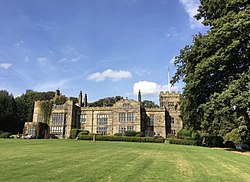
Huntroyde Hall
Huntroyde Hall is a grade II listed, 16th-century house in the civil parish of Simonstone in the Borough of Ribble Valley, Lancashire, England. Its estate, Huntroyde Demesne (known locally as 'Huntroyde'), once extended to over 6,500 acres.
Huntroyde Hall is reputed to stand on the site of a hunting lodge once owned by John O' Gaunt. The Huntroyde Hall Estate came to the Starkie family by marriage in circa.1464. The first recorded house was constructed on an H-shaped plan in 1576 for the Starkie family and re-built in the Georgian style in the mid-19th century. Wings added to the west side in 1777 and 1850 have since been demolished. The remaining part of the house was re-faced in ashlar sandstone in 1885. Huntroyde Hall features a Grade II listed Ha-Ha, one of the longest in the North of England.

1.4 km
St James' Church, Altham
St James' Church is in the village of Altham, Lancashire, England. It is an active Anglican parish church in the deanery of Accrington, the archdeaconry of Blackburn, and the diocese of Blackburn. Its benefice has been united with that of All Saints, Clayton-le-Moors. The church is recorded in the National Heritage List for England as a designated Grade II* listed building.