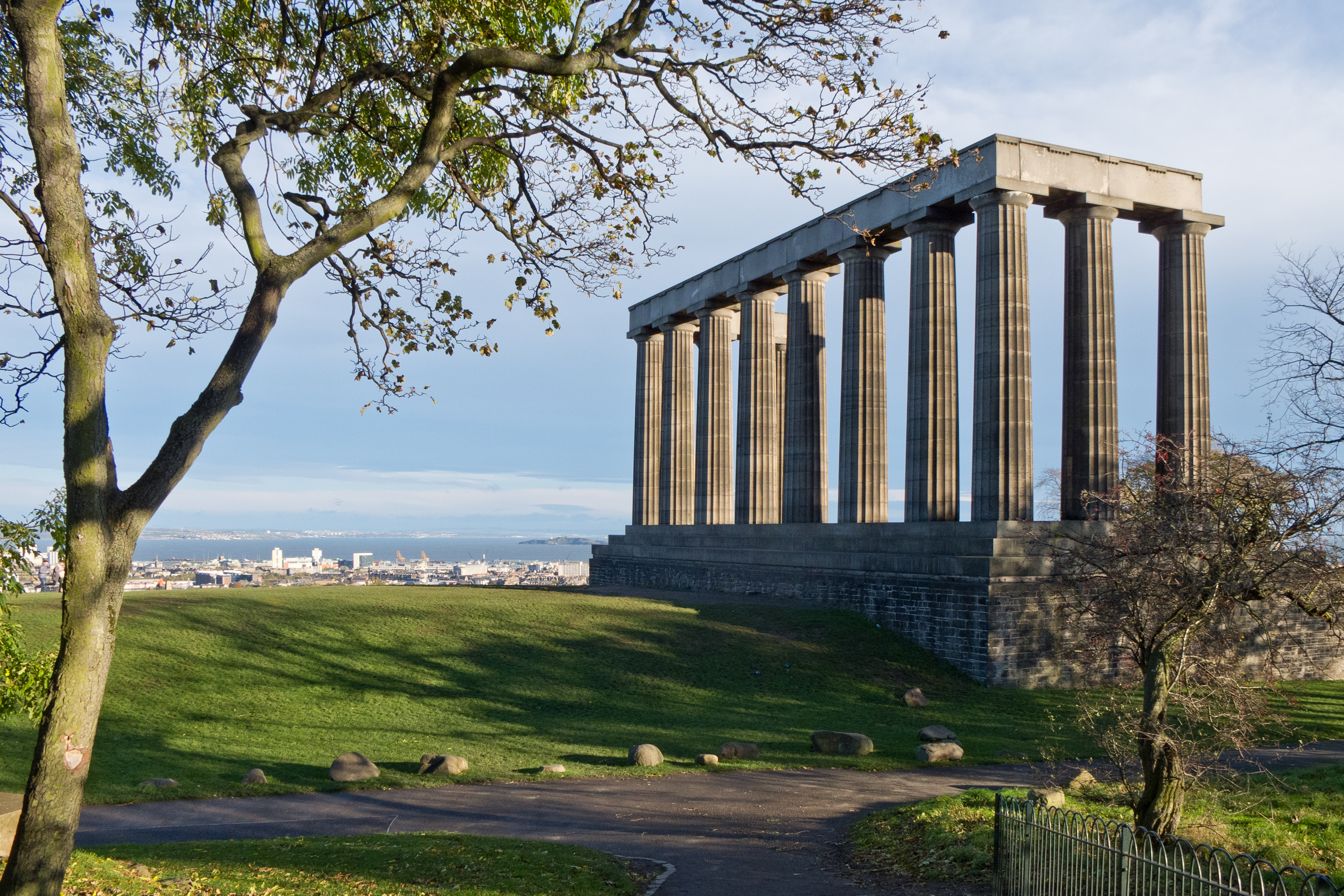
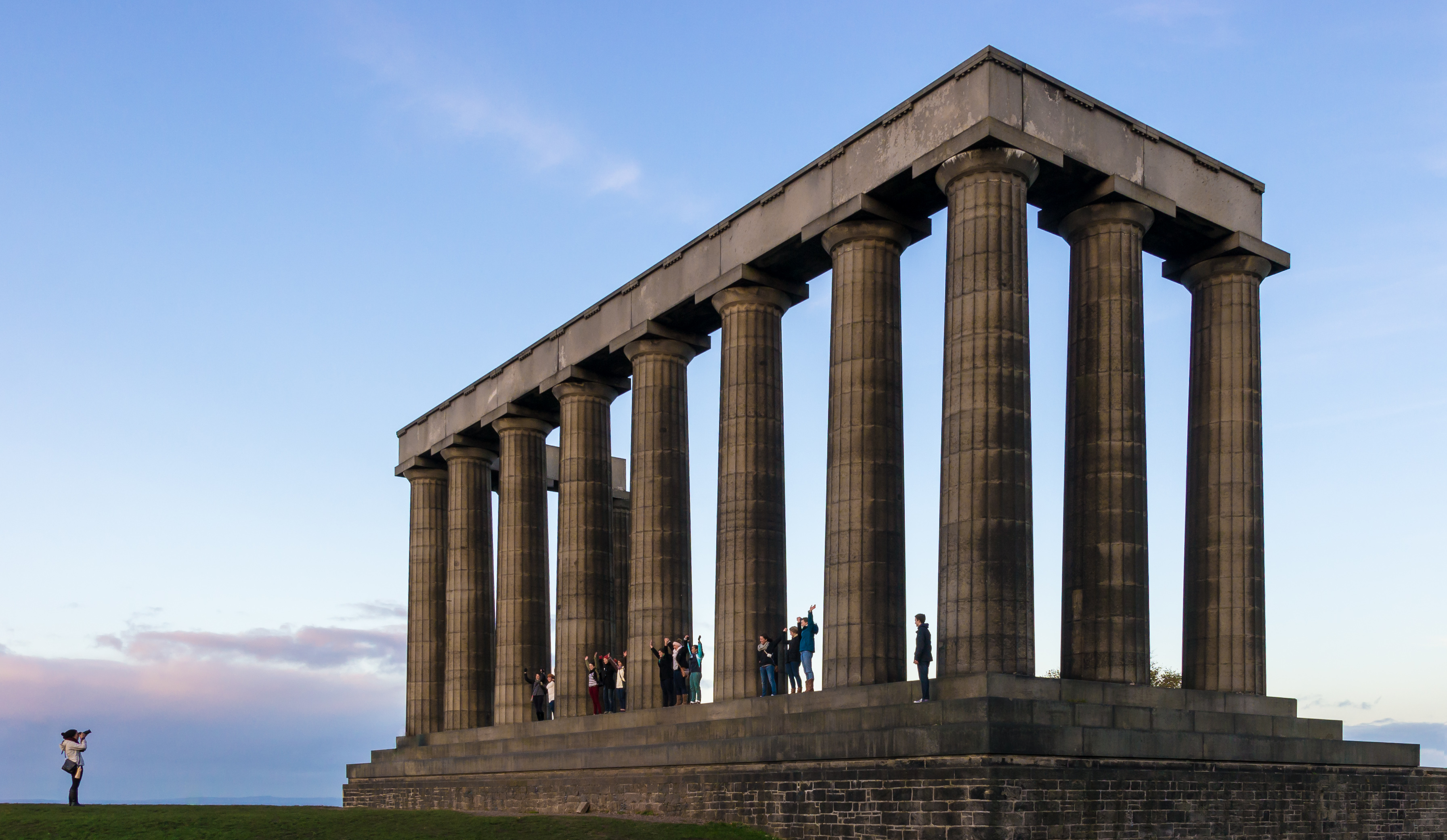
Le Monument national d'Écosse, à Édimbourg, est érigé à la mémoire des soldats et des marins écossais qui ont trouvé la mort lors des guerres napoléoniennes. Son inscription le définit comme « A Memorial of the Past and Incentive to the Future Heroism of the Men of Scotland ».
1. Histoire

Situé au sommet de Calton Hill, à l'est de Princes Street, le monument a été dessiné en 1823-1826 par les architectes Charles Robert Cockerell et William Henry Playfair dans un style néoclassique, sur le modèle du Parthénon d'Athènes. C'est en partie à cette similitude que la ville d'Édimbourg doit son surnom d'« Athènes du Nord ». Elle le doit également à l'architecture néoclassique de la Galerie nationale d'Écosse et de la Royal Scottish Academy. Les travaux de construction du monument, commencés en 1826, durent s'interrompre en 1829 faute de crédits. L'édifice est donc resté inachevé en dépit de nombreux projets destinés à le terminer, ce qui lui a valu des surnoms tels que Edinburgh's Disgrace, The Pride and Poverty of Scotland ou Edinburgh's Folly, cette dernière appellation se référant aux fabriques de jardin. En l'état, il n'est constitué que de 12 colonnes et d'une architrave.

1. Protection

Le monument est classé bâtiment de catégorie A en 1966. Ce n'est pas un monument inscrit.

1. Bibliographie

(en) Michael Linning, Report of the proceedings of a numerous and respectable meeting ... with a view to the erection of a national monument ..., J. Ballantyne, 1819, p. 39

1. Liens externes

(en) Archiseek - National Monument (en) Edinburgh Architecture - National Monument (en) 'A Building from which Derived "All that is Good". Observation on the Intended Reconstruction of the Parthenon on Calton Hill' by Marc Fehlmann in the online art magazine Nineteenth-Century Art Worldwide

1. Notes et références

Portail de l’architecture et de l’urbanisme Portail du néo-classicisme Portail de l’Écosse Portail des monuments classés au Royaume-Uni

Lieux à Proximité Voir Menu
Location Image
7 m

National Monument of Scotland

The National Monument of Scotland, on Calton Hill in Edinburgh, is Scotland's national memorial to the Scottish soldiers and sailors who died fighting in the Napoleonic Wars. It was intended, according to the inscription, to be "A Memorial of the Past and Incentive to the Future Heroism of the Men of Scotland". The monument dominates the top of Calton Hill, just to the east of Princes Street. It was designed during 1823–1826 by Charles Robert Cockerell and William Henry Playfair and is modeled upon the Parthenon in Athens. Construction started in 1826 and, due to the lack of funds, was left unfinished in 1829. This circumstance gave rise to various nicknames such as "Scotland's Folly", "Edinburgh's Disgrace", "the Pride and Poverty of Scotland" and "Edinburgh's Folly".
Location Image
62 m

Nelson Monument, Edinburgh

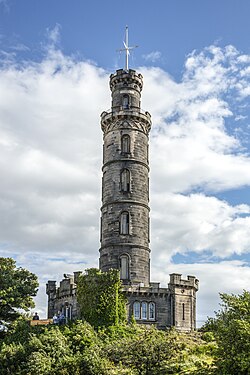
The Nelson Monument is a commemorative tower in honour of Vice Admiral Horatio Nelson, located in Edinburgh, Scotland. It is situated on top of Calton Hill, and provides a dramatic termination to the vista along Princes Street from the west. The monument was built between 1807 and 1816 to commemorate Nelson's victory over the French and Spanish fleets at the Battle of Trafalgar in 1805, and his own death at the same battle. In 1852 a mechanized time ball was added, as a time signal to shipping in Leith harbour. The time ball is synchronized with the One O'Clock Gun firing from Edinburgh Castle. The monument was restored in 2009. The Royal Navy's White Ensign and signal flags spelling out Nelson's famous message "England expects that every man will do his duty" are flown from the monument on Trafalgar Day each year.
Location Image
63 m

Dugald Stewart Monument

The Dugald Stewart Monument is a memorial to the Scottish Enlightenment philosopher Dugald Stewart (1753–1828). It is situated on Calton Hill overlooking the city of Edinburgh and was designed by Scottish architect William Henry Playfair.
Location Image
63 m

Calton Hill

Calton Hill (; Scottish Gaelic: Cnoc Coilltinn) is a hill in central Edinburgh, Scotland, situated beyond the east end of Princes Street and included in the city's UNESCO World Heritage Site. Views of, and from, the hill are often used in photographs and paintings of the city. Calton Hill is the headquarters of the Scottish Government, which is based at St Andrew's House, on the steep southern slope of the hill. The Scottish Parliament Building and other prominent buildings such as Holyrood Palace lie near the foot of the hill. Calton Hill is also the location of several monuments and buildings: the National Monument, the Nelson Monument, the Dugald Stewart Monument, the old Royal High School, the Robert Burns Monument, the Political Martyrs' Monument and the City Observatory. The area lies between the Edinburgh districts of Greenside and Abbeyhill.
Location Image
89 m

City Observatory

The City Observatory was an astronomical observatory on Calton Hill in Edinburgh, Scotland. It is also known as the Calton Hill Observatory. The site is enclosed by a boundary wall with a monument to John Playfair, president of the Edinburgh Astronomical Institution, in the southeast corner. The oldest part is the Gothic Tower in the southwest corner, facing Princes Street and Edinburgh Castle. It is also known as Observatory House, the Old Observatory, or after its designer James Craig House. The central building with the appearance of a Greek temple is the Playfair Building, named after the building's designer William Henry Playfair. This houses the 6-inch (15 cm) refractor in its dome and the 6.4-inch (16 cm) transit telescope in its eastern wing. The largest dome of the site is the City Dome in the northeast corner. During the early 20th century this contained a 22-inch (56 cm) refractor. In 2018, the entire site was restored and new buildings were added. The City Observatory site was opened freely to the public for the first time on 24 November 2018 as the new site for Collective, a centre for contemporary art.