

 English
 Français

Temple protestant d'Alger
Le temple protestant d'Alger est un lieu de culte luthéro-réformé construit en 1845, durant l'occupation coloniale. Il est situé rue de Chartres, rebaptisé après la Seconde Guerre mondiale rue du docteur Charles-Aboulker, et aujourd'hui 15 rue Amar El Kama, dans la Casbah d'Alger. La paroisse est alors membre de l'Église protestante unie d'Algérie.
Nearby Places View Menu
111 m
Dar Aziza
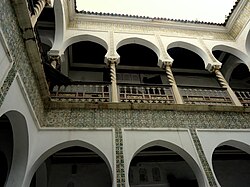
Dar Aziza is a 16th-century Moorish palace located in the Casbah of Algiers in Algeria. Today, it houses the National Agency of Archaeology and Protection of Historic Sites and Monuments. Dar Aziza, arguably the most iconic surviving building of its era in Algiers, was part of a large governmental compound known as Janina Palace, which existed before the arrival of Turkish corsairs.

120 m
Ketchaoua Mosque
The Ketchaoua Mosque (Arabic: جامع كتشاوة), also known as Djamaa Ketchaoua, is a mosque in the city of Algiers, the capital of Algeria. Completed in the 17th century, during Ottoman period, the mosque is located at the foot of the Casbah of Algiers, a UNESCO World Heritage Site and is on the first of the Casbah's many steep stairways. Its construction was logistically and symbolically a cynosure of pre-colonial Algiers. The mosque is noted for its unique fusion of Moorish and Byzantine architecture.
Built by Hayreddin Barbarossa as a mosque in 1020 AH (1611/1612 CE), in 1831 Muslims were evicted under French rule and the structure was converted to a Roman Catholic cathedral in 1832, renamed as the Cathedral of St Philippe (French: Cathédrale Saint-Philippe), which it remained until 1962. The former mosque-church was demolished between 1845 and 1860 and a new cathedral was built. Following Algerian independence in 1962, this structure was converted back into a mosque. In spite of these transitions, the mosque has retained its original grandeur and is one of the major tourist attractions of Algiers.
122 m
Serkadji Prison
Serkadji Prison, formerly Barberousse Prison, was a high-security prison in Algiers, Algeria; in 1995, about two-thirds of the 1,500 prisoners detained are (or were) accused or convicted of terrorism.

150 m
Regency of Algiers
The Regency of Algiers was an early modern semi-independent Ottoman province and nominal vassal state on the Barbary Coast of North Africa from 1516 to 1830. Founded by the privateer brothers Aruj and Hayreddin Reis (also known as the Barbarossa brothers), the Regency succeeded the Kingdom of Tlemcen as a formidable base that waged maritime holy war (Jihad) on European Christian powers. It was ruled by elected regents under a stratocracy led by Janissaries and corsairs. Despite its pirate reputation in Europe, Algiers maintained long-standing diplomatic ties with European states and was a recognized Mediterranean power.
The Regency emerged in the 16th-century Ottoman–Habsburg wars. As self-proclaimed ghazis gaining popular support and legitimacy from the religious leaders at the expense of hostile local emirs, the Barbarossa brothers and their successors carved a unique corsair state that drew revenue and political power from its naval warfare against Habsburg Spain. In the 17th century, when the wars between Spain and the Ottoman Empire, Kingdom of France, Kingdom of England and Dutch Republic ended, Barbary corsairs started capturing merchant ships and their crews and goods from these states. When the Ottomans could not prevent these attacks, European powers negotiated directly with Algiers and also took military action against it. This policy would emancipate Algiers from the Ottomans.
The Regency held significant naval power in the 16th and 17th centuries and well into the end of the Napoleonic wars despite European naval superiority. Its institutionalised privateering dealt substantial damage to European shipping, took captives for ransom, plundered booty, hijacked ships and eventually demanded regular tribute payments. In the rich and bustling city of Algiers, the Barbary slave trade reached an apex. The Regency also expanded its hold in the interior by allowing a large degree of autonomy to the tribal communities. After the janissary coup of 1659, the Regency became a sovereign military republic, and its rulers were thenceforth elected by the council known as the diwan rather than appointed by the Ottoman sultan previously.
Despite wars over territory with Spain and the Maghrebi states in the 18th century, Mediterranean trade and diplomatic relations with European states expanded, as wheat exports secured Algerian revenues after privateering decline. Bureaucratisation efforts stabilized the Regency's government, allowing into office regents such as Mohammed ben-Osman, who maintained Algerian prestige thanks to his public and defensive works. Increased Algerian privateering and demands for tribute started the Barbary Wars at the beginning of the 19th century, when Algiers was decisively defeated for the first time. Internal central authority weakened in Algiers due to political intrigue, failed harvests and the decline of privateering. Violent tribal revolts followed, mainly led by maraboutic orders such as the Darqawis and Tijanis. In 1830, France took advantage of this domestic turmoil to invade. The resulting French conquest of Algeria led to colonial rule until 1962.

180 m
Dar Mustapha Pacha
Dar Mustapha Pacha (French: Palais Mustapha Pacha) is a Moorish palace, located in the Casbah of Algiers, Algiers, Algeria. It houses the National Museum of Miniatures, Illumination and Calligraphy.
It was built by the future Dey Mustapha Pacha between 1798 and 1799. The main entrance to the palace is situated at No. 12 Ahmad and Muhammad Mecheri Street, under a projecting roof terrace which is bordered by rows of Roman tiles. The main door opens onto a sqifa (entrance hall), which leads to the main courtyard of the palace. The courtyard is sheltered with groined vaults and is dispersed with decorative niches which form window-seat benches. There is also a second entrance hall which is overlooked by two marble-framed doors; this connects the main sqifa used by visitors to enter the interior courtyard. The centre of the residential quarters is surrounded by galleries and supported by arches which rest on marble columns and are distinguished by decorative tiles. The ceilings are supported by wooden beams which cover the galleries on the ground floor and the first floor of the palace.