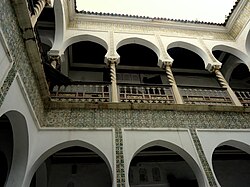
Dar Mustapha Pacha (French: Palais Mustapha Pacha) is a Moorish palace, located in the Casbah of Algiers, Algiers, Algeria. It houses the National Museum of Miniatures, Illumination and Calligraphy. It was built by the future Dey Mustapha Pacha between 1798 and 1799. The main entrance to the palace is situated at No. 12 Ahmad and Muhammad Mecheri Street, under a projecting roof terrace which is bordered by rows of Roman tiles. The main door opens onto a sqifa (entrance hall), which leads to the main courtyard of the palace. The courtyard is sheltered with groined vaults and is dispersed with decorative niches which form window-seat benches. There is also a second entrance hall which is overlooked by two marble-framed doors; this connects the main sqifa used by visitors to enter the interior courtyard. The centre of the residential quarters is surrounded by galleries and supported by arches which rest on marble columns and are distinguished by decorative tiles. The ceilings are supported by wooden beams which cover the galleries on the ground floor and the first floor of the palace.

1. See also

Casbah of Algiers

1. References
Lieux à Proximité Voir Menu
Location Image
15 m

Dar Hassan Pacha

Dar Hassan Pacha is an 18th-century palace located in the Casbah of Algiers, Algeria. It was built in 1791 and used to belong to Hassan III Pasha, who signed a treaty with the US September 5, 1795. After 1830, it became the winter residence of the French Governor of Algiers, and was completely remodelled in 1839, when the entrance was changed and a new façade was added.
Location Image
19 m

National Library of Algeria

The National Library of Algeria (Arabic: المكتبة الوطنيّة الجزائريّة; French: Bibliothèque nationale d'Algérie) is the main state library of Algeria, located in the Hamma district of Algiers. It was first established in 1835 by the French colonial government, before becoming Algeria's national library when the country gained its independence in 1962.
Location Image
78 m

Ketchaoua Mosque

The Ketchaoua Mosque (Arabic: جامع كتشاوة), also known as Djamaa Ketchaoua, is a mosque in the city of Algiers, the capital of Algeria. Completed in the 17th century, during Ottoman period, the mosque is located at the foot of the Casbah of Algiers, a UNESCO World Heritage Site and is on the first of the Casbah's many steep stairways. Its construction was logistically and symbolically a cynosure of pre-colonial Algiers. The mosque is noted for its unique fusion of Moorish and Byzantine architecture. Built by Hayreddin Barbarossa as a mosque in 1020 AH (1611/1612 CE), in 1831 Muslims were evicted under French rule and the structure was converted to a Roman Catholic cathedral in 1832, renamed as the Cathedral of St Philippe (French: Cathédrale Saint-Philippe), which it remained until 1962. The former mosque-church was demolished between 1845 and 1860 and a new cathedral was built. Following Algerian independence in 1962, this structure was converted back into a mosque. In spite of these transitions, the mosque has retained its original grandeur and is one of the major tourist attractions of Algiers.
Location Image
86 m

Dar Aziza

Dar Aziza is a 16th-century Moorish palace located in the Casbah of Algiers in Algeria. Today, it houses the National Agency of Archaeology and Protection of Historic Sites and Monuments. Dar Aziza, arguably the most iconic surviving building of its era in Algiers, was part of a large governmental compound known as Janina Palace, which existed before the arrival of Turkish corsairs.