Marketfield Street is a short one-way, one-block-long alleyway in the Financial District of Manhattan, New York City. The street begins as a southern branch of Beaver Street, then veers east and north, ending at Broad Street. Alternative past names include Exchange Street, Field Street, Fieldmarket Street, Oblique Road, and Petticoat Lane. The name Marketfield Street is a translation from the Dutch. The street originally ran to the Dutch livestock market, Marcktveldt, located near where Battery Park is now, which was then outside the walls of the city. The market operated from 1638 to 1647. In 1641, the Governor-General of New Netherland, Willem Kieft, opened the colony's first cattle market there. By 1680, mainly poor people were living on Marketfield Street. In 1688, the city's first French Huguenot church was built there. In September 1776, Marketfield Street was part of the area devastated by the Great Fire of New York, which engulfed the southwestern tip of Manhattan. In 1821, a hurricane hit the East Coast, destroying the street's dock. In 1821, Marketfield Street, which overlooked the Hudson River, had a single name throughout its length, but by the 1830s, the street was renamed "Battery Place" from Bowling Green to the Hudson River. The 1882 construction of the New York Produce Exchange demolished the block of the street that contained the French church. The American Bank Note Company Building at 70 Broad Street, between Marketfield and Beaver Street, was erected in 1908 as the headquarters of the American Bank Note Company.

Nearby Places View Menu
Location Image
40 m

2 Broadway

2 Broadway is an office building at the south end of Broadway, near Bowling Green Park, in the Financial District of Manhattan in New York City. The 32-story building, designed by Emery Roth & Sons and constructed from 1958 to 1959, contains offices for the Metropolitan Transportation Authority (MTA). 2 Broadway serves as the headquarters for some of the MTA's subsidiary agencies. The building is on a site bounded by Broadway and Whitehall Street to the west, Beaver Street to the north, and Stone Street to the south. It fills most of the lot, with the building rising in triple setbacks. The facade is covered in blue-green tinted glass, which dates from a 1999 redesign by Skidmore, Owings & Merrill. The site was previously occupied by the George B. Post–designed New York Produce Exchange building, which was completed in 1884. Plans for the skyscraper date to 1953, when William Lescaze devised plans to replace the Produce Exchange Building. Emery Roth & Sons were selected to be the architects when Uris Buildings Corporation took over the project. The original tenants were largely financial firms, while the Produce Exchange owned the land under the building and occupied some lower floors. Olympia and York acquired 2 Broadway in 1976 and the underlying land in 1983. After the building became mostly vacant during the early 1990s, Tamir Sapir purchased 2 Broadway in 1995. The building was renovated after the MTA leased all the space in 1998; the project encountered high costs and several delays.
Location Image
42 m

New York Produce Exchange

The New York Produce Exchange was a commodities exchange headquartered in the Financial District of Lower Manhattan in New York City. It served a network of produce and commodities dealers across the United States. Founded in 1861 as the New York Commercial Association, it was originally headquartered at Whitehall Street in a building owned by the New York Produce Exchange Company. The Association was renamed the New York Produce Exchange in 1868 and took over the original building in 1872. Between 1881 and 1884, the Produce Exchange built a new headquarters on 2 Broadway, facing Bowling Green in Lower Manhattan. The structure, designed by George B. Post, was the first in the world to combine wrought iron and masonry in its structural construction. The main feature of the structure was an exchange floor that measured approximately 220 by 144 feet (67 by 44 m). The Produce Exchange was profitable following the building's completion. By the 1880s, it had the largest membership of any exchange in the United States, with a maximum of three thousand members. By 1900, the exchange was doing $15 million a day in business. In the early 20th century, activity on the Produce Exchange started to decline due to competition from other cities. The Produce Exchange sold off its building for development in the 1950s; the headquarters was demolished to make way for a skyscraper called 2 Broadway. The exchange had its trading floor in the skyscraper from 1959 until 1973, when it was restructured as the Produce Exchange Realty Trust, a real estate investment trust.
Location Image
75 m

American Bank Note Company Building

The American Bank Note Company Building is a five-story building at 70 Broad Street in the Financial District of Manhattan in New York City. The building was designed by architects Kirby, Petit & Green in the neo-classical style, and contains almost 20,000 square feet (1,900 m2) of space, with offices and residences on the upper floors. The exterior consists of a main facade on Broad Street with two columns, as well as side facades with pilasters on Beaver and Marketfield Streets. The building was erected in 1908 as the home of the American Bank Note Company, a leading engraving company that produced banknotes, currency, stamps, and stock certificates. The company had previously occupied several other sites in Lower Manhattan, and it developed a printing plant in the Bronx after 70 Broad Street was completed. After the company sold the American Bank Note Company Building in 1988, the structure was sold to numerous owners, and renovated into offices and residences. The American Bank Note Company Building is a New York City designated landmark and listed on the National Register of Historic Places (NRHP). It is also a contributing property to the Wall Street Historic District, a NRHP district created in 2007.
Location Image
78 m

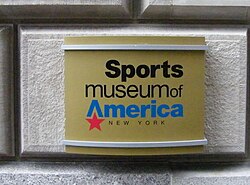
Sports Museum of America

The Sports Museum of America (SmA) was the United States' first national sports museum dedicated to the history and cultural significance of sports in America. It opened in May 2008 and closed less than nine months later, in February 2009. The Sports Museum of America was the nation's first major museum incorporating most major sports. In addition to becoming the official home of the Heisman Trophy and its annual presentation, the museum also housed the first-ever Women's Sports Hall of Fame. Among its board of directors were Mario Andretti, Martina Navratilova, Joe Frazier, Bob Cousy, Billie Jean King, Paul Hornung, and fifty other Hall of Fame athletes. The museum was located in Lower Manhattan at the end of the Canyon of Heroes, at 26 Broadway, across from Bowling Green, close to the Statue of Liberty and Ellis Island ferry, the Whitehall Terminal of the Staten Island Ferry, Wall Street, and the World Trade Center.