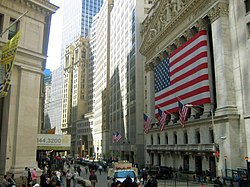
Marketfield Street is a short one-way, one-block-long alleyway in the Financial District of Manhattan, New York City. The street begins as a southern branch of Beaver Street, then veers east and north, ending at Broad Street. Alternative past names include Exchange Street, Field Street, Fieldmarket Street, Oblique Road, and Petticoat Lane. The name Marketfield Street is a translation from the Dutch. The street originally ran to the Dutch livestock market, Marcktveldt, located near where Battery Park is now, which was then outside the walls of the city. The market operated from 1638 to 1647. In 1641, the Governor-General of New Netherland, Willem Kieft, opened the colony's first cattle market there. By 1680, mainly poor people were living on Marketfield Street. In 1688, the city's first French Huguenot church was built there. In September 1776, Marketfield Street was part of the area devastated by the Great Fire of New York, which engulfed the southwestern tip of Manhattan. In 1821, a hurricane hit the East Coast, destroying the street's dock. In 1821, Marketfield Street, which overlooked the Hudson River, had a single name throughout its length, but by the 1830s, the street was renamed "Battery Place" from Bowling Green to the Hudson River. The 1882 construction of the New York Produce Exchange demolished the block of the street that contained the French church. The American Bank Note Company Building at 70 Broad Street, between Marketfield and Beaver Street, was erected in 1908 as the headquarters of the American Bank Note Company.

Lieux à Proximité Voir Menu
Location Image
42 m

New York Produce Exchange

Le New York Produce Exchange était un marché à terme agricole de New York. Fondé en 1861, il avait dans les années 1880 plus de membres qu'aucune autre une bourse à terme des États-Unis. Son siège, le Bowling Green a été le premier bâtiment au monde à combiner le fer forgé et la maçonnerie dans sa structure de construction. Il a été démoli en 1957.
Location Image
96 m

Bowling Green (New York)

Le Bowling Green est un petit jardin public du quartier de Lower Manhattan à New York, situé au pied de Broadway, près du site du quartier hollandais de La Nouvelle-Amsterdam. Construit en 1733, son nom vient du fait qu'il comportait à l'origine un boulingrin (bowling green). En forme de goutte d'eau, il est le parc public le plus ancien de New York, et il est encore à ce jour entouré par une barrière datant du XVIIIe siècle. Au nord du jardin se trouve la sculpture du taureau de Wall Street (Charging Bull). Le Bowling Green Fence and Park fait partie du Registre national des lieux historiques.
Location Image
100 m

Broad Street (Manhattan)

Broad Street est une rue de New York.
Location Image
101 m

26 Broadway

Le 26 Broadway est un gratte-ciel de style néoclassique de bureaux de 159 mètres de hauteur construit à New York en 1924. À l'origine l'immeuble abritait des locaux d'une des branches de la Standard Oil. L'immeuble a été conçu par les agences Shreve, Lamb & Blake, Kimball & Thompson, Carrère & Hastings (en). La surface de plancher de l'immeuble est de 60 376 m2.
Location Image
108 m

Fort Amsterdam

Fort Amsterdam est le nom d'un ancien fort érigé en 1626 par les Néerlandais situé sur le site actuel de Battery Park, sur la pointe sud de Manhattan, à New York. Il changea de nom à plusieurs reprises durant la période anglaise, puisqu'il prit successivement les noms de Fort William, de Fort Anne et de Fort George.