Location Image

Chapelle Sainte-Marguerite d'Édimbourg

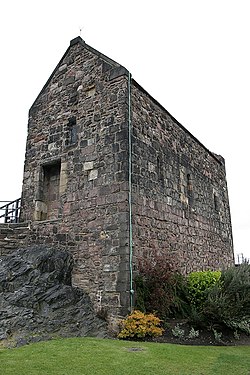
La chapelle Sainte-Marguerite d'Édimbourg est un lieu de culte écossais situé au château d'Édimbourg. Cet exemple d'architecture normande est le bâtiment le plus ancien encore en existence à Édimbourg.

1. Historique


1. = Chapelle castrale construite au XIIe siècle =

La légende dit que sainte Marguerite a prié dans cette petite chapelle, mais des recherches récentes indiquent qu’elle a été construite au début du XIIe siècle par son quatrième fils qui est devenu le roi David Ier en 1124. Le bâtiment a été restauré à l’identique.

1. = Destruction du château hormis cette chapelle Sainte-Marguerite =

Dans la nuit du 14 mars 1314, le château d’Édimbourg fut capturé par le comte Randolph de Moray qui, conformément à la politique du roi Robert de Brus, détruisit tous les bâtiments du château, à l’exception de la petite chapelle. En 1329, Bruce évoqua, sur son lit de mort, l’histoire de la reine Marguerite et donna des ordres pour que la chapelle soit réparée. Une quarantaine de livres écossaises furent mises de côté à cette fin. La chapelle fut ensuite connue, pendant de nombreuses années, sous le nom de « chapelle royale du château ». En dépit de l’existence d’une autre chapelle plus grande également en usage dans le château, un nombre assez élevé de cérémonies eut lieu dans la chapelle Sainte-Marguerite.

1. = Réforme protestante et affectation profane de la chapelle =

Tombée en désuétude lors la Réforme protestante, la chapelle Sainte-Marguerite fut alors utilisée comme magasin de poudre du XVIe siècle jusqu’à 1845, époque à laquelle Sir Daniel Wilson s’occupa de la faire connaître avant d’en superviser la supervision en 1853 avec le soutien de la reine Victoria. Une proposition ultérieure de l’architecte écossais Hippolyte Blanc (en) pour l’agrandir et l’enrichir fut rejetée.

1. = Retour de la chapelle au culte presbytérien =

Les vitraux réalisés par Douglas Strachan pour illustrer Saint-André, St Columba, sainte Marguerite, saint Ninian et William Wallace, ont été installés en 1922. En 1929, des travaux supplémentaires ont été réalisés pour rendre la chapelle au culte. Restaurée et réaménagée, celle-ci a été consacrée le 16 mars 1934. La chapelle Sainte-Marguerite est classée aux Monuments historiques.

1. Architecture de la chapelle

Le petit édifice en pierre irrégulière a une certaine similitude avec des chapelles écossaise et irlandaise celtiques antérieures. La structure rectangulaire avec une largeur intérieure de 3 m a une porte d’entrée d’un côté à l’arrière de la nef, qui est de 4,87 m de long, puis un chancel vouté typiquement roman de 1,52 m de large avec des moulures en forme de chevron décorant la voûte au-dessus des colonnes de chaque côté donne sur un sanctuaire en abside de 3 m de long et d’un rayon de 1,52 m. Le mur nord a été renouvelé, et les trois murs extérieurs restants, ainsi que le mur du chœur, font 61 cm d’épaisseur. Cinq petites fenêtres en plein cintre et le cintre au-dessus de la porte d’entrée de confirment le style roman.

1. Références


1. Annexes


1. = Bibliographie =

James Grant, Old and New Edinburgh, Newtongrange, Lang Syne Publishers, 1979 (1885). David MacGibbon et Thomas Ross, Castellated and domestic architecture of Scotland : from the 12th to the 18th century, Édimbourg, Douglas, 1887* John Gifford, Colin McWilliam, David Walker, Christopher Wilson, Edinburgh, Middlesex ; New York, Penguin Books, 1984. 84) p. 91-2.

Iain MacIvor, Edinburgh Castle, London, B.T. Batsford ; Édimbourg, Historic Scotland, 1993 RCAHMS, Inventory Edinburgh, 1951, p. 1-25. Daniel Wilson, Memorials of Edinburgh in the olden time, Édimbourg, A and C. Black, 1891. A Historical account of the life of St Margaret, with a description of St Margaret's chapel and of Mons Meg. - Edinburgh : Anderson, 1875. Consultable sur la bibliothèque numérique de l'Université Rennes 2

1. = Liens externes =

(en) About Queen Margaret of Scotland Portail de l’architecture chrétienne Portail du protestantisme Portail de l’Écosse Portail de la Normandie Portail des monuments classés au Royaume-Uni

Nearby Places View Menu
Location Image
7 m

St Margaret's Chapel, Edinburgh

St Margaret's Chapel, in Edinburgh Castle, is the oldest surviving building in Edinburgh, Scotland. An example of Romanesque architecture, it is a category A listed building. It was constructed in the 12th century, but fell into disuse after the Reformation. In the 19th century the chapel was restored and today is cared for by the St Margaret's Chapel Guild.
Location Image
32 m

Scottish National War Memorial

The Scottish National War Memorial is located in Edinburgh Castle and commemorates Scottish service personnel and civilians, and those serving with Scottish regiments, who died in the two world wars and subsequent conflicts. Its chief architect was Robert Lorimer, commissioned in 1919, and the monument was formally opened in 1927. It is housed in a redeveloped barrack block in Crown Square, at the heart of the castle, and incorporates numerous monuments. The Rolls of Honour kept in the memorial include the names of those Scots servicemen and women and Scots civilians that died in all wars after 1914. This includes all Scots who were killed as a result of enemy action or who died as a result of wounds, diseases, or injuries while serving in the British Armed Forces, the Merchant Navy, the armed forces of the Dominions, the women's services, and the nursing services, together with all members of Scottish regiments. The Rolls of Honour include those who died between 4 August 1914 and 31 August 1921 as having died in the First World War and those between 3 September 1939 and 31 December 1947 as having died in the Second World War. Those not serving in the Scottish regiments must either have been born in Scotland or have at least one parent born in the country. The memorial rolls list close to 135,000 casualties of the First World War and over 50,000 of the Second World War. More casualties from later wars are also inscribed, including from the Malayan Emergency, the Korean War (1950–1953), Operation Banner (1969–2007) during The Troubles, the Falklands War (1982), and the Gulf War (1990–1991). Most recently casualties from Iraq and Afghanistan have been added to the Rolls of Honour.
Location Image
45 m

Castle Rock (Edinburgh)

Castle Rock (Scottish Gaelic: Creag a' Chaisteil, Scottish Gaelic pronunciation: [ˈkʰʲɾʲekˈaˈxaʃtʰʲɪl]) is a volcanic plug in the middle of Edinburgh upon which Edinburgh Castle sits. The rock is estimated to have formed some 350 million years ago during the early Carboniferous period. It is the remains of a volcanic pipe which cut through the surrounding sedimentary rock, before cooling to form very hard dolerite, a coarser-grained equivalent of basalt. Subsequent glacial erosion was resisted more by the dolerite, which protected the softer rock to the east, leaving a crag and tail formation. The summit of the castle rock is 130 m (430 ft) above sea level, with rocky cliffs to the south, west and north, rearing up to 80 m (260 ft) from the surrounding landscape. This means that the only readily accessible route to the castle lies to the east, where the ridge slopes more gently. The defensive advantage of such a site is clear, but the geology of the rock also presents difficulties, since basalt is an extremely poor aquifer. Providing water to the Upper Ward of the castle was problematic, and despite the sinking of a 28 m (92 ft) deep well, the water supply often ran out during drought or siege, for example during the Lang Siege of 1573.
Location Image
45 m

Edinburgh Castle

Edinburgh Castle (Scottish Gaelic: Caisteal Dhùn Èideann) is a historic castle in Edinburgh, Scotland. It stands on Castle Rock, which has been occupied by humans since at least the Iron Age. There has been a royal castle on the rock since the reign of Malcolm III in the 11th century, and the castle continued to be a royal residence until 1633. From the 15th century, the castle's residential role declined, and by the 17th century it was principally used as a military garrison. Its importance as a part of Scotland's national heritage was recognised increasingly from the early 19th century onwards, and various restoration programmes have been carried out over the past century and a half. Edinburgh Castle has played a prominent role in Scottish history, and has served variously as a royal residence, an arsenal, a treasury, a national archive, a mint, a prison, a military fortress, and the home of the Honours of Scotland – the Scottish regalia. As one of the most important strongholds in the Kingdom of Scotland, the castle was involved in many historical conflicts from the Wars of Scottish Independence in the 14th century to the Jacobite rising of 1745. Research undertaken in 2014 identified 26 sieges in its 1,100-year history, giving it a claim to having been "the most besieged place in Great Britain and one of the most attacked in the world". Few of the present buildings pre-date the Lang Siege of 1573, when the medieval defences were largely destroyed by artillery bombardment. The most notable exceptions are St Margaret's Chapel from the early 12th century, which is regarded as the oldest building in Edinburgh, the Royal Palace, and the early 16th-century Great Hall. The castle is the site of the Scottish National War Memorial and the National War Museum. The British Army is still responsible for some parts of the castle, although its presence is now largely ceremonial and administrative. The castle is the regimental headquarters of the Royal Regiment of Scotland and the Royal Scots Dragoon Guards and houses their regimental museums, along with that of the Royal Scots. The castle, in the care of Historic Environment Scotland, is Scotland's most (and the United Kingdom's second most) visited paid tourist attraction, with over 2.2 million visitors in 2019 and over 70 percent of leisure visitors to Edinburgh visiting the castle. As the backdrop to the Royal Edinburgh Military Tattoo during the annual Edinburgh Festival, the castle has become a recognisable symbol of Edinburgh in particular and of Scotland as a whole.
Location Image
52 m

The Museum of the Royal Scots (The Royal Regiment) and the Royal Regiment of Scotland

The Museum of the Royal Scots (The Royal Regiment) and the Royal Regiment of Scotland is a regimental museum displaying the collections of the Royal Scots and the Royal Regiment of Scotland. It is based in the Royal Scots drill hall (built in 1900) at Edinburgh Castle in Scotland.