

 English
 Français

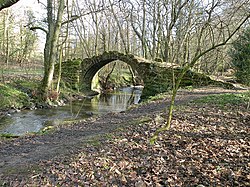
The Nidd Viaduct, also known as the Bilton Viaduct, is a former railway bridge in Bilton (just north of Harrogate), a village in North Yorkshire, northern England. It crosses the River Nidd and its gorge. It opened in 1847 and closed to trains in the 1960s. It is now a listed building and carries a cycling trail.
Nearby Places View Menu
249 m
Oak Beck (Harrogate)
Oak Beck is a watercourse that flows eastwards across the northern part of Harrogate in North Yorkshire, England. The beck flows through a broad V-shaped valley, before emptying into the River Nidd at Bilton, just upstream from the Nidd Gorge Viaduct. Water from Oak Beck has been used as a water supply for Harrogate and also for industrial purposes further downstream.

1.0 km
Harrogate Gasworks Railway
Harrogate Gasworks Railway was an industrial railway in the town of Harrogate, North Yorkshire, England. It was built to the gauge of 2 ft and ran between Bilton Junction on the North Eastern Railway (formerly the Leeds and Thirsk Railway), to the Harrogate Gas Company's (HGC) works at New Park, north of the town centre. It opened in 1908 to carry coal to the works for gasification, and outbound byproduct liquids. It closed to traffic in 1956. The railway was noted for its tight gauge restrictions in the tunnel at New Park. Two of its steam locomotives have survived into preservation, and are still in use on heritage railways.

1.1 km
Gardeners Arms
The Gardeners Arms is a pub in Bilton, a suburb of Harrogate in North Yorkshire.
The pub was built, probably in 1698, for the Mountgarrett estate. It has retained its original layout, although the rear rooms have been converted from residential to pub use, and there is a 20th century extension at the west end. In the 1970s, the estate sold the pub to its tenant, Maurice Johnson. The pub was purchased by Sean Franklin in 1980, who set up a brewery on the premises, at which he pioneered the use of American hops in the United Kingdom. In 1988, Daleside Brewery moved in. The pub was later sold to Samuel Smith Old Brewery. It has lawns to the side and rear with numerous tables and seats, and trees and a stream behind. The pub was grade II listed in 1975, and it is rated two stars on the National Inventory of Historic Pub Interiors.
The public house is built of gritstone, and has a stone slate roof with coped gables and kneelers. There are two storeys and two bays. The central doorway has an architrave and a bracketed hood, and the windows are mullioned with three lights, and contain sashes. Inside, there is a central corridor with rooms either side. On the right is the parlour, with a serving hatch, and behind it is a small bar and snug. On the left is a room named the "piggery", with a large fireplace, and behind is a room named "Wrinkley Lodge". The floors have flagstones.
1.2 km
Red Cat Cottage
The Red Cat Cottage (formerly Red Cat Inn), a Grade II listed building, is now a residence that sits at the top of Bachelor Gardens in Bilton, a district of Harrogate in North Yorkshire, England.
At the time of Oliver Cromwell this house was an inn that sat on Dragon Lane. The earliest part of the house dates back to the 17th century, whilst the main body was added in the 18th century and the top of the house was built in the 20th century. A red dragon was painted on the outside of the inn as it was known as the Red Dragon. Over the years locals thought the Dragon resembled more of a cat and the Inn became known as the Red Cat. The Red Cat Inn is now known as the Red Cat Cottage and is still a residence to this day.