

 English
 Français

Trinity Building
Le Trinity Building est un gratte-ciel de New York construit en 1905. Il s'élève à une centaine de mètres sur 22 étages.
Nearby Places View Menu

17 m
Trinity and United States Realty Buildings
The Trinity Building, designed by Francis H. Kimball and built in 1905, with an addition of 1907, and Kimball's United States Realty Building of 1907, located respectively at 111 and 115 Broadway in Manhattan's Financial District, are among the first Gothic-inspired skyscrapers in New York, and both are New York City designated landmarks. The Trinity Building, adjacent to the churchyard of Richard Upjohn's neo-Gothic Trinity Church, replaced an 1853 Upjohn structure of the same name. Earlier, the Van Cortlandt sugar house stood on the west end of the plot – a notorious British prison where American soldiers were held during the Revolutionary War.

42 m
Trinity Church Cemetery
The parish of Trinity Church has three separate burial grounds associated with it in the New York City borough of Manhattan. The first, Trinity Churchyard, is located in Lower Manhattan at 74 Trinity Place, near Wall Street and Broadway. Alexander Hamilton and his wife Elizabeth Schuyler Hamilton, Albert Gallatin, and Robert Fulton are buried in the downtown Trinity Churchyard.
The second Trinity parish burial ground is the St. Paul's Chapel Churchyard, which is also located in lower Manhattan, six blocks (roughly 440 yards (400 m)) north of Trinity Church. It was established in 1766. Both of these churchyards are closed to new burials.
Trinity's third place of burial, Trinity Church Cemetery and Mausoleum, located in Hamilton Heights in Upper Manhattan, is one of the few active burial sites in Manhattan. Trinity Church Cemetery and Mausoleum is listed on the National Register of Historic Places and is the burial place of notable people including John James Audubon, John Jacob Astor IV, Mayor Edward I. Koch, Governor John Adams Dix, Ralph Ellison, and Eliza Jumel. In 1823, all burials south of Canal Street became forbidden by New York City due to city crowding, yellow fever, and other public health fears.
After considering locations in the Bronx and portions of the then-new Green-Wood Cemetery, in 1842 Trinity Parish purchased the plot of land now bordered by 153rd Street, 155th Street, Amsterdam Avenue, and Riverside Drive to establish the Trinity Church Cemetery and Mausoleum. The cemetery is located beside the Chapel of the Intercession that Audubon co-founded in 1846, but this chapel is no longer part of Trinity parish. James Renwick, Jr., is the architect of Trinity Church Cemetery and further updates were made by Calvert Vaux. The uptown cemetery is also the center of the Heritage Rose District of New York City.
A no-longer-extant Trinity Parish burial ground was the Old Saint John's Burying Ground for St. John's Chapel. This location is bounded by Hudson, Leroy and Clarkson streets near Hudson Square. It was in use from 1806 to 1852 with over 10,000 burials, mostly poor and young. In 1897, it was turned into St. John's Park, with most of the burials left in place. The park was later renamed Hudson Park, and is now James J. Walker Park. (This park is different from a separate St. John's Park, a former private park and residential block approximately one mile to the south that now serves as part of the Holland Tunnel access.)

55 m
City Hotel (Manhattan)
The City Hotel (1794–1849) stood at 123 Broadway, occupying the whole block bounded by Cedar, Temple, and Thames Streets, in today's Financial District of Manhattan, New York City. It was the first functioning hotel in the United States. Until the early 1840s it was the city's principal site for prestigious social functions and concerts. Designed by John McComb Jr., it offered not only luxurious accommodations, but also such amenities as shops, a barroom, and a coffeehouse, as well as public dining and dancing. Its five stories and 137 rooms replaced the former home of Stephen Delancey, built around 1700, which had become an inn.
An 1825 guide-book, first published in 1817, calls it "an immense building, 5 stories in height, [which] contains 78 rooms of various dimensions, fitted up and furnished in a tasteful, elegant and convenient manner … the proprietor of this Hotel makes it his constant study to provide the best of every thing to his visitors." An 1828 expanded edition states:
City Hotel, [operated] by Chester Jennings, is the chief place of resort, and … the loftiest edifice of that kind in the city, containing more than one hundred large and small parlours and lodging-rooms, besides the City Assembly Room, chiefly used for Concerts and Balls. The rooms appropriated for private families, parlours, and dining rooms are superbly fitted up, and constantly occupied by respectable strangers. Extensive additions have recently been made to this establishment. The principal Book stores and Libraries are in the vicinity. Prices, over two days, $1.50 per day, $10 per week, $416 per year—Board only, $5.50 per week, dinner only, $3.50 per week.
Upon its closing on April 30, 1849, the New York Herald wrote: "In times gone by, it was the first hotel of the country, and the great men of the country always patronized it … ". It was once owned by Ezra Weeks. In 1828 John Jacob Astor bought it. He gave it to a granddaughter, Sara Langdon, who married Francis Robert Boreen in 1834, as a dowry. In 1849–50 she replaced it with a block of stores called the Boreel Building, and in 1878–79 replaced that with an office building, also called the Boreel Building.

63 m
New York Law Institute
The New York Law Institute is the oldest circulating law library in New York City and is open to Institute members and to scholars of history and the law.
67 m
Joie de Vivre (di Suvero)
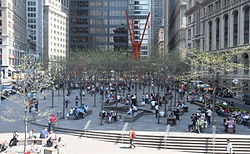
Joie de Vivre (English: Joy of Life) is an outdoor sculpture by Mark di Suvero, located at Zuccotti Park in the Financial District of Lower Manhattan, New York City. The 70-foot sculpture, composed of "open-ended tetrahedrons", was installed by the intersection of Broadway and Cedar Street in June 2006 and was previously located at the Holland Tunnel rotary (also named St. John's Park).
In October 2011, during Occupy Wall Street, a man climbed Joie de Vivre, where he remained for several hours until he was escorted down by police.