

 English
 Français
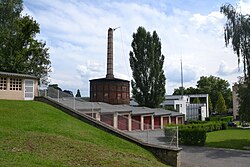
Four industriel à porcelaine Haviland
Le four industriel à porcelaine Haviland est un four à porcelaine situé à Limoges, dans le département français de la Haute-Vienne. Il s'agit de l'un des derniers fours à porcelaine conservés à Limoges, ville connue pour son industrie porcelainière. C'est le seul vestige de l'ancienne usine de Théodore Haviland, fils de David Haviland, fondateur de l'entreprise Haviland, encore active en 2026. Laissé à l'abandon après la démolition de l'usine au début des années 1990, il est finalement remis en état en 2024.
1. Localisation
Le four Haviland se trouve à Limoges, dans l'emprise de l'ancienne usine de porcelaine de Théodore Haviland, située entre les quartiers de Montjovis et du Mas-Loubier, au nord du centre-ville. Il est distant de 2,2 km de l'hôtel de ville, et se trouve à 700 m au nord-ouest de la place Carnot. Le four est précisément localisé entre deux rues desservant une cité résidentielle, l'allée Prosper-Mérimée, en impasse, à l'ouest, et la rue Albert-Camus, au nord-est. Il est bordé par une rangée de garages formant l'extrémité de l'allée Mérimée. Au sud, il domine le commissariat de police, à quelques dizaines de mètres, et le parc Victor-Thuillat, à 100 m.
1. Description
Le four est enserré dans une cage métallique qui le consolide. Il comprend deux chambres voûtées superposées et dix alandiers (bouches ou foyers placés à la base des fours à céramique).
1. Histoire
L'usine de porcelaine de Théodore Haviland est créée en 1892. Le four en question — dit no 16 — est édifié en 1907, et modifié en 1920 par l'ajout d'une cheminée et la suppression d'une partie du globe. Le bâtiment qui l'abrite est détruit en même temps que l'ensemble de l'usine, en 1991. Sur l'emplacement de celle-ci est construit le commissariat de police de Limoges. Livré aux aléas climatiques, le four est en état de dégradation avancé, tant et si bien que sa destruction est envisagée début 2019 par le Ministère de l'Intérieur, propriétaire du terrain. La mobilisation de la Direction régionale des Affaires culturelles et de l'association Espace Porcelaine, gestionnaire du Four des Casseaux, unique four protégé aux Monuments historiques, permet le sauvetage du bâtiment par son intégration à la mission Stéphane Bern sur la liste des sites retenus pour le loto du patrimoine en 2019. Il s'agit de l'un des vingt-deux sites du patrimoine industriel sélectionnés cette année-là. L'association Espace Porcelaine porte un projet de valorisation du site, soutenu financièrement par la fondation d'entreprise Haviland et la famille. Un square aménagé permettant des visites guidées associant au site l'histoire des quartiers industriels voisins est prévu. Fin 2019, un appel aux dons est lancé au public. Les travaux de réhabilitation s'achèvent en 2024, et le four est à nouveau inauguré en septembre 2025.
1. Notes et références


1. Voir aussi


1. = Articles connexes =
Porcelaine de Limoges
Portail de Limoges Portail de l'industrie Portail de la céramique
Nearby Places View Menu
Canton of Limoges-3
Palais des Sports de Beaublanc
Canton of Limoges-2
Arrondissement of Limoges
