

 English
 Français
Ancoats railway station
Ancoats Station was a goods station operated by the Midland Railway to handle freight traffic in Manchester, England, on land bought in the Ancoats district from the Mosley family, whose adjacent family seat Ancoats Hall was also taken over by the railway company for business use.
Nearby Places View Menu

270 m
Albion Mill, Ancoats
Albion Mill is a former industrial building in Manchester, United Kingdom. It occupies the site of a former cotton mill and ironworks.
John Hetherington & Sons made textile machinery in Ancoats. The company was founded in 1830 and as it expanded acquired the site of J. and J. L. Gray's Ancoats Mill, and other works on Pollard Street where around 1856 it established the Vulcan Works. The company moved to the Union Iron Works at West Gorton in 1939 as demand for its products declined. The Vulcan Works were used as business premises until 2004, when it was converted into flats as Albion Mill and Vulcan Mill. Today the mills have been converted into flats and offices.

307 m
Islington Branch Canal
The Islington Branch Canal was a short canal branch at Ancoats in north-west England, which joined the main line of the Ashton Canal between locks 1 and 2.
313 m
Manchester Art Museum
The Manchester Art Museum, also known as the Horsfall Museum or Ancoats Museum, was an art museum in Manchester, England, from 1877 until 1953. It was begun as an educational venture in 1877 by Thomas Coglan Horsfall, who had been inspired by John Ruskin to provide education and inspiration to the working classes. In 1886 the museum was moved to Ancoats Hall. The collection included a wide range of items including paintings, engravings, photographs, reproductions, antiquities, ceramics, glass, metalwork, natural history specimens, and images of Manchester.
In keeping with Horsfall's moral views, no nudes were displayed at the gallery. A room in the gallery was furnished by William Morris as an example of aesthetic design. According to the historian Shelagh Wilson, the gallery was popular as a respectable alternative attraction to pubs and music halls, but by the early 20th century it was unable to compete with new forms of popular entertainment. When a cinema opened nearby, attendance dropped dramatically.
In 1918 the museum was taken over by Manchester City Council. It closed in 1953 and its contents were absorbed into the collection of Manchester City Art Gallery.
315 m
Ancoats Hall
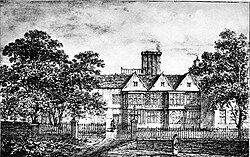
Ancoats Hall in Ancoats, Manchester, England, was a post-medieval country house built in 1609 by Oswald Mosley, a member of the Mosley family, Lords of the Manor of Manchester. The old timber-framed hall, built in the early 17th century, was described by John Aiken in his 1795 book Description of the country from 30 to 40 miles around Manchester. The old hall was demolished in the 1820s and replaced by a brick building in the early neo-Gothic style. The new hall, at the eastern end of Great Ancoats Street, between Every Street and Palmerston Street, was demolished in the 1960s.