

 English
 Français

RMS Campania
Le Campania est un paquebot de la Cunard Line mis en service en 1893. Ce service est de courte durée puisque le paquebot est réquisitionné dans le cadre de la Première Guerre mondiale. Son service s'achève accidentellement le 5 novembre 1918 : il sombre après être entré en collision avec le croiseur HMS Glorious.
Nearby Places View Menu

42 m
RMS Campania
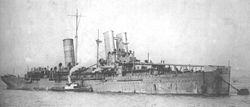
RMS Campania was a British ocean liner owned by the Cunard Line, built by Fairfield Shipbuilding and Engineering Company of Govan, Scotland, and launched on Thursday, 8 September 1892.
Identical in dimensions and specifications to her sister ship RMS Lucania, Campania was the largest and fastest passenger liner afloat when she entered service in 1893. She crossed the Atlantic in less than six days, and on her second voyage in 1893, she won the prestigious Blue Riband, previously held by the Inman Liner SS City of Paris. The following year, Lucania won the Blue Riband and kept the title until 1898 - Campania being the marginally slower of the two sisters.
928 m
HMS Campania (1914)
HMS Campania was a seaplane tender and aircraft carrier, converted from an elderly ocean liner by the Royal Navy early in the First World War. After her conversion was completed in mid-1915 the ship spent her time conducting trials and exercises with the Grand Fleet. These revealed the need for a longer flight deck to allow larger aircraft to take off, and she was modified accordingly. Campania missed the Battle of Jutland in May 1916, but made a number of patrols with elements of the Grand Fleet. She never saw combat and was soon relegated to a training role because of her elderly machinery. In November 1918 Campania was anchored with the capital ships of the Grand Fleet when a sudden storm caused her anchor to drag. With no second anchor being laid, she hit several of the ships and the collisions punctured her hull; she slowly sank, with no loss of life.

2.9 km
Burntisland railway station
Burntisland railway station is a railway station in the town of Burntisland, Fife, Scotland. The station is managed by ScotRail and is on the Fife Circle Line.

2.9 km
Burntisland Parish Church
Burntisland Parish Church (also known as St Columba's, Burntisland) is a church building in the Fife burgh of Burntisland, constructed for the Church of Scotland in 1592. It is historically important as one of the first churches built in Scotland after the Reformation, with a highly distinctive and apparently original square plan. It is Category A listed for its architectural and historical importance.
In 1601 the church was the location of a meeting of the General Assembly of the Church of Scotland which proposed to King James VI of Scotland that they work on a new Bible translation. When James became King James I of England he was able to devote resources to the production of what would ultimately become the King James Version.

3.1 km
Burntisland Burgh Chambers
Burntisland Burgh Chambers is a municipal structure in the High Street, Burntisland, Fife, Scotland. The building, which is the meeting place of the Burntisland Community Council, is a Category B listed building.