

 English
 Français
Crewood Hall
Crewood Hall is a country house to the northeast of the village of Kingsley, Cheshire, England. It dates from the 16th century, and has a porch dated 1638. Initially timber-framed, the building was encased in brick and remodelled in the 19th century. It has stone dressings and tiled roofs, and is in two storeys. The house consists of a hall with two cross wings and a two-storey porch at the end of the left wing. The lower storey of the porch is in sandstone and in the upper storey the timber-framing is exposed. The house is recorded in the National Heritage List for England as a designated Grade II* listed building. Associated with the house, and also listed at Grade II, are two farm buildings; stables, and a shippon and barn.
Nearby Places View Menu

1.1 km
Warburton's Wood Nature Reserve
Warburton's Wood Nature Reserve is a nature reserve near Kingsley, Cheshire, England, managed by the Cheshire Wildlife Trust.
The reserve consists of semi-natural woodland either side of a clough, or small valley, containing a tributary of the River Weaver. Together with Well Wood, a similar clough woodland to the east, it forms part of the Warburton's Wood and Well Wood Site of Special Scientific Interest, which covers a larger area of 8.1 hectares (20 acres).
Trees include familiar species such as pedunculate oak (Quercus robur), ash (Fraxinus excelsior) and hazel (Corylus avellana), but also small-leaved lime (Tilia cordata) and wild service-tree (Sorbus torminalis), which are uncommon in Cheshire.
The Wildlife Trust also owns the adjacent Hunter's Wood Nature Reserve, on which trees have been planted to act as a wildlife corridor, and with the hope that specialist plants from the ancient woodland will eventually colonise.

1.3 km
Dutton Park Farm Nature Reserve
Dutton Park Farm Nature Reserve is an 18-hectare (44-acre) nature reserve northwest of Weaverham, Cheshire, England. It is managed by the Cheshire Wildlife Trust.
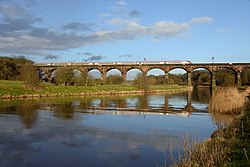
It lies below the Grade II* listed Dutton Viaduct and is looked after by the Cheshire Wildlife Trust in partnership with the Woodland Trust. The reserve's many pools and ponds are remnants of the original course of the River Weaver, and the new course of the Weaver now flows past the reserve.
Peregrine falcons have been known to use the viaduct as a vantage point, and kestrels and buzzards are regular visitors. The reserve's habitats of wildflower meadows benefit from regular grazing by Longhorn cattle, and the ponds have had their fish removed to allow aquatic wildlife to flourish. The scrub along the reserve fringe supports several summer migrants including whitethroats, sedge warblers, and the grasshopper warbler.
1.3 km
Hunter's Wood Nature Reserve
Hunter's Wood Nature Reserve is a nature reserve near Kingsley, Cheshire, England, managed by the Cheshire Wildlife Trust.
Hunter's Wood is a relatively new piece of woodland, originally planted on what was rough pasture on the southern bank of the River Weaver in 1999. There are small fragments of ancient woodland west, north and east of the reserve, some of them within the Warburton's Wood Nature Reserve, also managed by the Wildlife Trust. Hunter's Wood is intended to form a wildlife corridor linking these fragments, with the hope that specialist plants from the ancient woodland will eventually colonise. To this end, seeds were collected from surrounding areas and, in addition, 250 ash trees were planted.
1.6 km
Dutton Viaduct
Dutton Viaduct is on the West Coast Main Line where it crosses the River Weaver and the Weaver Navigation between the villages of Dutton and Acton Bridge in Cheshire, England (grid reference SJ581764), not far from Dutton Horse Bridge. It is recorded in the National Heritage List for England as a Grade II* listed building.
The viaduct was constructed during 1836, and was complete on 9 December of that year. It was the longest viaduct on the Grand Junction Railway (GJR). The viaduct was built at a cost of £54,440 (equivalent to £6,470,000 in 2023). The engineers were Joseph Locke and George Stephenson, and William Mackenzie was its contractor.
Since entering use in July 1837, Dutton Viaduct has remained in regular use. During its operating life, it has been subject to change; during the 1960s, the line was electrified overhead lines and supporting metalwork were installed across its length and its line speed was increased to 125 mph (200 km/h) in the West Coast Main Line route modernisation programme. It became a listed structure in the early 1990s.