

 English
 Français

Baxenden
Baxenden is a village and ward in the Borough of Hyndburn in Lancashire, North-West England. The ward population taken at the 2011 census was 4,042.
Nearby Places View Menu

781 m
Baxenden railway station
Baxenden railway station served the villages of Baxenden in Hyndburn and Rising Bridge in Rossendale. It was situated just inside the old boundary of Haslingden on the line from Bury Bolton Street to Accrington, which was opened in 1848 by the East Lancashire Railway. The station gave its name to the nearby Baxenden Bank, the two-mile section towards Accrington that included gradients as steep as 1 in 38.
The Accrington Corporation Steam Tramways Company built a tramline from Accrington in 1887 that terminated at the station. The station closed to passengers in 1951, some fifteen years before the line serving it suffered a similar fate.
992 m
The Hollins
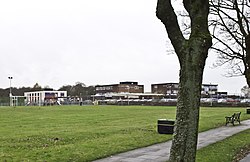
The Hollins (formerly known as The Hollins Technology College until 2017) is a coeducational secondary school located in Accrington in the English county of Lancashire.

1.1 km
River Hyndburn
The River Hyndburn is a minor river in Lancashire, England. Beginning as Woodnook Water on the slopes of Goodshaw Hill, it passes through Stone Fold, Rising Bridge and Baxenden where it is augmented by streams from Thirteen Stone Hill and continues to the Woodnook area of Accrington. Near St James Church, it collects Broad Oak Water (recorded in 1800 as the River Grange), becoming the River Hyndburn. It heads northward through the town centre, collecting Pleck Brook and turning west, flowing under the East Lancashire railway line viaduct and continuing to Church.
Here it turns northward again, meeting Hyndburn Brook just before it passes under the M65 motorway bridge to the south of Dunkenhalgh, which continues past Clayton-le-Moors and Great Harwood, ultimately joining the River Calder. Today, much of the course of the river and parts of its tributaries run underground through culverts. The Hyndburn borough of Lancashire is named after the river.

1.2 km
Haworth Art Gallery
The Haworth Art Gallery is a public art gallery located in Accrington, Lancashire, northwest England, and is the home of the largest collection in Europe of Tiffany glass from the studio of Louis Comfort Tiffany. The museum, a Tudor-style house, was originally built in 1909 to be the home of William Haworth, a manufacturer of textiles. The house was designed by Walter Brierley (1862–1926), a York architect known as "the Yorkshire Lutyens". It was bequeathed to the people of Accrington in 1920, and stands in nine acres of parkland on the south side of Accrington Town Centre.
The Haworth's Tiffany collection is the largest outside the United States, with almost every type of Tiffany glass, including 140 pieces, including Favrile glass tiles, jewels, samples and mosaics. It was the gift of Joseph Briggs, a design apprentice who left Accrington at 17 to emigrate to the United States, where he worked for Tiffany for 40 years from about 1892. In 1933, he sent his Tiffany collection home.
The collection is on permanent public display in four themed-rooms: 'Tiffany and Interior Design', 'Tiffany and the Past', 'Tiffany and Nature', and 'The Tiffany Phenomenon'. Notable in the Gallery's Tiffany collection are over 70 vases, including a group of 'Millefiore Paperweight' and 'Intaglio' or cut-glass examples, 'flowerform' vases, vases shaped like vegetables, 'Cypriote' and 'Tel-El-Amarna' vases inspired by Roman and Egyptian examples. There are also samples relating to decorative schemes Briggs was involved with, and his 'Sulphur-crested Cockatoos' mosaic.
The museum also has a collection of mainly 19th-century oil paintings and watercolours including works by Frederic, Lord Leighton, Claude Joseph Vernet, John Frederick Herring and others.