

 English
 Français

Stonegate
Stonegate est une rue située à York. La plupart des bâtiments de cette rue sont classés en raison de leur architecture ou de leur histoire.
Nearby Places View Menu

0 m
Stonegate (York)
Stonegate is a street in the city centre of York, in England, one of the streets most visited by tourists. Most of the buildings along the street are listed, meaning they are of national importance due to their architecture or history.

7 m
York Medical Society
The York Medical Society is a medical society founded in York, England, in 1832. It is located in a Grade II* listed building at 23 Stonegate, York.
The first president, Baldwin Wake, addressed the society at its first meeting in March 1832. Early meetings were held at the York Dispensary, a house in Market Town, and later in the Board Room at York County Hospital, and then at 9 Ousegate. It then met at the De Grey Rooms and then until 1915, it rented rooms at 1 Low Ousegate, when the society moved to the current location of 23 Stonegate, the previous home of Tempest Anderson and his father W.C. Anderson.
The building is a late 16th-century house, which incorporates the remains of several earlier structures on the site, and which has been altered and extended at various times in the centuries following its construction. It was first listed in 1954, and was upgraded to Grade II* in 1997. It houses a library consisting of books from its own collection as well as those from the York County Hospital and the York Dispensary.
It holds an annual oration.

11 m
21 and 25 Stonegate
21 and 25 Stonegate is a historic building in the city centre of York, in England.
The building's origins are in the 15th century, when a terrace of three timber-framed houses was constructed. This was probably originally five bays long, but the north-easternmost bay was later demolished. The houses were originally all two storeys tall, with the upper floors jettied. In the late 16th century, an extra storey was added to the south-westernmost bay. The north-easternmost bay had a rear wing added in brick in about 1700, and in the 18th century, the second bay from the south-west also had a third storey added. In the late 19th century, brick extensions were added at the back of the remaining bays.
From 1898 to 1902, the architect George Henry Walton worked from No. 21. The building was Grade II* listed in 1954, and was restored in 1974.
The front of the building is plastered, and the ground floor is occupied by shopfronts, some of which date from the 19th century. There are sash windows on the upper floors. The ground floor of one bay is now taken up with a wide passageway giving access to the York Medical Society building at 23 Stonegate. Inside, there is a historic staircase, and some cast iron fireplaces.

17 m
35 Stonegate
35 Stonegate is a Grade II* listed building in the city centre of York, in England.
The building lies on Stonegate, one of the most historic streets in the city of York. From the early 14th century, the site of the building was owned by the Prebend of Bramham. The front section of the current building was constructed in the 15th century, a timber-framed, three-storey range facing the street. In the early 17th century, a separate two-storey timber-framed building was built at the rear of the plot, possibly to serve as workshops. In about 1700, a further block was built, in brick, joining the two existing ranges together. The front building was altered at the same time, with a new staircase inserted.
In 1682, Francis Hildyard opened a bookshop in the building, known as "At the Sign of the Bible". From 1762 until 1811, it was a library and bookshop owned by John Todd. In 1759, he sold the first 200 copies of Laurence Sterne's novel, The Life and Opinions of Tristram Shandy, Gentleman, now commemorated in a York Civic Trust plaque. The property continued to operate as a bookshop until 1872, when it was purchased by John Ward Knowles, a stained glass maker. In 1874, he completed a renovation of the building. This includes a decorative facade, loosely inspired by the Tudor style, the ground floor shopfront, a bay window in the rear section, and a large amount of stained glass. The stained glass business closed in 1931, but the Knowles family continued living in the building until the 1990s.
In reference to the building's history, there is a sign above the door depicting a bible, with "HOLY BIBLE 1682" written on it. The first and second floors are both jettied, and both the 1682 date and the date of the 1874 restoration are inscribed on the front. Inside, the ground floor has 17th-century panelling, and the staircase of about 1700 survives, as do many doors of similar date. There is an 18th-century fireplace on the first floor. On the ground floor is a Gothic-style Victorian fireplace, and some ornate cupboards also dating from the restoration.
In 1999, the building was purchased by astrologer Jonathan Cainer, who initially sold horoscopes from it. In 2004, he worked with Uri Geller to relaunch it as the Museum of Psychic Experience. Derek Acorah filmed an episode of Ghost Towns Live in the building in 2006. The following year, Cainer transformed the building into Haunted, a haunted house attraction, which closed in 2014. In 2015, it became the first Oliver Bonas shop in the north of England.
25 m
Barley Hall
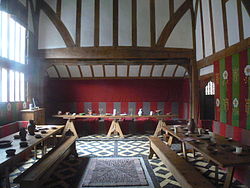
Barley Hall is a reconstructed medieval townhouse in the city of York, England. It was built around 1360 by the monks of Nostell Priory near Wakefield and extended in the 15th century. The property went into a slow decline and by the 20th century was sub-divided and in an increasingly poor physical condition. Bought by the York Archaeological Trust in 1987, it was renamed Barley Hall and heavily restored in a controversial project to form a museum. It is open to the public and hosts exhibitions.