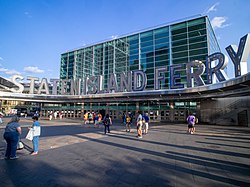
South Ferry is at the southern tip of Manhattan in New York City and is the embarkation point for ferries to Staten Island (Staten Island Ferry, through the Staten Island Ferry Whitehall Terminal) and Governors Island. Battery Park, abutting South Ferry on the west, has docking areas for ferries to Liberty Island and Ellis Island. Its name is derived from the more southerly route of service of the historical South Ferry Company in comparison to the Fulton Ferry.

1. History

The name "South Ferry" derives from a more southerly route of service than previous ferry lines between what were then the separate cities of New York and Brooklyn, rather than from being at the southern tip of Manhattan. The "Old Ferry" (later renamed the Fulton Ferry), crossed between Manhattan and Brooklyn from streets that in each city would eventually be renamed "Fulton Street". The "New Ferry" (also called the Catherine Ferry) crossed on a more northerly route than the Old Ferry, between Catherine Street in Manhattan, and Main Street in Brooklyn. As the City of Brooklyn grew, the area south of Atlantic Avenue, known as South Brooklyn, began to become developed, but the area lacked easy access to the ferry terminals in the northern parts of that city. Calls for a new ferry on a more southerly route were first brought up before the New York City Council in 1825, the proposal being commonly known as the "New South Ferry" since 1826, but progress stalled until the issue was taken up by the City of Brooklyn in 1833. The South Ferry Company established the South Ferry on May 16, 1836 to connect Lower Manhattan to the foot of Atlantic Avenue in Brooklyn and the month-old Brooklyn and Jamaica Railroad (renamed Atlantic Avenue Railroad, later the Atlantic Avenue Railroad's streetcar line, later still part of the South Side Railroad of Long Island, now the Atlantic Branch of the Long Island Rail Road) through the Cobble Hill Tunnel. "South Ferry" was also the name of the Brooklyn landing and ferry house. In the 20th and early 21st centuries, the Brooklyn landing site served cargo as Brooklyn Piers 5 and 6, now part of Brooklyn Bridge Park The Fulton Ferry Company, which then operated only the Fulton Ferry, merged with the South Ferry Company in 1839 to form the New York and Brooklyn Union Ferry Company.

1. Transportation connections

South Ferry is served by several New York City Subway stations.

South Ferry–Whitehall Street, a station complex consisting of three components: New South Ferry on the IRT Broadway–Seventh Avenue Line; serving the 1 train South Ferry loops on the IRT Broadway–Seventh Avenue Line and the IRT Lexington Avenue Line; (there are two platforms, both are closed to passengers; the IRT Broadway–Seventh Avenue Line temporarily reopened to provide replacement service from 2013 to 2017, after the new station was flooded by Hurricane Sandy.) Whitehall Street on the BMT Broadway Line; serving the N, ​R, and ​W trains Bowling Green on the IRT Lexington Avenue Line; serving the 4 and ​5 trains (some Lexington Avenue Line trains stopped at South Ferry until 1977) Broad Street on the BMT Nassau Street Line; serving the J and ​Z trains Also serving the ferry terminal directly is the M15 Select Bus Service route via a bus loop directly at the front door of the terminal. The M15, M20 and M55 local routes stop on nearby streets. Starting in 1877, South Ferry also hosted a four-track elevated terminal with access to all Manhattan elevated train lines running up Second, Third, Sixth and Ninth Avenues. The station was closed in 1950 after the cessation of Third Avenue Elevated service.

1. See also

Battery Maritime Building Battery Park City Ferry Terminal Fulton Ferry, Brooklyn List of ferries across the East River Paulus Hook Ferry Terminal Peter Minuit Plaza South Ferry, Brooklyn Weehawken Port Imperial West Midtown Ferry Terminal

1. References


1. External links

Media related to South Ferry (Manhattan) at Wikimedia Commons

Nearby Places View Menu
Location Image
23 m

South Ferry Plaza

The South Ferry Plaza, also called A Lighthouse At The Tip Of The Island, was a supertall skyscraper proposed in 1987 to rise right next to the East River on Manhattan Island in New York City. The building would have sat on top of the South Ferry terminal and tower 1,084 ft (330 m) above street level, with 60 stories of office space. It was designed by architect Fox & Fowle Architects and Leslie E. Robertson Associates. The architects designed the building for office use and the skyscraper incorporated recycled marble and steel with glass in its structure. The architectural plan had a glass dome that was supposed to be lit at night, which also contained an observation deck and three restaurants located inside the dome. In addition, the project called for the renovation of the South Ferry Terminal, including the train station so it can accommodate 100,000 people. The project would have doubled the size of Battery Park if it had proceeded, since the building included a plaza that was planned to tie in with Battery Park via a new promenade at the tip of Manhattan. The project was canceled in 1991 because of a lack of funding.
Location Image
34 m

Staten Island Ferry Whitehall Terminal

The Whitehall Terminal is a ferry terminal in the South Ferry section of Lower Manhattan, New York City, at the corner of South Street and Whitehall Street. It is used by the Staten Island Ferry, which connects the island boroughs of Manhattan and Staten Island. The Whitehall Terminal is one of the ferry's two terminals, the other being St. George Terminal on Staten Island. The Whitehall Terminal opened in 1903 as a terminal for municipal ferry operations. It was originally designed nearly identically to the Battery Maritime Building; a connector between the two terminals was planned but never built. The Whitehall Terminal was renovated from 1953 to 1956 at a cost of $3 million, but it had deteriorated by the 1980s. It was gutted by a fire in 1991. The terminal was completely rebuilt and reopened in February 2005 as a major integrated transportation hub.
Location Image
66 m

South Ferry station (IRT elevated)

The South Ferry station was an elevated station at the southern terminal of the IRT Second, Third, Sixth and Ninth Avenue Lines. It was located next to Battery Park at the lower tip of Manhattan, New York City. Two tracks came from the combined Second and Third Avenue Lines, and two from the Sixth and Ninth Avenue Lines, making four tracks at the terminal, with platforms on the outside and between each pair of tracks (no platform in the center). The station was right above access to various ferries at South Ferry, at both the Battery Maritime Building and the Whitehall Terminal. The next stop on the Second and Third Avenue Lines was Hanover Square. The next stop on the Sixth and Ninth Avenue Lines was Battery Place. The first elevated station at South Ferry was opened April 5, 1877 by the New York Elevated Railroad. It had one island platform between two tracks and was operated as an extension of the company's Ninth Avenue Line. The tracks were later continued straight into the company's Third Avenue Line, which opened August 26, 1878. The four-track station, opened March 1879, was built to provide an adequate terminal for both lines. It was located on a very short branch line, at right angles to the old station, facing toward the ferry terminals. Later the Second and Sixth Avenue Lines also used the terminal. A fire at the station in 1919 damaged the Whitehall Street Terminal. Ridership on the Els began to decline as subway stations were replacing them. The Sixth Avenue Line was eliminated from the station in 1938, the Ninth Avenue Line in 1940, and the Second Avenue Line in 1942. When the Third Avenue Line was eliminated in 1950, the station was permanently closed. The station site is currently occupied by the South Ferry subway station.
97 m

Casa Cipriani

Casa Cipriani is a hotel and private membership club that opened in August 2021 in the Battery Maritime Building, a ferry terminal, in lower Manhattan, New York City. While initial work rehabilitating the structure was completed by other entities, the final project and conversion, which includes a jazz cafe along with typical hotel amenities, was done in partnership with the New York City Economic Development Corporation, Midtown Equities, Centaur Properties, and Cipriani. For the physical conversion, Marvel Architects worked with Thierry Despont. Members of Casa Cipriani's private club have included Drew Barrymore and John Legend. Club members can book rooms at the hotel before the general public can, although the club's membership fees cost thousands of dollars as of 2023. In May 2024, Americas Great Resorts added the hotel to its Top Picks as a landmark property. The first edition of the Michelin Keys Guide, in 2024, ranked Casa Cipriani as a "three-key" hotel, the highest accolade granted by the guide.