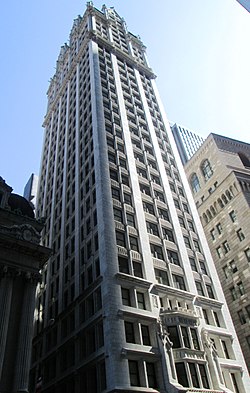
La Liberty Tower, anciennement Sinclair Oil Building, est un gratte-ciel situé au 55 Liberty Street, à son intersection avec la Nassau Street, dans le Financial District de Manhattan à New York. La construction a débuté en 1909 pour s'achever en 1910 : la tour était alors occupée par des bureaux. Elle a été dessinée par l'architecte de Chicago Henry Ives Cobb, dans un style néo-gothique. Lors de son édification, les gratte-ciel n'en étaient qu'à leurs premiers débuts, et le savoir-faire nécessaire à leur construction était bien mince : ainsi, la Liberty Tower a été construite sur des fondations surdimensionnées, qui descendent de l'équivalent de cinq étages sous le niveau de la rue. Cela a permis au bâtiment de résister à l'effondrement des deux tours jumelles du World Trade Center en 2001. L'édifice est bâti en pierre calcaire et recouvert de terre cuite blanche ornée d'oiseaux, d'alligators, et autres créatures chimériques.

Nearby Places View Menu
Location Image
8 m

Liberty Tower (Manhattan)

The Liberty Tower, formerly the Sinclair Oil Building, is a 33-story residential building in the Financial District of Manhattan in New York City. It is at 55 Liberty Street at the northwest corner with Nassau Street. It was built in 1909–10 as a commercial office building and was designed by Henry Ives Cobb in a Gothic Revival style. The site is adjacent to the New York Chamber of Commerce Building, while the Federal Reserve Bank of New York Building is to the east, across Nassau Street. Upon its completion, Liberty Tower was said to be the world's tallest building with such a small footprint, having a floor area ratio of 30 to 1. The building's articulation consists of three horizontal sections similar to the components of a column, namely a base, shaft, and capital. The limestone building is covered in white architectural terracotta with elaborate ornament. When the building opened in 1910, one of its first commercial tenants was the law office of future U.S. president Franklin Delano Roosevelt. Shortly after World War I, the entire building was bought by Sinclair Oil. In 1979, architect Joseph Pell Lombardi converted the building from commercial use into residential apartments and renamed it the "Liberty Tower", in one of the first such conversions in Manhattan south of Canal Street. The building was designated a city landmark by the New York City Landmarks Preservation Commission in 1982 and was added to the National Register of Historic Places (NRHP) in 1983. It is also a contributing property to the Wall Street Historic District, an NRHP district created in 2007.
Location Image
29 m

Chamber of Commerce Building (Manhattan)

The Chamber of Commerce Building is a commercial building on 65 Liberty Street, between Liberty Place and Broadway, in the Financial District of Manhattan in New York City, New York, U.S. Designed by architect James Barnes Baker, the four-story Beaux-Arts building was constructed between 1901 and 1902 as the first headquarters to be built specifically for the Chamber of Commerce of the State of New York. The facade is a New York City designated landmark, and the building is listed on both the New York State Register of Historic Places and the National Register of Historic Places (NRHP) as a National Historic Landmark. It is also a contributing property to the Wall Street Historic District, listed on the NRHP. The structure is clad with Vermont marble and includes a rusticated masonry base, a short colonnade, and a copper mansard roof. The facade formerly contained statues of John Jay, Alexander Hamilton, and DeWitt Clinton, which had been designed by Daniel Chester French and Philip Martiny. The second story contained the Chamber of Commerce's Great Hall, hung with portraits of important individuals from American history. The rest of the building was largely devoted to offices or meeting rooms for the chamber. Over the years, numerous stores and banks have rented out the ground story. The building's design was largely positively received upon its completion. The building was constructed after wealthy members of the Chamber of Commerce raised funds. The architecture firm of Helmle and Corbett remodeled the interior and built a new floor in 1922, resulting in changes to the mansard roof. French and Martiny's sculptures, installed in 1903, were removed in 1926 due to severe deterioration. After the Chamber of Commerce relocated to Midtown Manhattan in 1979, the building stood vacant for ten years. The International Commercial Bank of China bought the building in 1989, and the interior was subsequently renovated by Haines Lundberg Waehler.
Location Image
58 m

140 Broadway

140 Broadway (formerly known as the Marine Midland Building or the HSBC Bank Building) is a 51-story International Style office building on the east side of Broadway between Cedar and Liberty streets in the Financial District of Manhattan in New York City. The building was designed by Gordon Bunshaft, of the firm Skidmore, Owings & Merrill, and consists of a mostly smooth black facade on a trapezoidal plot. It is approximately 688 feet (210 m) tall, with approximately 1.17 million rentable square feet (109,000 m2). It is known for the distinctive sculpture at its entrance, Isamu Noguchi's Cube. The developer Erwin S. Wolfson acquired the site in several stages between 1952 and 1961. Initial plans called for a 36-story monolith, but when Wolfson died, the architects modified their plans to a 51-story tower, which occupied only two-fifths of the block and conformed to the 1961 Zoning Resolution. The building was erected between late 1964 and 1967 and was originally known for its main tenant, the Marine Midland Corporation (later part of HSBC). Several early tenants were affiliated with the financial industry, including banking and accounting firms. In 1998, the building was sold to Silverstein Properties, which undertook a major renovation. The primary tenant of the building since 2002 is Brown Brothers Harriman, filling a vacancy left after HSBC relocated in 2001. The building has been owned by Union Investment since 2004, and the New York City Landmarks Preservation Commission designated the building as a city landmark in 2013. Reviews of the building among architecture critics have been largely positive, with several praising the structure's smooth black facade.
Location Image
94 m

Equitable Building (Manhattan)

The Equitable Building is an office skyscraper located at 120 Broadway, between Pine and Cedar streets, in the Financial District of Lower Manhattan, in New York City. The skyscraper was designed by Ernest R. Graham in the Neoclassical style, with Peirce Anderson as the architect-in-charge. It is 555 feet (169 m) tall, with 38 stories and 1.2 million square feet (110,000 m2) of floor space. The building's articulation consists of three horizontal sections similar to the components of a column, namely a base, shaft, and capital. The Equitable Building replaced the Equitable Life Building, the previous headquarters of the Equitable Life Insurance Company, which burned down in 1912. Work on the Equitable Building started in 1913 and was completed in 1915. Upon opening, it was the largest office building in the world by floor area. The Equitable Building hosted a variety of tenants and, by the 1920s, was the most valuable building in New York City. The Equitable Life Insurance Company, the building's namesake, occupied a small portion of the building until it moved out during 1960. The owner as of 2022, Silverstein Properties, purchased the Equitable Building in 1980 and has renovated it multiple times. Upon its completion, the Equitable Building was controversial because of its lack of setbacks, which in turn does not allow sunlight to reach the surrounding ground. This contributed to the adoption of the first modern building and zoning restrictions on vertical structures in Manhattan, the 1916 Zoning Resolution. The building was designated a National Historic Landmark in 1978 and was designated a city landmark by the New York City Landmarks Preservation Commission in 1996. It is also a contributing property to the Wall Street Historic District, a NRHP district created in 2007.
Location Image
107 m

Double Check

Double Check is a 1982 sculpture by John Seward Johnson II, located across from Zuccotti Park at the corner of Liberty Street and Broadway in Manhattan, New York City. The bronze sculpture portrays a well-dressed businessman sitting with his briefcase open, which is filled with office materials getting ready to enter an office building. The statue is notable for its association with the 9/11 attacks.