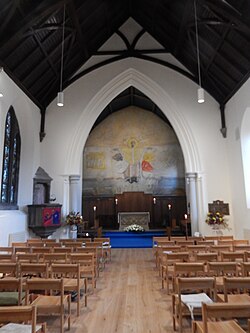
Magdalen Chapel (ou chapelle de la Madeleine) est une chapelle du XVIe siècle située sur Cowgate, dans la vieille ville d'Édimbourg, en Écosse. Elle est désignée monument classé de catégorie A.

1. Histoire

La chapelle a été construite entre 1541 et 1544 grâce à l'argent légué par Michael MacQueen ou MakQuhen (décédé en 1537), un marchand qui fournissait des épices et du linge à la maison royale. Elle a été conçue pour accueillir un aumônier et servir d'hospice à sept pauvres hommes qui devaient prier pour l'âme de Marie, reine d'Écosse. Avant la Réforme écossaise, la reine régente Marie de Guise y organisait des cours académiques. Jonet Rynd mourut en décembre 1553 et fut enterré dans la chapelle. L'Assemblée générale de l'Église d'Écosse s'est tenue dans la chapelle en avril 1578. Il existe une tradition selon laquelle la première Assemblée générale de décembre 1560 s'est également tenue dans la chapelle. Plusieurs réunions des Covenantaires se sont tenues dans la chapelle, la plus importante étant celle du 17 mai 1674 dont William Weir était le prédicateur. La chapelle a été restaurée en 1992/93, et abrite aujourd'hui le siège de la Scottish Reformation Society.

1. Éléments notables

Le vitrail de la fenêtre centrale du mur sud présente les armoiries de l'Écosse et les armes de Marie de Guise : il s’agit du seul vitrail intact d’avant la Réforme subsistant en Écosse. Une épée qui aurait appartenu au capitaine Covenanter John Paton et la table utilisée pour préparer les corps des Covenanters pour l'enterrement (après leur exécution dans le Grassmarket voisin) sont toujours présentes dans la chapelle. Le tombeau de Janet Rynd, avec ses armoiries et une bordure inscrite, se trouve au sud-est de l'église. Les vitraux de la fenêtre principale sud datent de 1893 et sont de William Graham Boss.

1. Notes et références

(en) Cet article est partiellement ou en totalité issu de l’article de Wikipédia en anglais intitulé « Magdalen Chapel, Edinburgh » (voir la liste des auteurs).

1. Liens externes

Scottish Reformation Society Métiers incorporés d'Édimbourg Portail du protestantisme Portail de l’architecture chrétienne Portail de l’Écosse Portail des monuments classés au Royaume-Uni

Nearby Places View Menu
126 m

John Porteous (soldier)

Captain John Porteous (c. 1695 – 7 September 1736) was a Scottish military officer who served in the Edinburgh City Guard and played a major role in the Porteous Riots, which resulted in his death.
Location Image
179 m

The Hub, Edinburgh

The Hub is a public arts and events building in the centre of Edinburgh, Scotland. Located at the top of the Royal Mile, it is a prominent landmark as its tall Gothic spire (71.7 meters) is the highest point in central Edinburgh, and towers over the surrounding buildings below Edinburgh Castle. It was the Highland Tolbooth St John's Church. The building is a notable example of Gothic Revival architecture and was designed by architects J Gillespie Graham and Augustus Pugin. Constructed between 1842 and 1845, it was originally designed as a meeting hall for the General Assembly of the Church of Scotland. From 1929 the building was used as a church until the mid-1980s. Today it is the home of the Edinburgh International Festival and is used as a ticket office, information centre and performance venue. The General Assembly of the Church of Scotland continues to meet here each May.
Location Image
188 m

Gladstone's Land

Gladstone's Land is a surviving 17th-century tenement house situated in the Old Town of the city of Edinburgh, Scotland. It has been restored and furnished by the National Trust for Scotland, and is operated as a popular tourist attraction.
Location Image
192 m

St Columba's-by-the-Castle

St Columba's-by-the-Castle is a congregation of the Scottish Episcopal Church in central Edinburgh, Scotland. The church is located close to Edinburgh Castle, on the south slope of Castle Hill, and is protected as a category B listed building. The church was constructed in 1846–1847 in an Early English Gothic style, to designs by architect John Henderson. Stone for the building was brought from the palace of Mary of Guise, 16th-century queen regent of Scotland, on the Royal Mile. Its layout was inspired by the reforms of Anglican worship arising from the Oxford Movement. St Columba's-by-the-Castle is part of a local ecumenical partnership (LEP) with Greyfriars Tolbooth & Highland Kirk (Church of Scotland) and Augustine United Church (United Reformed Church). It is also part of Edinburgh Churches Together and Action of Churches Together in Scotland. During the Edinburgh Festival Fringe it has been used by the promoter C venues as a venue.
Location Image
208 m

Lady Stair's House

Lady Stair's House is a 17th-century townhouse in Lady Stair's Close, off the Lawnmarket, in Edinburgh's Old Town. It now houses the Writers' Museum, dedicated to the lives and works of various Scottish literary greats. The house was built in 1622 for Sir William Gray of Pittendrum and his wife Giles (née Smith). A lintel above the door bears the date of construction and the initials WG and GS, along with a coat of arms and the motto "feare the Lord and depart from evill". It was previously known as Lady Gray's House, Giles having resided there for several years after her husband's death. The present name derives from Elizabeth Dalrymple, Dowager Countess of Stair, who acquired the house in 1719. It remained in the possession of the Dalrymple family until 1765, after which it passed through the hands of a succession of owners. In 1895, at the suggestion of the town planner and preservationist Patrick Geddes, it was purchased by Archibald Primrose, 5th Earl of Rosebery, a descendant of the original occupants. Rosebery commissioned the architect George Shaw Aitken to conduct a thorough restoration of the building, and presented it to the city of Edinburgh in 1907. Since then it has been used as a museum, first of civic history and then of literary history. It was designated a Category A listed building in 1970.