

 English
 Français

Moray Estate
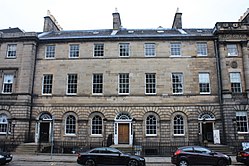
The Moray Estate, also known as the Moray Feu, is an early 19th century building venture attaching the west side of the New Town, Edinburgh. Built on an awkward and steeply sloping site, it has been described as a masterpiece of urban planning.
Nearby Places View Menu

189 m
James Clerk Maxwell Foundation
The James Clerk Maxwell Foundation is a registered Scottish charity set up in 1977. By supporting physics and mathematics, it honors one of the greatest physicists, James Clerk Maxwell (1831–1879), and while attempting to increase the public awareness and trust of science. It maintains a small museum in Maxwell's birthplace. This museum is owned by the Foundation.
213 m
International Centre for Mathematical Sciences
The International Centre for Mathematical Sciences (ICMS) is a mathematical research centre based in Edinburgh. According to its website, the centre is "designed to bring together mathematicians and practitioners in science, industry and commerce for research workshops and other meetings."
The centre was jointly established in 1990 by the University of Edinburgh and Heriot-Watt University, under the supervision of Professor Elmer Rees, with initial support from Edinburgh District Council, the Scottish Development Agency and the International Centre for Theoretical Physics. Its current operations are primarily funded by grants from the Engineering and Physical Sciences Research Council of the UK.
In April 1994 the Centre moved to 14 India Street, Edinburgh, the birthplace of James Clerk Maxwell and home of the James Clerk Maxwell Foundation. In 2010 it was relocated to 15 South College Street to accommodate larger events. As of 2020, the ICMS is located within the newly established Bayes centre.
The current scientific director (appointed in 2021) is Professor Minhyong Kim. The ICMS is a member of the European Mathematical Society.

237 m
Bute House
Bute House (Scottish Gaelic: Taigh Bhòid) is the official residence and workplace of the first minister of Scotland. Located at 6 Charlotte Square in the New Town of Edinburgh, it is the central house on the north side of the square and was designed by Robert Adam. It has served as the official residence of every first minister since Donald Dewar in 1999, and prior to that, the secretary of state for Scotland who headed the Scotland Office, from the 1970s until 1999. Bute House was conveyed to the National Trust for Scotland by the 6th Marquess of Bute in 1966.
The house is a Category A listed building and is constructed in an 18th century town house Neoclassical style, using sandstone materials. Designed by Robert Adam, Charlotte Square was designed by Adam as a single scheme, and it was part of architect James Craig’s First "New Town plan" which was unveiled in 1767, with Adam being commissioned in 1791 to design unified frontages for Charlotte Square. Together with Charlotte Square as a whole, Bute House has been described as "perhaps the finest architectural achievement of Georgian Edinburgh".
Alongside two other personal offices at the Scottish Parliament Building and St. Andrew's House, Bute House also contains a smaller office used by the first minister when in official residence. As well as serving as the official residence of the first minister, Bute House is frequently used by the First Minister to hold press conferences, media briefings, meetings of the cabinet of the Scottish Government and appointing members to the Scottish Cabinet.
The four-storey house contains the Cabinet Room, where the Scottish Cabinet meets each Tuesday, governmental and ministerial offices, conference, reception, sitting and dining rooms where the first minister works and where Scottish Government ministers, official visitors and guests are received and entertained. The second and third floors contain the private residence of the first minister.
248 m
The Georgian House, Edinburgh
The Georgian House is an 18th-century townhouse situated at No. 7 Charlotte Square in the heart of the historic New Town of the city of Edinburgh, Scotland. It has been restored and furnished by the National Trust for Scotland, and is operated as a popular tourist attraction, with over 40,000 visitors annually.