All Saints' Church is the parish church of Moor Monkton, a village north-west of York in England. The church dates from the 12th century, when the nave and chancel were constructed. From this period survives some of the stonework, the two south doorways, two windows in the north wall, and the lower part of the chancel arch. The church was largely rebuilt in 1638 by Sir Henry Slingsby, who added a brick tower. In 1879, the church was heavily restored by James Fowler, who replaced the tower, and removed most of the furnishings and stained glass. The church was Grade II* listed in 1966. Lying a mile south of the village of Moor Monkton, it was lit only by candles, oil and gas lamps until 2009, when it was finally connected to the electric grid.

The church is built of sandstone and gritstone, with a tile roof. The nave is of four bays, and the chancel of three. The tower has three stages and full-height buttresses. There is a parapet, with gargoyles in the form of animal heads. Built into the porch is a slab which depicts the head and feet of a priest. Inside, there is a small figure with a missing head, and an 18th century memorial showing a figure on a bier.

Nearby Places View Menu
Location Image
909 m

Moor Monkton

Moor Monkton is a village and civil parish in the county of North Yorkshire, England. It is situated on the River Nidd and 7 miles (11 km) north-west from York city centre.
Location Image
1.4 km

Marston Moor railway station

Marston Moor railway station served the village of Long Marston, North Yorkshire, England from 1848 to 1967 on the Harrogate line.
Location Image
1.8 km

Nun Monkton

Nun Monkton is a village and civil parish in the county of North Yorkshire, England. It is situated 8 miles (13 km) northwest of York at the confluence of the rivers Ouse and Nidd. Cottages and houses are grouped around a village green of 20 acres (81,000 m2) with a duck pond and a maypole. The Ouse is navigable for another 19 miles (30 km) and river traffic played an important part in the village's life until the middle of the twentieth century. Until 1974 it was part of the West Riding of Yorkshire. From 1974 to 2023 it was part of the Borough of Harrogate, it is now administered by the unitary North Yorkshire Council.
Location Image
1.8 km

River Nidd

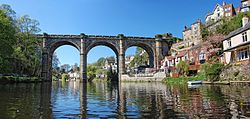
The River Nidd is a tributary of the River Ouse in the English county of North Yorkshire. It rises in Nidderdale at Nidd Head Spring on the slopes of Great Whernside. In its first few miles it has been dammed three times, creating Angram Reservoir, Scar House Reservoir and Gouthwaite Reservoir, which attract a total of around 150,000 visitors a year. It joins the River Ouse at Nun Monkton. The upper river valley, Nidderdale, was designated as an Area of Outstanding Natural Beauty in 1994. The Yorkshire Dales Rivers Trust has a remit to conserve the ecological condition of the River Nidd from its headwaters to the Humber estuary.