CircleCI est une plate-forme d'intégration continue et de livraison continue qui peut être utilisée pour mettre en œuvre des pratiques Devops. La société a été fondée en septembre 2011 et a levé 315 millions de dollars en financement de capital-risque en 2021, pour une valorisation de 1,7 milliard de dollars. CircleCI est l'une des plateformes CI/CD les plus populaires au monde.

1. Histoire

La société a été fondée en septembre 2011. Le produit a été publié pour la première fois pour un test bêta le 11 octobre 2011. Les premiers clients sont apparus trois mois après le démarrage de l'entreprise, tandis qu'il a fallu attendre 6 mois avant le premier paiement. En 2013, CircleCI a subi une importante violation de données due à son fournisseur MongoHQ, mais a pu réagir rapidement et remplacer ses clés de sécurité, ce qui n'a pratiquement pas entraîné de perte de clients. Typé Clojure a été utilisé chez CircleCI dans les systèmes de production de septembre 2013 à septembre 2015. En 2014, Paul Biggar a quitté l'entreprise, mais est resté au conseil d'administration. L'entreprise est passée rapidement de 20 employés fin 2014 à 60 employés à l'été 2016. En août 2019, CircleCI a rendu la prise en charge des versions Windows généralement disponible. Ce même mois, il y a eu une violation de données dans un compte de fournisseur d'analyse tiers utilisé par CircleCI. En novembre 2019, CircleCI a ouvert un bureau à Londres.

1. = Financement =

CircleCI a levé 50 000 $ auprès d'un petit investisseur quelques mois après son démarrage, 1,5 million de dollars de financement de démarrage en 2013, un tour de table de série A de 6 millions de dollars de DFJ en 2014, un tour de financement de série B de 18 millions de dollars de Scale Venture Partners en 2016, une série C de 31 millions de dollars dirigée par Top Tier Capital Partners en 2018, une série D de 56 millions de dollars dirigée par Owl Rock Capital et NextEquity Partners en 2019, une série E de 100 millions de dollars dirigée par IVP en 2020, et un cycle de série F de 100 millions de dollars dirigé par Greenspring Associates en 2021. Au total, cela représente un financement de 315 millions de dollars.

1. = Acquisitions =

CircleCI a acquis Distiller en 2014, Vamp en 2021 et Ponicode en 2022.

1. Produit

CircleCI surveille les référentiels GitHub, GitHub Enterprise et Atlassian Bitbucket et lance des builds (compilation du code et lancement des tests) pour chaque nouveau commit (au sens de Git; une sauvegarde de l'état du code à un moment donné). CircleCI teste automatiquement les builds dans les conteneurs Docker ou les machines virtuelles et déploie les builds de passage vers les environnements cibles. Un tableau de bord et une API permettent de suivre l'état des builds et les métriques liées aux builds. Une intégration Slack informe les équipes en cas de problème. La prise en charge de SSH permet d'exécuter des tâches localement et des mesures de sécurité empêchent la falsification. CircleCI propose également une fonction d'approbation du flux de travail qui met en pause le(s) travail(s) jusqu'à ce qu'une approbation manuelle soit donnée. CircleCI prend en charge Go, Java, Ruby, Python, Scala, Node.js, PHP, Haskell et tout autre langage fonctionnant sous Linux ou macOS. La société propose un service cloud géré avec un niveau gratuit disponible. La plate-forme peut également être auto-hébergée sur un serveur privé (derrière un pare-feu d'entreprise) ou sous forme de déploiement privé dans le cloud. Le service cloud a été initialement écrit à partir de zéro, mais utilise désormais Nomad et Kubernetes de HashiCorp. CircleCI réduit les risques en assurant des tests et des versions fréquents, et avec le service cloud géré, prend en charge la maintenance et l'approvisionnement de l'infrastructure CI. Le service cloud peut être configuré en quelques minutes, mais il est moins personnalisable que Jenkins.

1. = Orbs =

Les orbes sont des extraits partageables de YAML qui peuvent être utilisés pour simplifier les builds CircleCI et effectuer des déploiements. CircleCI avait des intégrations avec 45 partenaires en 2019. Les environnements de déploiement cibles de CircleCI incluent Amazon Web Services, Heroku, Azure, Google Compute Engine, les images Docker et les machines virtuelles Linux, Android, Windows ou macOS avec VMware. En 2018, le fichier config.yml de CircleCI était le fichier YAML à la croissance la plus rapide sur GitHub. La syntaxe de configuration propriétaire introduit le verrouillage du fournisseur, ce qui signifie que le changement de services CI nécessite la réécriture du pipeline.

1. = Les clients =

Facebook, Coinbase, Sony, Kickstarter, GoPro et Spotify ont utilisé CircleCI en 2019.

1. Notes et références


1. Articles connexes

Travis CI

1. Liens externes

Organisation GitHub Documentation CircleCI Portail de l’informatique

Nearby Places View Menu
Location Image
489 m

San Francisco Ferry Building

The San Francisco Ferry Building is a terminal for ferries that travel across the San Francisco Bay, a food hall and an office building. It is located on The Embarcadero in San Francisco, California and is served by Golden Gate Ferry and San Francisco Bay Ferry routes. On top of the building is a 245-foot-tall (75 m) clock tower with four clock dials, each 22 feet (6.7 m) in diameter, which can be seen from Market Street, a main thoroughfare of the city. Designed in 1892 by American architect A. Page Brown in the Beaux-Arts style, the ferry building was completed in 1898. At its opening, it was the largest project undertaken in the city up to that time. One of Brown's design inspirations for the clock tower may have been the current 16th-century iteration of the 12th-century Giralda bell tower in Seville, Spain. The entire length of the building on both frontages is based on an arched arcade. With decreased use since the 1950s, after bridges were constructed to carry transbay traffic and most streetcar routes were converted to buses, the building was adapted to office use and its public spaces broken up. In 2002, a restoration and renovation were undertaken to redevelop the entire complex. The 660-foot-long (200 m) Great Nave was restored, together with its height and materials. A marketplace was created on the ground floor, the former baggage handling area. The second and third floors were adapted for office and Port Commission use. On every hour during daylight, the clock bell chimes portions of the Westminster Quarters. The ferry terminal is a designated San Francisco landmark and is listed on the National Register of Historic Places.
Location Image
539 m

Vaillancourt Fountain

Vaillancourt Fountain, sometimes called Québec libre!, is a large fountain in Embarcadero Plaza in San Francisco, designed by the Québécois artist Armand Vaillancourt in collaboration with the plaza's landscape architect, Lawrence Halprin, and completed in 1971. It is about 40 feet (12 m) high and is constructed out of precast concrete square tubes. Long considered controversial because of its stark, modernist appearance, there have been several unsuccessful proposals to demolish the fountain over the years. It was the site of a free concert by U2 in 1987, when lead singer Bono spray painted graffiti on the fountain and was both praised and criticized for the action. The city determined the fountain to be a historic resource in 2025, and later voted to remove it citing concerns about structural deterioration.
Location Image
543 m

Abraham Lincoln Brigade Monument

The Abraham Lincoln Brigade Monument is a steel and onyx art installation in Embarcadero Plaza in San Francisco's Financial District, in the U.S. state of California. The Monument was designed by Ann Chamberlain and Walter J. Hood with US$400,000 in funding from the Abraham Lincoln Brigade Archives to honor the Lincoln Battalion and XV International Brigade, formed to fight for the Spanish Republic during the Spanish Civil War. It was dedicated on March 30, 2008 and is part of the San Francisco Arts Commission collection. One side of the monuments' panels show portraits of the volunteers. The other side of the panels contain annotated maps of the front lines between 1936 and 1938, as well as quotes of volunteers Abe Osheroff, Dave Smith, Alvah Bessie, Edwin Rolfe, Frederick Martin, Ruth Davidow, Robert Colodny, and Steve Nelson. The remainder panels contain words about that period from historians, labor organizers, writers, and musicians, such as Dolores Ibarruri, Albert Camus, Ernest Hemingway, and Paul Robeson. Intermittent repairs occurred in the decade since the Monument was installed. In August 2018, the onyx stone panels were removed and taken offsite for repair, due to a combination of design issues and neglect. The Monument was restored by May 2020.
Location Image
654 m

Sue Bierman Park

Sue Bierman Park, previously known as Ferry Park, is a 5.3-acre (2.1 ha) park in San Francisco, California in the Financial District, in the U.S. state of California. The park is named after Sue Bierman, a San Francisco civic activist and San Francisco Supervisor. It was completed in 1975 and is owned and operated by the San Francisco Recreation & Parks Department. Sue Bierman Park is bordered by Washington Street on the north, The Embarcadero on the east, a combination of Embarcadero Plaza and Clay Street on the south, and Davis Street on the west. Drumm Street cuts through the center of the park.
Location Image
696 m

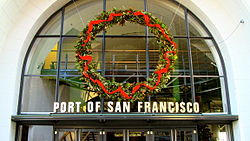
Port of San Francisco

The Port of San Francisco is a semi-independent organization that oversees the port facilities at San Francisco, California, United States. It is run by a five-member commission, appointed by the mayor subject to confirmation by a majority of the San Francisco Board of Supervisors. The Port is responsible for managing the larger waterfront area that extends from the anchorage of the Golden Gate Bridge, along the Marina district, all the way around the north and east shores of the city of San Francisco including Fisherman's Wharf and the Embarcadero, and southward to the city line just beyond Candlestick Point. In 1968, the State of California, via the California State Lands Commission for the state-operated San Francisco Port Authority (est. 1957), transferred its responsibilities for the Harbor of San Francisco waterfront to the City and County of San Francisco/San Francisco Harbor Commission through the Burton Act AB2649. All eligible state port authority employees had the option to become employees of the City and County of San Francisco to maintain consistent operation of the port of San Francisco. The port of San Francisco lies on the western edge of the San Francisco Bay near the Golden Gate. It has been called one of the three great natural harbors in the world, but it took two long centuries for navigators from Spain and England to find the anchorage originally called Yerba Buena: a port, as was said in its early days, in which all the fleets of the world could find anchorage. The port area under the commission's control comprises nearly eight miles of waterfront lands, commercial real estate and maritime piers from Hyde Street on the north to India Basin in the southeast. The list of landmarks under port control include Fisherman's Wharf, Pier 39, the Ferry Building, Oracle Park (formerly AT&T Park, SBC Park and Pacific Bell Park), located next to China Basin and Pier 70 at Potrero Point. Huge covered piers on piles jut out into San Francisco Bay along much of the waterfront, bordered by the Embarcadero roadway. In 2015, the city, acting through the port of San Francisco, launched the San Francisco Seawall Earthquake Safety and Disaster Prevention Program (Seawall Program).