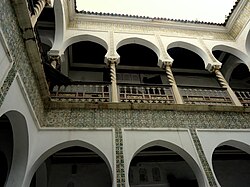
Les voûtes de la basse Casbah d'Alger, appelées également voûtes de Khayr ad-Din en référence à l'amiral Khayr ad-Din Barberousse, désignent un ensemble de structures voûtées situées dans la partie basse de la Casbah d’Alger, à proximité du port d'Alger. Construites ou réaménagées sous la Régence d’Alger à partir du XVIe siècle, ces voûtes servaient de casemates, d’entrepôts et d’abris militaires en lien avec l'Amirauté d’Alger. Certaines portions de cet ensemble architectural pourraient toutefois remonter à des périodes antérieures, notamment à l'époque antique d'Icosium, en tant que soubassements ou fondations. Aujourd’hui, ces voûtes subsistent partiellement, et font l’objet de programmes de restauration et de réhabilitation dans le cadre de la préservation du patrimoine de la Casbah classée à l’UNESCO.

1. Histoire

Ces voûtes auraient été édifiées ou utilisées au XVIe siècle par Khayr ad-Din Barberousse pour des activités maritimes et militaires, notamment comme entrepôts pour les armes, les vivres ou les marchandises saisies lors des prises en mer. Elles sont situées stratégiquement entre le port et la Casbah, facilitant le ravitaillement et la logistique navale. Elles connurent également des restructurations en 1814, durant le règne du dey Hadj Al, afin de maintenir leur usage dans un contexte de défense maritime encore actif. Durant la Régence d'Alger (1518–1830), ces espaces ont servi de casemates, d’abris pour les troupes, ou encore de dépôts pour la flotte de guerre algéroise. Elles faisaient partie du complexe défensif et portuaire qui incluait la darse, les remparts et plusieurs tours de guet. Après la conquête française de l'Algérie, les forces coloniales les réaménagèrent et y installèrent de grands fours pour fabriquer du pain destiné à leurs soldats. Les artilleurs français furent frappés par la magnificence des voûtes casematées du môle, à l'intérieur desquelles étaient installés les canons. Certaines pièces d'artillerie étonnaient par leurs riches ciselures, d'autres par leur histoire prestigieuse ; parmi ces dernières figurait notamment la célèbre « Consulaire » symbole de la puissance de la Régence d'Alger rapporté en France comme trophée de guerre. En 1837, les soldats français édifièrent un premier étage au-dessus des anciennes voûtes. L'ensemble, ainsi réaménagé, servit à cette époque de magasins de liquides pour l'approvisionnement de l'armée coloniale, renforçant l'usage logistique et militaire des lieux sous l'administration française. La dalle du premier étage fut également utilisée comme base pour la construction de la place du Gouvernement, rebaptisée place des Martyrs à l'indépendance du pays. Entre 1860 et 1866, les autorités coloniales françaises entreprirent des travaux de réhabilitation des voûtes dans le cadre de l'aménagement du port et de la basse Casbah. Ces travaux inclurent notamment le renforcement des murs de soutènement, afin de stabiliser les structures voûtées situées en contrebas des nouvelles infrastructures urbaines jusqu'à Alger-Centre. Aujourd’hui, les voûtes subsistent toujours. Certaines ont été enfouies, transformées ou intégrées à des constructions coloniales. D'autres sont localisées sous la Place des Martyrs, où des fouilles ont révélé des couches successives, notamment de l'époque de la régence. Elles constituent un témoignage précieux de l’infrastructure maritime algéroise du XVIe siècle au XIXe siècle.

1. Architecture

Les 5000 m² de voûtes sont construites en maçonnerie de pierre, avec des arcs en plein cintre, caractéristiques de l'architecture militaire méditerranéenne de cette époque. Certaines parties auraient été remaniées ou intégrées à des édifices plus récents. Elles sont semi-enterrées ou adossées aux pentes de la Casbah. Plusieurs magasins « Makhazine » furent progressivement édifiés jusqu'à former une voûte continue. Une succession de voûtes d'arêtes uniques en leur genre, réalisées grâce à des techniques avancées et à l'emploi de blocs de pierre acheminés depuis différents sites archéologiques environnant Alger. Les lieux sont souvent inaccessibles au public mais font l’objet d’études archéologiques ponctuelles. Ils sont protégés au titre du patrimoine historique d'Alger, inscrit sur la liste du patrimoine mondial de l’UNESCO depuis 1992.

1. Restauration et réhabilitation

Les voûtes sont actuellement en cours de restauration et de réhabilitation dans le cadre d’un programme de mise en valeur du patrimoine historique et maritime de la ville d'Alger. Ce projet vise à renforcer l'attractivité culturelle du site et à réintégrer ces structures dans le tissu urbain de la Casbah. Elles vont ainsi abriter des commerces et des restaurants, redonnant vie à ces espaces tout en respectant leur caractère patrimonial. Par ailleurs, une partie des voûtes abrite déjà le Musée public national maritime d'Alger, qui expose des collections liées à l'histoire navale de la ville et de la Méditerranée.

1. Références


1. Articles connexes

Casbah d’Alger Port d'Alger Régence d'Alger Portail de l’architecture et de l’urbanisme Portail de l’histoire de l’art Portail d'Alger

Nearby Places View Menu
Location Image
47 m

Djamaa el Kebir

The Djamaa el Kebir or Great Mosque of Algiers (Arabic: الجامع الكبير, romanized: djama' el-kebir), is a mosque located in the city of Algiers, Algeria. Built in 1097, it is one of the few remaining examples of Almoravid architecture. Although it has undergone other additions and reconstructions since its foundation, it is the oldest mosque in Algiers and is said to be one of the oldest mosques in Algeria after Sidi Okba Mosque and Sidi Ghanem Mosque. The mosque is located in the Casbah of Algiers, a UNESCO World Heritage Site.
Location Image
112 m

Regency of Algiers

The Regency of Algiers was an early modern semi-independent Ottoman province and nominal vassal state on the Barbary Coast of North Africa from 1516 to 1830. Founded by the privateer brothers Aruj and Hayreddin Reis (also known as the Barbarossa brothers), the Regency succeeded the Kingdom of Tlemcen as a formidable base that waged maritime holy war (Jihad) on European Christian powers. It was ruled by elected regents under a stratocracy led by Janissaries and corsairs. Despite its pirate reputation in Europe, Algiers maintained long-standing diplomatic ties with European states and was a recognized Mediterranean power. The Regency emerged in the 16th-century Ottoman–Habsburg wars. As self-proclaimed ghazis gaining popular support and legitimacy from the religious leaders at the expense of hostile local emirs, the Barbarossa brothers and their successors carved a unique corsair state that drew revenue and political power from its naval warfare against Habsburg Spain. In the 17th century, when the wars between Spain and the Ottoman Empire, Kingdom of France, Kingdom of England and Dutch Republic ended, Barbary corsairs started capturing merchant ships and their crews and goods from these states. When the Ottomans could not prevent these attacks, European powers negotiated directly with Algiers and also took military action against it. This policy would emancipate Algiers from the Ottomans. The Regency held significant naval power in the 16th and 17th centuries and well into the end of the Napoleonic wars despite European naval superiority. Its institutionalised privateering dealt substantial damage to European shipping, took captives for ransom, plundered booty, hijacked ships and eventually demanded regular tribute payments. In the rich and bustling city of Algiers, the Barbary slave trade reached an apex. The Regency also expanded its hold in the interior by allowing a large degree of autonomy to the tribal communities. After the janissary coup of 1659, the Regency became a sovereign military republic, and its rulers were thenceforth elected by the council known as the diwan rather than appointed by the Ottoman sultan previously. Despite wars over territory with Spain and the Maghrebi states in the 18th century, Mediterranean trade and diplomatic relations with European states expanded, as wheat exports secured Algerian revenues after privateering decline. Bureaucratisation efforts stabilized the Regency's government, allowing into office regents such as Mohammed ben-Osman, who maintained Algerian prestige thanks to his public and defensive works. Increased Algerian privateering and demands for tribute started the Barbary Wars at the beginning of the 19th century, when Algiers was decisively defeated for the first time. Internal central authority weakened in Algiers due to political intrigue, failed harvests and the decline of privateering. Violent tribal revolts followed, mainly led by maraboutic orders such as the Darqawis and Tijanis. In 1830, France took advantage of this domestic turmoil to invade. The resulting French conquest of Algeria led to colonial rule until 1962.
Location Image
205 m

Dar Aziza

Dar Aziza is a 16th-century Moorish palace located in the Casbah of Algiers in Algeria. Today, it houses the National Agency of Archaeology and Protection of Historic Sites and Monuments. Dar Aziza, arguably the most iconic surviving building of its era in Algiers, was part of a large governmental compound known as Janina Palace, which existed before the arrival of Turkish corsairs.
Location Image
261 m

Bab Dzira

Bab Dzira (in Arabic: باب الدزيرة), also known as Bab El Dzira, was one of the Gates of the Casbah of Algiers, opening onto the sea along the city’s waterfront. It was among the historic city gates of Algiers. In recent years, the name *Bab Dzira* has also been used to designate a new urban space built between Boulevard Che-Guevara and Boulevard Zighoud Youcef, facing the Port of Algiers, designed for public leisure and recreation.
Location Image
270 m

Dar Mustapha Pacha

Dar Mustapha Pacha (French: Palais Mustapha Pacha) is a Moorish palace, located in the Casbah of Algiers, Algiers, Algeria. It houses the National Museum of Miniatures, Illumination and Calligraphy. It was built by the future Dey Mustapha Pacha between 1798 and 1799. The main entrance to the palace is situated at No. 12 Ahmad and Muhammad Mecheri Street, under a projecting roof terrace which is bordered by rows of Roman tiles. The main door opens onto a sqifa (entrance hall), which leads to the main courtyard of the palace. The courtyard is sheltered with groined vaults and is dispersed with decorative niches which form window-seat benches. There is also a second entrance hall which is overlooked by two marble-framed doors; this connects the main sqifa used by visitors to enter the interior courtyard. The centre of the residential quarters is surrounded by galleries and supported by arches which rest on marble columns and are distinguished by decorative tiles. The ceilings are supported by wooden beams which cover the galleries on the ground floor and the first floor of the palace.