Farnley is a village and civil parish in the county of North Yorkshire, England, near Otley, West Yorkshire. The name "Farnley" indicates that the village was first established in an area heavy with ferns. It is mentioned in the 1086 Domesday Book as Fernelai and Fernelie. From 1974 to 2023 it was part of the Borough of Harrogate, it is now administered by the unitary North Yorkshire Council.

To the south of the village lies Farnley Hall, a stately home built by John Carr. The house has a rich history, being associated with names such as Fairfax, Cromwell, and Turner. A selection of Turner's works from the Farnley Hall collection were sold in 1890 for £25,000. The primary school in Farnley is occasionally used as a location for filming the soap opera Emmerdale. When found as a surname the most popular is Fearnley; other surnames related to the area are Farnely, Farnley and Fernleigh.

Nearby Places View Menu
Location Image
369 m

All Saints' Church, Farnley

All Saints' Church is an Anglican church in Farnley, North Yorkshire, a village in England. A church was built in Farnley in the 13th century, but at some point much of it was demolished, with the former chancel serving as a chapel. A new church was commissioned by Ayscough Fawkes, and was completed in 1851, reusing most of the walling from the chapel. The church was grade II listed in 1985. The church is built of gritstone with a slate roof, and is in the Early English style. It consists of a nave and a chancel in one unit, a south porch, and a bellcote on the west gable. The windows are lancets. Some of the stained glass is 17th century and was designed by Henry Gyles. It was originally made for Hawksworth Hall, and was moved to Farnley Hall before being installed in the church. Inside the church, there is a west gallery with a vestry below, and the pews probably date from 1851.
Location Image
571 m

Farnley Hall, North Yorkshire

Farnley Hall is a stately home in Farnley, North Yorkshire, England. It is located near Otley. The original early seventeenth-century house was added to in the 1780s by John Carr, who also designed Harewood House. The hall is now a Grade I listed building. The house consists of an 18th-century square block with earlier and later L-shaped wings at the rear and is built of coursed squared gritstone and ashlar with stone slate and lead roofs.
Location Image
1.4 km

Lindley Wood Reservoir

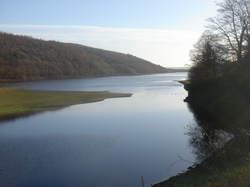
Lindley Wood Reservoir is located in the Washburn Valley north of Otley in Yorkshire, England.
1.5 km

Leathley Mill

Leathley Mill is a historic building in Leathley, a village in North Yorkshire, in England. The watermill was built in the mid 18th century to grind corn. It lies on the River Washburn, alongside the contemporary miller's house. The mill was altered in the 19th century, and was grade II* listed in 1966. Later in the century, it was converted into housing. The mill is built of gritstone with a corrugated asbestos roof. It has a T-shaped plan, consisting of a three-storey main range, and a two-storey range at right angles. The main range contains a wagon entrance and an arched mill entrance to the right. At the rear is an outshut with a corrugated iron roof over the mill race and an undershot wood and iron waterwheel. The well-preserved interior includes the original floors and stairs, trap doors, corn bins, and the main shaft and cogs of the waterwheel. The mill house is grade II listed. It is built of gritstone, with quoins, and a stone slate roof with shaped kneelers and stone coping. The doorway is in the centre, and the windows are recessed, with flat-faced mullions and plain surrounds.