

 English
 Français

Golcar United Football Club is a semi-professional football club based in Golcar, Huddersfield, West Yorkshire, England. They are currently members of the Northern Counties East League Premier Division and play at Longfield Avenue.
Nearby Places View Menu

467 m
Golcar
Golcar (pronounced ) is a village on a hillside crest above the Colne Valley in the Kirklees district, in West Yorkshire, England, 3 miles (5 km) west of Huddersfield, and just north of the River Colne and the Huddersfield Narrow Canal.
The 2021 population census lists the village as having 18,725 permanent residents. The main transport access is from the A62 (Manchester Road), through Milnsbridge in the valley bottom or via Scapegoat Hill from the A640 (New Hey Road) at the top of the hill.
The township of Golcar consists of Bolster Moor, Golcar, Wellhouse, Pole Moor and Scapegoat Hill.
479 m
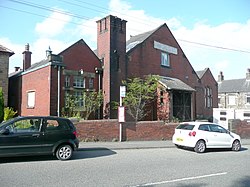
Scar Lane drill hall, Milnsbridge
The Scar Lane drill hall is a former military installation in Milnsbridge, West Yorkshire, England.
781 m
Golcar railway station
Golcar railway station is a former railway station serving Golcar in West Yorkshire, England that was located between the existing Huddersfield and Slaithwaite stations. Along with several other stations on this stretch of line, it was closed to passengers on 7 October 1968 – a result of the Beeching Axe. No trace of the station remains, though there have been calls to rebuild the station to serve the village and also neighbouring Milnsbridge.

842 m
Longwood, Huddersfield
Longwood is a village and suburb of the town of Huddersfield in the English county of West Yorkshire. It is situated some 2.5 miles (4.0 km) west of Huddersfield town centre, in the valley of the Longwood Brook, a tributary of the River Colne.
The village is the home of the Longwood Sing, an annual event, where choirs from around the area gather to sing hymns and songs. Near the amphitheatre, where the sing takes place, the folly Nab End Tower can be found. The tower was built in 1861 by unemployed local woollen mill workers. In 2008 it was restored by Kirklees Metropolitan Borough Council at a cost of £200,000.
There are also three reservoirs that supply Huddersfield. They were built around 1840, although strengthening work in the 1930s makes them appear newer. One now covered and the lower reservoir looking more like a natural lake that is called a compensation reservoir - 'Compensation' as it was set up to compensate the mill owner for water lost from natural sources that now went to the main reservoirs to be distributed by the water corporation under 'rates' systems - although the mill owner was most likely the owner of the main reservoir too.
During the 1840s, Longwood was the home to the Hanson family of Ballroyd. Mary Hanson set up a carrying business to supplement her husband's income from farming and soon the Hanson wagons were seen taking the Great North Road to London. James Hanson, founder and former chairman of Hanson plc, is a direct descendant of the Ballroyd family. When he was made a life peer, he took the title Baron Hanson of Edgerton after the nearby suburb of Edgerton.
Longwood was built up around the woollen industry and its mills, most of which have now been demolished and replaced by housing. As a result of this the village has recently seen an influx of new inhabitants.
In 2005, a campaign was mounted to save the Longwood allotment plots (situated behind the Mechanics' Institute) from being developed into housing.
Longwood Church is dedicated to St. Mark, and is in the Church of England parish of Huddersfield, being a perpetual curacy. Longwood is also home to the 27th Longwood Scout Group.
The name Longwood derives from Old English Lang wudu, meaning "The Long Wood".