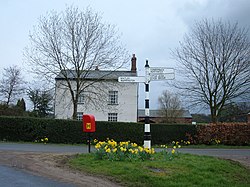
Comberbach , deriving from the late Britonnic, or early Welsh for a "small confluence" is a civil parish and small village in the unitary authority of Cheshire West and Chester and the ceremonial county of Cheshire, England, between Northwich and Warrington. The population of the civil parish taken at the 2011 census was 953. The village has a new memorial hall (partly Lottery Funded), a bowling club, one pub - the Spinner and Bergamot, (the Drum and Monkey closed in 2013) - and a post office/village shop. There is a county primary school, a Methodist chapel and an old-fashioned red phone box. Older residents and those who have lived in the village for a long time pronounce the name 'comma-batch', the first 'b' being silent. Cartoonist John Geering, the artist behind Bananaman, lived here. Comberbach Mummers perform the traditional Soulcaking Play (a form of mummers play), from 31 October for two weeks. It restarted in the mid-1980s. The mummers meet most Thursday evenings in The Spinner and Bergamot pub.

Nearby Places View Menu
Location Image
750 m

Marbury Reedbed Nature Reserve

Marbury Reedbed Nature Reserve is a 6-hectare (15-acre) nature reserve located at the western end of Budworth Mere, north of Northwich, Cheshire, England. It is managed by the Cheshire Wildlife Trust under lease from the Royal Society for Nature Conservation, which purchased the land by public subscription in 1934 as a memorial to the Cheshire naturalist Thomas Coward. The reserve, which is adjacent to Marbury Country Park, contains a range of habitats, with the reedbed, carr woodland and semi-natural broadleaved woodland demonstrating the various stages of hydrosere succession (a gradual change from open water to woodland). The open water contains a rich selection of plants, including water lilies, and provides valuable feeding and breeding habitat for kingfishers, little grebes and great crested grebes. The reedbed is almost exclusively composed of common reed and is a residence for summer birds such as reed and sedge warblers. In recent years the reedbed has been used as an over-wintering site by bittern, and the trust manages the reedbed for this secretive heron by cutting glades through the reeds to allow better feeding opportunities. The diminutive and shy lesser spotted woodpecker has also been seen occasionally in the reserve's woodlands.
Location Image
1.3 km

Marbury Country Park

Marbury Country Park is a country park in Cheshire, England. It lies in the heart of Northwich Community Woodlands, an integral part of the Mersey Forest. Former industrial land is gradually being transformed to create a rich and green environment stretching from Marbury to Northwich. Many of the features of the Country Park, including the lime avenues and the arboretum, are a legacy of the days when Marbury was a grand estate. The last Marbury Hall, built in the 1850s, was a fine-looking house modelled on the French chateau at Fontainebleau, with an imposing carriage drive entrance. Originally owned by the Smith-Barry family, the hall became a country club in the 1930s, and then a POW camp during WWII. After this the hall served as a hostel for ICI employees during its considerable post-war expansion and some of the POW camp huts persisted as accommodation for the workforce. By the 1960s the hall had fallen into disrepair and was demolished. The history of the hall was told in a community play in 2002. The Friends of Anderton and Marbury (FOAM) are a group involved with looking after both parks and organising walks, talks, conservation tasks and events.
Location Image
1.5 km

Belmont Hall, Cheshire

Belmont Hall is a country house one mile (1.6 km) to the northwest of the village of Great Budworth, Cheshire, England. It is recorded in the National Heritage List for England as a designated Grade I listed building. The house stands to the north of the A559 road. Since 1977 it has been occupied by Cransley School.
Location Image
1.5 km

Cogshall Hall

Cogshall Hall is a country house near the village of Comberbach, Cheshire, England. It was built in about 1830 for Peter Jackson. A kitchen wing was added to the rear during the early 20th century. It is constructed in red-brown brick, and has a slate hipped roof. It is rectangular in plan, and has two storeys. Its architectural style is Georgian. The entrance front has five bays and an Ionic portico. There is a similar, smaller portico on the right side. The house is recorded in the National Heritage List for England as a designated Grade II* listed building. The lodge to the hall was built at about the same time. It has a Tuscan porch with a pediment, and is listed at Grade II. The architectural historian Nikolaus Pevsner refers to the lodge as being "ambitious". In July 2019, both the main estate house and the former lodge, the Grange, were listed for sale as part of the 99-acre property. The Hall, of Flemish-bond brick with a slate roof, was described in Cheshire Country Houses in the early 1900s as "a house of note". As photographs in a news report indicate, much of the interior has been modernized recently and the gardens have been restored.