
Cogshall Hall is a country house near the village of Comberbach, Cheshire, England. It was built in about 1830 for Peter Jackson. A kitchen wing was added to the rear during the early 20th century. It is constructed in red-brown brick, and has a slate hipped roof. It is rectangular in plan, and has two storeys. Its architectural style is Georgian. The entrance front has five bays and an Ionic portico. There is a similar, smaller portico on the right side. The house is recorded in the National Heritage List for England as a designated Grade II* listed building. The lodge to the hall was built at about the same time. It has a Tuscan porch with a pediment, and is listed at Grade II. The architectural historian Nikolaus Pevsner refers to the lodge as being "ambitious". In July 2019, both the main estate house and the former lodge, the Grange, were listed for sale as part of the 99-acre property. The Hall, of Flemish-bond brick with a slate roof, was described in Cheshire Country Houses in the early 1900s as "a house of note". As photographs in a news report indicate, much of the interior has been modernized recently and the gardens have been restored.

Nearby Places View Menu
Location Image
1.5 km

Comberbach

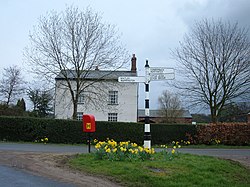
Comberbach , deriving from the late Britonnic, or early Welsh for a "small confluence" is a civil parish and small village in the unitary authority of Cheshire West and Chester and the ceremonial county of Cheshire, England, between Northwich and Warrington. The population of the civil parish taken at the 2011 census was 953. The village has a new memorial hall (partly Lottery Funded), a bowling club, one pub - the Spinner and Bergamot, (the Drum and Monkey closed in 2013) - and a post office/village shop. There is a county primary school, a Methodist chapel and an old-fashioned red phone box. Older residents and those who have lived in the village for a long time pronounce the name 'comma-batch', the first 'b' being silent. Cartoonist John Geering, the artist behind Bananaman, lived here. Comberbach Mummers perform the traditional Soulcaking Play (a form of mummers play), from 31 October for two weeks. It restarted in the mid-1980s. The mummers meet most Thursday evenings in The Spinner and Bergamot pub.
Location Image
2.0 km

St Luke's Church, Lower Whitley

St Luke's Church is in the village of Lower Whitley, in the civil parish of Whitley, Cheshire, England. The church is recorded in the National Heritage List for England as a designated Grade II* listed building. It is an active Anglican parish church in the diocese of Chester, the archdeaconry of Chester and the deanery of Great Budworth. It is one of three parish churches in the parish of Aston-by-Sutton, Little Leigh and Lower Whitley. The other two being St Peter, Aston-by-Sutton and St Michael and All Angels, Little Leigh. The three were previously individual parishes in a united benefice with St Mark, Antrobus.
Location Image
2.0 km

Antrobus, Cheshire

Antrobus is a civil parish and village in Cheshire, England, about 7 miles (11 km) south of Warrington. It lies within the unitary authority of Cheshire West and Chester, and had a population of 832, reducing to 791 at the 2011 Census, and to 767 in the 2021 census. The parish is the most northeasterly point of Cheshire West and Chester, and as such borders both Warrington and Cheshire East. As well as Antrobus village centre itself, the parish includes other large hamlets at Frandley, about 1 mi (1.6 km) south-west from the main village, and Crowley, about 2 mi (3.2 km) to the north-east. The village shop and post office is owned and run cooperatively by the villagers for the benefit of the community having previously closed in 2003.
2.1 km

St Mark's Church, Antrobus

St Mark's Church is in Knutsford Road in the village of Antrobus, Cheshire, England. It is an active Anglican parish church in the deanery of Great Budworth, the archdeaconry of Chester, and the diocese of Chester. Its incumbent is shared with St Mary and All Saints Church, Great Budworth. The church is recorded in the National Heritage List for England as a designated Grade II listed building. It was a Commissioners' church, having received a grant towards its construction from the Church Building Commission.