English
 Français

The Botanical Garden Hamma (Arabic: حديقة التجارب الحامة) (French: Jardin d'Essai du Hamma) is an arboretum and botanical garden spanning 58 hectares (140 acres) in the Mohamed Belouizdad neighborhood of Algiers, Algeria. Founded in 1832, it is regarded as one of the world's most significant acclimatization gardens, acting as both a scientific research hub and a lush lung for the city.
1. History


1. = 19th Century: Establishment and Expansion =
General Antoine Avisard and Civil Intendant Pierre Genty de Bussy established the garden in 1832. The project's original goal was to drain the "Hamma" (which means "fever" or "marsh" in Arabic) in order to build a model farm and an exotic species testing site. The garden's emphasis shifted to "acclimatization"—the study of how plants from various climates could survive and flourish in North Africa—under the direction of Auguste Hardy (1842–1867). The garden had grown to its present size and was home to more than 8,000 species by 1867. Important avenues were planted during this time, such as the Ficus Alley (1863) and the Dragon Tree Alley (1847).
1. = 20th Century: Cultural and Scientific Growth =
The garden changed from being a strictly scientific nursery to a public park in 1914. Architects Renénier and Paul Guion created the famous "French Garden" viewpoint, which faces the Mediterranean Sea, between 1913 and 1946. Because of its dense, jungle-like English Garden section, the garden became well-known throughout the world in 1932 when Johnny Weissmuller's Tarzan the Ape Man was filmed there.
1. = Recent History =
The garden underwent a significant five-year restoration beginning in 2004 after being neglected during the 1990s. In collaboration with the Algerian National Institute of Agronomical Research (INRAA), the Algiers Wilaya is currently in charge of its public reopening in 2009.
1. Geography and Layout
Because of its proximity to the Bay of Algiers and the protective Arcades hill, the garden, which is divided into multiple distinct zones, benefits from a unique microclimate.
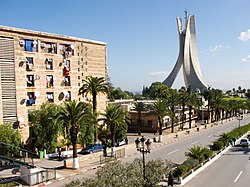
The French Garden is a formal, symmetrical garden with rows of Washingtonia palms, fountains, and five terraced levels. The English Garden is a wilder, more naturalistic space with a lake, meandering paths, and thick tropical vegetation. The Martyrs' Memorial on the hill above dominates the Arboretum, a 20-hectare area devoted to the study of trees.
1. Flora and Fauna
There are currently about 1,200 different plant species in the garden. Among the notable botanical collections are:
Avenues include enormous Ficus macrophylla, dragon trees (Dracaena draco), and giant bamboo. Historical collections of cotton, henna, indigo, and medicinal herbs are examples of economic plants. A 1900-founded zoological park on the property is home to lions, brown bears, and a variety of exotic birds, including the vulturine guineafowl.
1. Scientific Significance
The Hamma Botanical Garden functions as an ex situ conservation center in addition to being a tourist destination. It functions:
A seed bank: storing native Algerian plant seeds at regulated temperatures. Thousands of specimens from the tropics and North Africa are kept in a herbarium. Environmental Education: Through its dedicated school for nature education, it hosts more than 15,000 students every year.
1. Animals
Bengal tiger Brown bear Asian elephant Lion Leopard Llama Emu Striped hyena Common genet Guinea baboon Crocodile Japanese carp
1. References


1. External links
Official website (in French)
Nearby Places View Menu

20 August 1955 Stadium (Algiers)

National Museum of Fine Arts of Algiers

Maqam Echahid