

 English
 Français

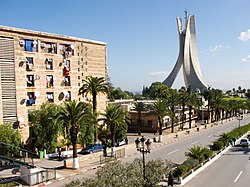
The Maqam Echahid (Arabic: مقام الشهيد, Maqāmu š-šahīd, Arabic pronunciation: [maqaːmu ʃːahiːd], Kabyle: Asmektay n umeɣras/ⴰⵙⵎⴽⵜⴰⵢ ⵏ ⵓⵎⴻⵖⵔⴰⵙ, English: Martyr's Memorial) is a concrete monument commemorating the Algerian War. The monument was opened on July 5, 1982, on the 20th anniversary of Algeria's independence. It is fashioned in the shape of three standing palm leaves, which shelter the "Eternal Flame" under it. At the edge of each palm leaf is a statue of a soldier representing a stage of Algeria's struggle for independence.
1. History
President Houari Boumédiène was the project's creator, but Chadli Bendjedid, his successor, oversaw its completion and inauguration.
Designers: Polish sculptor Marian Konieczny, calligrapher Abdelhamid Skander, and renowned Algerian painter Bachir Yellès spearheaded the artistic vision. Engineering: The structural studies and construction were carried out by the Canadian engineering firm Lavalin (now SNC-Lavalin). Construction Period: Beginning on November 15, 1981, and ending for the July 1982 anniversary, the monument was constructed in an unprecedented seven months and twenty days. Site Significance: It was built where an old military fort once stood. The location is strategically important because it offers a 360-degree view of the Bay of Algiers and overlooks the Botanical Garden (Jardin d'essai) and the Hamma neighborhood.
1. Architectural Features
Designed to withstand the high seismicity (earthquake risk) of the area, the monument is a marvel of late-modernist concrete architecture.
Height: 302 feet, or 92 meters. Structure: It is made up of three stylized palm fronds, also known as fins, that come together at a height of 47 meters. The Turret: Above the intersection is a 10-meter-diameter Islamic-style turret with a 6-meter dome on top. The Eternal Flame: In remembrance of the martyrs, a "Eternal Flame" burns in the middle of the three fronds on the esplanade. Statues: Each frond has a bronze statue at its base that depicts a different stage of the conflict:
The early struggle against French colonization is represented by the Popular Resistance (1830–1954). The guerrillas (Moudjahidine) of the revolutionary war were represented by the National Liberation Army (1954–1962). The modern Algerian military and national defense are represented by the People's National Army (Post-1962).
1. Symbolism
The most contentious and significant aspect of the monument's identity is its three palm fronds. They are typically understood to represent:
The Three Revolutions: Following independence, the modern state was built through the Industrial, Agrarian, and Cultural revolutions. Unity: The political, military, and social pillars of the Algerian struggle coming together. Growth: Algeria's Saharan identity and the notion of "rebirth" from the soil are evoked by the shape of palm leaves.
1. National Museum of the Moudjahid
The National Museum of the Moudjahid is located directly beneath the monument.
Underground Layout: The museum is located underground and has an amphitheater and a large circular crypt. Collections: It contains items from the 1830 invasion to the 1954–1962 conflict, such as revolutionaries' personal belongings, weapons, historical records, and pictures of the "guillotine" that colonial forces used. Sanctuary: The lower level has a domed sanctuary with Quranic verses engraved on the walls, providing a place for quiet contemplation.
1. Recent Renovations
The French-Belgian company Schréder renovated the monument's lighting significantly in 2017–2018. For national holidays and international events, the monument can be illuminated in a variety of colors (usually the green, red, and white of the Algerian flag) thanks to the installation of a dynamic LED system.
1. Gallery


1. See also
Algerian War Azadi Tower Pearl square Memorial to the Liberation of Algeria
1. References
Nearby Places View Menu

National Museum of Fine Arts of Algiers
Diar el Mahçoul
El Madania
