

 English
 Français

Holy Trinity Church is in the centre of the town of Warrington, Cheshire, England. The church is recorded in the National Heritage List for England as a designated Grade II* listed building. It is an active Anglican parish church in the diocese of Liverpool, the archdeaconry of Warrington and the deanery of Warrington.
Nearby Places View Menu

54 m
Borough of Warrington
The Borough of Warrington is a unitary authority area with borough status in the ceremonial county of Cheshire, England. The borough is centred around the town of Warrington, and extends out into outlying villages of Lymm and Great Sankey and the town of Birchwood.
The borough is geographically located to the north and northeast of the Cheshire West and Chester and Halton districts in Cheshire, the metropolitan borough of St Helens in Merseyside to the northwest and north and the metropolitan boroughs of Wigan and Trafford in Greater Manchester to the northeast, east, and southeast. Additionally, to the south-east, the borough borders Cheshire East. The borough is also located between the cities of Liverpool, Salford, Manchester, Chester and Preston. The district straddles the historic counties of Cheshire (the southern part of the district includes Lymm and Stockton Heath) and Lancashire (the northern part including Warrington itself and Latchford).
126 m
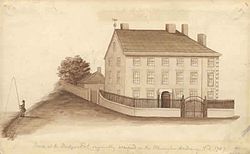
Warrington Academy
Warrington Academy, active as a teaching establishment from 1756 to 1782, was a prominent dissenting academy, that is, a school or college set up by those who dissented from the established Church of England. It was located in Warrington (then part of Lancashire, now within Cheshire), a town about half-way between the rapidly industrialising Manchester and the burgeoning Atlantic port of Liverpool. Formally dissolved in 1786, the funds then remaining were applied to the founding of Manchester New College in Manchester, which was effectively the Warrington Academy's successor, and in time this led to the formation of Harris Manchester College, Oxford.
A statue of Oliver Cromwell stands in front of the academy.

131 m
Warrington
Warrington () is an industrial town in Cheshire, England. The town is the main settlement of the Borough of Warrington and sits on the banks of the River Mersey and was historically part of Lancashire. It is 16 miles (26 km) east of Liverpool and 16 miles (26 km) west of Manchester.
The population in 2021 was recorded as 174,970 for the built-up area and 210,900 for the wider borough, the latter being more than double that of 1968 when it became a new town. Warrington is the largest town in the ceremonial county of Cheshire.
Warrington was founded by the Romans at an important crossing place on the River Mersey. A new settlement was established by the Saxon Wærings. By the Middle Ages, Warrington had emerged as a market town at the lowest bridging point of the river. A local tradition of textile and tool production dates from this time.
The expansion and urbanisation of Warrington coincided with the Industrial Revolution, particularly after the Mersey was made navigable in the 18th century. The West Coast Main Line runs north to south through the town, and the Liverpool to Manchester railway (the Cheshire Lines route) west to east. The Manchester Ship Canal cuts through the south of the borough (west to east). The M6, M56 and M62 motorways form a partial box around the town and are all accessible through Warrington.
The modern Borough of Warrington was formed in 1974 with the amalgamation of the former County Borough of Warrington, part of the Golborne Urban District, the Lymm Urban District, part of the Runcorn Rural District, the Warrington Rural District and part of the Whiston Rural District.
139 m
Warrington bombings
The Warrington bombings were two bomb attacks that took place during early 1993 in Warrington, Cheshire, England. The first attack happened on 26 February, when a bomb exploded at a gas storage facility. This first explosion caused extensive damage, but no injuries. While fleeing the scene, the bombers shot and injured a police officer and two of the bombers were caught after a high-speed car chase. The second attack happened on 20 March, when two smaller bombs exploded in litter bins outside shops and businesses on Bridge Street. Two children were killed and 56 people were injured.
The attacks were carried out by the Provisional Irish Republican Army (IRA). From the early 1970s, the IRA had been carrying out attacks in both Northern Ireland and England with the stated goal of putting pressure on the UK Government to withdraw from Northern Ireland.