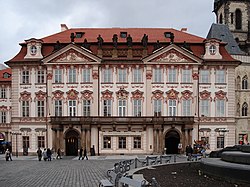
La Maison à la cloche de pierre (en tchèque Dům U kamenného zvonu) est un édifice médiéval situé sur la place de la Vieille-Ville à Prague, au numéro 16, à droite du rococo palais Kinsky.

1. Histoire

Construite au début du XIVe siècle, probablement sous le roi Jean Ier de Bohême (Jean de Luxembourg), elle a ensuite été convertie en palais urbain et agrandie. Charles IV aurait d'ailleurs dû y vivre après s'être installé en Bohême lors de la rénovation de son futur siège, le château de Prague. L'emblème de la maison, qui lui a donné son nom, était une cloche de pierre. On voit la cloche dans un angle de l'édifice. Le nom de la maison est documenté pour l'année 1417. Des statues, dont les consoles et les auvents ont survécu, se tenaient entre les fenêtres à croisées gothiques.

Au XVIIe siècle, la maison a été entièrement repensée en style baroque. Après de nouvelles modifications, la décision fut prise en 1961 de redonner à la maison son état gothique initial, dans la mesure où les divers éléments structurels le permettaient. Plus de 12 000 éléments de construction et pierres de relief d'origine ont été réutilisés. Deux étages d'origine gothique ont été restaurés. Les travaux durèrent de 1975 à 1988. Après cela, la maison a été donnée à la Galerie de la ville de Prague, qui l'utilise aujourd'hui pour des expositions d'art. Dans la cave de la Maison à la cloche de pierre il y a un lapidarium et une petite exposition sur l'histoire de la maison et la reconstruction.

1. Référence

(de) Cet article est partiellement ou en totalité issu de l’article de Wikipédia en allemand intitulé « Haus zur steinernen Glocke » (voir la liste des auteurs).

1. Liens web

Galerie de la ville de Prague: Maison A la cloche de pierre, portail du tourisme de la ville de Prague, consulté le 15 Novembre 2019. at-the-stone-bell, kralovskacesta.cz (anglais), consulté le 15 Novembre 2019. Portail de l’architecture et de l’urbanisme Portail de Prague

Nearby Places View Menu
Location Image
0 m

Stone Bell House

The Stone Bell House (Czech: Dům U Kamenného zvonu) is located on the Old Town Square in Prague. It is located next to the Kinský Palace on the corner of Old Town Square and Týnská street.
Location Image
37 m

Kinský Palace (Prague)

Kinský Palace (Czech: Palác Kinských, German: Palais Goltz-Kinsky) is a former palace and now an art museum in Prague, Czech Republic. It is located on the Old Town Square in the Old Town quarter of Prague. The palace's name refers to its former ownership by the Kinsky (Czech: Kinský) noble family.
Location Image
54 m

Old Town Square

Old Town Square (Czech: Staroměstské náměstí [ˈstaroˌmɲɛstskɛː ˈnaːmɲɛsciː] or colloquially Staromák [ˈstaromaːk] , German: Altstädter Ring) is a historic square in the Old Town quarter of Prague, the capital of the Czech Republic. It is located between Wenceslas Square and Charles Bridge.
Location Image
54 m

Kingdom of Bohemia

The Kingdom of Bohemia, sometimes referenced in English literature as the Czech Kingdom (Czech: České Království), was a medieval and early modern monarchy in Central Europe. It was the predecessor state of the modern Czech Republic. The Kingdom of Bohemia was an Imperial State in the Holy Roman Empire. The Bohemian king was a prince-elector of the empire. The kings of Bohemia, besides the region of Bohemia itself, also ruled other lands belonging to the Bohemian Crown, which at various times included Moravia, Silesia, Lusatia, and parts of Saxony, Brandenburg, and Bavaria. The kingdom was established by the Přemyslid dynasty in the 12th century from the Duchy of Bohemia. It was later ruled by the House of Luxembourg, the Jagiellonian dynasty, and from 1526 the House of Habsburg and its successor, the House of Habsburg-Lorraine. Numerous kings of Bohemia were also elected Holy Roman Emperors, and the capital, Prague, was the imperial seat in the late 14th century, and again at the end of the 16th and the beginning of the 17th centuries. Shortly before the dissolution of the Holy Roman Empire in 1806, the kingdom became part of the newly proclaimed Habsburg Austrian Empire, and subsequently the Austro-Hungarian Empire from 1867. Bohemia retained its name and formal status as a separate Kingdom of Bohemia until 1918, known as a crown land within the Austro-Hungarian Empire, and its capital Prague was one of the empire's leading cities. The Czech language (called the Bohemian language in English usage until the 19th century) was the main language of the Diet and the nobility until 1627 (after the Bohemian Revolt was suppressed). German was then formally made equal with Czech and eventually prevailed as the language of the Diet until the Czech National Revival in the 19th century. German was also widely used as the language of administration in many towns after the Germans immigrated and populated some areas of the country in the 13th century. The royal court used the Czech, Latin, and German languages, depending on the ruler and period. Following the defeat of the Central Powers in World War I, both the Kingdom and Empire were dissolved. Bohemia became the core part of the newly formed Czechoslovak Republic.
Location Image
55 m

Church of Our Lady before Týn

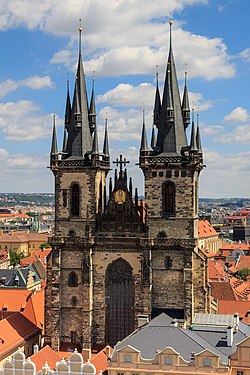
The Church of the Mother of God before Týn (in Czech Kostel Matky Boží před Týnem, also Týnský chrám ("Týn Church") or just Týn), or Church of Our Lady before Týn, is a Gothic church and a dominant feature of the Old Town of Prague, Czech Republic. It has been the main church of this part of the city since the 14th century. The church's two towers are 80 m high, and each tower's spire is topped by eight smaller spires in two layers of four.