

 English
 Français
The Brian Clarke Church of England Academy is a co-educational Church of England free school, located in the town centre of Oldham, Greater Manchester, England. The school caters to pupils aged 11–16 (Key Stage 3 & Key Stage 4). It was temporarily located at The Blue Coat School, whilst construction on the purpose-built new school complex was completed. The school moved into the new building in May 2023. The school is named after the artist Sir Brian Clarke, painter and stained-glass designer, who was born in Oldham. The motto of the school is Luceat lux vestra, from Matthew 5:16: "Let your light shine".
Nearby Places View Menu
0 m
The Blue Coat School, Oldham
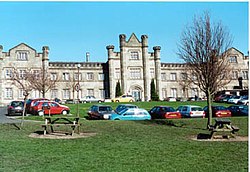
The Blue Coat School is a co education Church of England academy for 11- to 18-year-olds, located in the town of Oldham, Greater Manchester, England.
The school caters for pupils aged 11–18, offering A-level and GCSE courses. It is one of the few schools in the country to hold Leading Edge Partnership programme and science college status. Prior to becoming leading edge, Blue Coat had been a beacon school. This means the school has social responsibility to help develop other secondary schools in the area, as well as themselves.
The motto of the school is from the Latin: Semper Quaereamus Virtutem – "Let us always seek virtue".
340 m
Rifle Street drill hall, Oldham
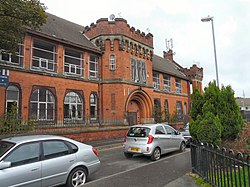
The Rifle Street drill hall is a former military installation in Oldham.
389 m
Oldham Coliseum Theatre
Oldham Coliseum Theatre is a theatre in Oldham, Greater Manchester, England. Located on Fairbottom Street in the town centre, it opened in 1887 as the Colosseum, a reconstruction of an 1885 wooden circus building, has since been rebuilt as a masonry building, and in the 20th century was a music hall and briefly a cinema before reverting to being a repertory theatre. It was closed in 2023 and was to be redeveloped, but is to reopen in 2026 after refurbishment.

421 m
Oldham Parish Church
The Church of St Mary with St Peter, commonly known as Oldham Parish Church, is the Church of England parish church of Oldham in Greater Manchester, England. It forms part of the Diocese of Manchester, and is a grade II* listed building.
A church building had existed on the site since 1280. During this time, a small chapel stood on the site to serve the local townships of Oldham, Chadderton, Royton and Crompton. This was later replaced by an Early English Gothic Church in the 15th century. With the coming of the Industrial Revolution, the population of Oldham increased at a rapid rate (from under 2,000 in 1714, to over 32,000 by 1831). The rapid growth of the local population warranted that the building be rebuilt into the current structure. Though the budget was originally agreed at £5,000, the final cost of building was £30,000, one third of which was spent on the crypt structure. Alternative designs by Sir Charles Barry, the designer of the Palace of Westminster, although now regarded by some as superior, were rejected. In 1805 the churchyard was enlarged and nearby Church Lane, Oldham became a cul-de-sac severing an ancient route through the town. The previous continuance of the road (Church Street) was lowered by 6 feet and became an extension of the recently created Church Terrace.
The church its present form, dates from 1830 and was designed in the Gothic Revival Style by Richard Lane, a Manchester-based architect. It has been designated by English Heritage as a Grade II* listed building. It was linked with St Mary's Church in Prestwich and together the sites were principal churches of the ancient ecclesiastical parish of Prestwich-cum-Oldham.
The reredos tryptich behind high altar was created by the designer Edward Stanley Watkins in 1908. It depicts Christ in Majesty in a medieval style, depicting leading historical figures of the church in England. He also designed the triptych in the side chapel in north aisle.
The peal of twelve bells was cast in 1922 by John Taylor & Co of Loughborough. An additional flat 6th was cast in 1978. The church also retains its original bell, cast in 1722 by Abraham Rudhall II of Gloucester.