

 English
 Français
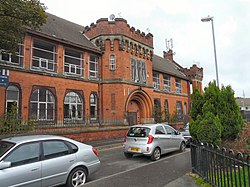
Rifle Street drill hall, Oldham
The Rifle Street drill hall is a former military installation in Oldham.
Nearby Places View Menu
340 m
The Brian Clarke Church of England Academy
The Brian Clarke Church of England Academy is a co-educational Church of England free school, located in the town centre of Oldham, Greater Manchester, England.
The school caters to pupils aged 11–16 (Key Stage 3 & Key Stage 4). It was temporarily located at The Blue Coat School, whilst construction on the purpose-built new school complex was completed. The school moved into the new building in May 2023.
The school is named after the artist Sir Brian Clarke, painter and stained-glass designer, who was born in Oldham. The motto of the school is Luceat lux vestra, from Matthew 5:16: "Let your light shine".
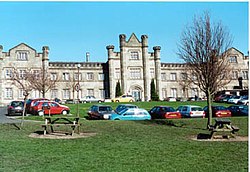
340 m
The Blue Coat School, Oldham
The Blue Coat School is a co education Church of England academy for 11- to 18-year-olds, located in the town of Oldham, Greater Manchester, England.
The school caters for pupils aged 11–18, offering A-level and GCSE courses. It is one of the few schools in the country to hold Leading Edge Partnership programme and science college status. Prior to becoming leading edge, Blue Coat had been a beacon school. This means the school has social responsibility to help develop other secondary schools in the area, as well as themselves.
The motto of the school is from the Latin: Semper Quaereamus Virtutem – "Let us always seek virtue".

366 m
Oldham
Oldham is a town in Greater Manchester, England. It lies amongst the Pennines on elevated ground between the rivers Irk and Medlock, 5 miles (8 km) southeast of Rochdale, and 7 miles (11 km) northeast of Manchester. It is the administrative centre of the Metropolitan Borough of Oldham, which had a population of 242,003 in 2021.
Within the boundaries of the historic county of Lancashire, and with little early history to speak of, Oldham rose to prominence in the 19th century as an international centre of textile manufacture. It was a boomtown of the Industrial Revolution, and among the first ever industrialised towns, rapidly becoming "one of the most important centres of cotton and textile industries in England." At its zenith, it was the most productive cotton spinning mill town in the world, producing more cotton than France and Germany combined. Oldham's textile industry fell into decline in the mid-20th century; the town's last mill closed in 1998.
The demise of textile processing in Oldham depressed and heavily affected the local economy. The town centre is the focus of a project that aims to transform Oldham into a centre for further education and the performing arts. It is, however, still distinguished architecturally by the surviving cotton mills and other buildings associated with that industry.
In the 2021 United Kingdom census Oldham built-up area subdivision, as defined by the Office for National Statistics, had a population of 110,718 and an area of 1,639 hectares (6.33 sq mi), giving a population density of 6,757 inhabitants per hectare (1,750,000/sq mi), while the Borough of Oldham had a population of 242,003, an area of 1,424 hectares (5.50 sq mi), and a population density of 1,729 inhabitants per hectare (448,000/sq mi).

420 m
Oldham bus station
Oldham bus station is a bus station located in the town of Oldham in Greater Manchester. The bus station is found on Cheapside at the junction of West Street. The bus station opened in January 2001 and replaced the previous bus station at Town Square and the bus stops on Cheapside and West Street. The bus station is run by Transport for Greater Manchester.