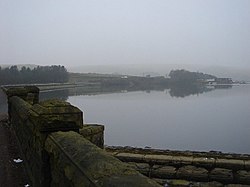
Spitlers Edge is a ridge running along the eastern edge of Anglezarke Moor, Chorley, Lancashire, England from Standing Stones Hill to Hordern Stoops. The peak, complete with a cairn at 1,286 feet (392 m), is the high point of the moorland. Redmonds Edge links Spitlers Edge to Great Hill and is paved. As of 2017, there are plans to extend the paving along the length of Spitlers Edge - with funding secured from the Lancashire Environmental Fund and United Utilities. Along the length of the edge is a stone wall of some historical importance - the boundary was built in 1841 as a relief measure to provide respite from the Hungry Forties, and is the parliamentary division boundary between Chorley and Blackburn. The name is derived from the fact that in mediaeval times, the Knights Hospitallers of St. John of Jerusalem used this route when travelling to their holdings in this district. The ridge provides the peaks that supply the source water to the River Yarrow.

Nearby Places View Menu
Location Image
1.9 km

Great Hill (England)

Great Hill is a hill in Lancashire, England, on Anglezarke Moor, between the towns of Chorley and Darwen. It is part of the West Pennine Moors and lies approximately 3 miles north of Winter Hill, the highest point in the area at 456 m (1,498 ft). The summit at 381 m (1,252 ft) is only slightly higher than the surrounding moorland, but provides excellent views in all directions particularly to the north and west. Paths head west towards White Coppice via the ruins of Drinkwaters, south to Winter Hill via Hordern Stoops, and east to Darwen Tower via Pimm's, Picadilly and the ruins of Hollinshead Hall. The sources of Black Brook and the River Roddlesworth are on the slopes of the hill. The traditional walker's cairn has been replaced by a stone bench in the shape of a cross, which offers shelter from the wind.
Location Image
1.9 km

Black Brook (Chorley)

Black Brook in Lancashire has its source at Great Hill in the West Pennine Moors. The water is acidic due to a high level of peat in the uplands near to Round Loaf, giving the brook its brown colour. The young river was known as Warth Brook in olden Heapey. A feeder stream also known as Black Brook joins near Kittiwake Road - this short and weak water course commences at Eagle Tower. The jointed brook feeds Anglezarke Reservoir, and joins the River Yarrow in lowland Chorley at Yarrow Bridge. The entire course of Black Brook and the River Yarrow fall within Chorley and its villages.
Location Image
2.2 km

Belmont Reservoir

Belmont Reservoir is a reservoir north of the small moorland village of Belmont, Lancashire, England, fed by the Belmont Brook. It was built in 1826 by the Bolton Waterworks to supply water to the rapidly expanding town of Bolton. Belmont was once a thriving industrial centre for stone quarrying and printing. The reservoir is the home of the Bolton Sailing Club. The reservoir is important to wintering wildfowl.
Location Image
2.2 km

Ward's Reservoir

Ward's Reservoir (or Wards Reservoir), known locally as the Blue Lagoon, is a small reservoir close to the village of Belmont, Lancashire, England. It is in the West Pennine Moors north of Bolton. The reservoir did not supply drinking water but was built to supply water to Rycroft Works in the early 19th century. It was enlarged in 1893 by Deacons who used the water to supply Belmont Bleachworks. It holds 150,000 cubic metres of water, with a surface area of 28,000 square metres, when full. Most of the reservoir is only a few feet deep, but it has a depth of about 80 feet (24 m) at its deepest point. The reservoir was drained by its owner, Belmont Holdings, in 2010, despite efforts by local residents to save it. It had fallen into a state of disrepair following the closure of the bleachworks, and was considered a flood risk by the Environment Agency. By the end of August 2010 heavy rain had refilled the reservoir, and in September 2010 it was sold for £50,000. The buyer is thought to be a Horwich-based consortium who will renovate and develop the reservoir for recreational use.