

 English
 Français

Widnes Dock
Widnes Dock was the first rail-to-ship facility in the world. It was built in 1833 between the end of the Sankey Canal and the St Helens and Runcorn Gap Railway in Widnes.
Nearby Places View Menu
77 m
Spike Island, Widnes
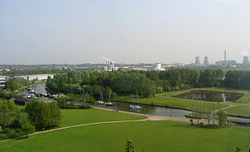
Spike Island is a park in Widnes, Halton, North West England. It is an artificial island between the Sankey Canal and the estuary of the River Mersey containing parkland, woodland, wetlands and footpaths. It is next to the Catalyst Science Discovery Centre, an interactive science and technology museum.
Spike Island was at the centre of the British chemical industry during the Industrial Revolution. In 1833, Widnes Dock, the world's first rail-to-ship dock, was built on the island. In 1848, John Hutchinson built the first chemical factory in Widnes on the island. The chemical industry in Widnes grew rapidly thereafter. By the 1970s no working chemical factories remained, and from 1975 onwards the island was cleaned up and turned over to public recreation.
A famous concert by the rock band the Stone Roses, subsequently the subject of an eponymous film (2012), took place on the island in May 1990.
419 m
West Bank Dock
West Bank Dock was situated on the River Mersey at Widnes.
It was built in 1864 to cater for the growing chemical industry.
It took over some of the traffic of the Widnes Dock.
The dock closed in the 1970s.
In 2008, the Stobart Group had received a contract for "the demolition of an unused industrial estate and the cleanup of acres of contaminated land at the West Bank Dock Estate in Widnes." from the Northwest Regional Development Agency. The new Mersey Multimodal Gateway will be built on the old West Bank Dock Estate.

512 m
St Mary's Church, Widnes
St Mary's Church is in the West Bank area of Widnes, Cheshire, England. The church is recorded in the National Heritage List for England as a designated Grade II* listed building. It is an active Anglican parish church in the diocese of Liverpool, the archdeaconry of Warrington and the deanery of Widnes. Together with the churches of St Paul, Widnes, and St Mary, Hale, it forms the South Widnes Team. It has been described as "the last great church masterpiece" created by the Lancaster architects Austin and Paley.
608 m
Widnes South railway station
Widnes South railway station was located in the town of Widnes in Cheshire, England on the east side of Victoria Road. It was built by the London and North Western Railway and situated on their Widnes Deviation Line, opening to passengers and goods in March 1870. This route was constructed by the LNWR to improve traffic flow on the busy Ditton Junction to Warrington Bank Quay Low Level and Manchester (the former Garston and Warrington Railway, later renamed as the St Helens Railway). It replaced an earlier station on the G&WR line located slightly further south and also had a connection to the St Helens and Runcorn Gap Railway, providing access towards the north.
Passenger services were primarily local in nature and provided by Liverpool Lime Street to Warrington Bank Quay & Manchester Oxford Road stopping trains and the Ditton Dodger between Ditton and St Helens Central - this pattern continued after the 1923 Grouping brought the route under the control of the London, Midland & Scottish Railway and the subsequent nationalisation of the UK railway network in January 1948. The line was also heavily used by freight, with the LNWR treating it as a key artery for through east–west traffic.
St Helens trains were withdrawn by the British Transport Commission in June 1951 – service levels on the route having been cut prior to World War II and never fully restored afterwards. The station was subsequently renamed as Widnes South by BR in January 1959 to differentiate it from the neighbouring Widnes Central station on the former Manchester, Sheffield and Lincolnshire Railway & Midland Railway Joint Widnes Loop line and "North" (now known simply as Widnes) on the Cheshire Lines Committee main line. It then closed to regular passenger traffic on 10 September 1962 with the withdrawal of services on the Ditton to Manchester via Warrington route. Special excursions run in conjunction with Widnes rugby league club home matches continued to call until 1965, whilst the goods depot remained open until 1969.
By December 2015 the route through the station was still used by freight traffic, the main flow being block coal trains to and from the power station at Fiddlers Ferry. The station buildings and one platform had been demolished, though the westbound platform still remained intact, albeit overgrown. The connection towards St Helens was closed in 1982 (along with the station signal box), whilst the main line now terminates at Arpley yard, near Warrington Bank Quay station. The section east of Warrington towards Manchester and Stockport was closed in 1985.
In January 2016 the last remains of the station were demolished. Contractors began work at the beginning of the month; they demolished the remains of the platforms, filled in the subway and landscaped the resulting embankment sides.