

 English
 Français
West Bank Dock
West Bank Dock was situated on the River Mersey at Widnes. It was built in 1864 to cater for the growing chemical industry. It took over some of the traffic of the Widnes Dock. The dock closed in the 1970s. In 2008, the Stobart Group had received a contract for "the demolition of an unused industrial estate and the cleanup of acres of contaminated land at the West Bank Dock Estate in Widnes." from the Northwest Regional Development Agency. The new Mersey Multimodal Gateway will be built on the old West Bank Dock Estate.
Nearby Places View Menu

139 m
St Mary's Church, Widnes
St Mary's Church is in the West Bank area of Widnes, Cheshire, England. The church is recorded in the National Heritage List for England as a designated Grade II* listed building. It is an active Anglican parish church in the diocese of Liverpool, the archdeaconry of Warrington and the deanery of Widnes. Together with the churches of St Paul, Widnes, and St Mary, Hale, it forms the South Widnes Team. It has been described as "the last great church masterpiece" created by the Lancaster architects Austin and Paley.

419 m
Widnes Dock
Widnes Dock was the first rail-to-ship facility in the world. It was built in 1833 between the end of the Sankey Canal and the St Helens and Runcorn Gap Railway in Widnes.

468 m
Widnes–Runcorn Transporter Bridge
The Widnes–Runcorn Transporter Bridge crossed the river Mersey and Manchester Ship Canal linking the towns of Runcorn and Widnes. Completed in 1905, it was Britain's first transporter bridge and the largest of its type ever built in the world. It continued in use until 22 July 1961, when it was replaced by a through arch bridge, now known as the Silver Jubilee Bridge. The transporter bridge was then demolished.
496 m
Spike Island, Widnes
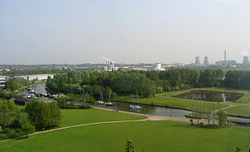
Spike Island is a park in Widnes, Halton, North West England. It is an artificial island between the Sankey Canal and the estuary of the River Mersey containing parkland, woodland, wetlands and footpaths. It is next to the Catalyst Science Discovery Centre, an interactive science and technology museum.
Spike Island was at the centre of the British chemical industry during the Industrial Revolution. In 1833, Widnes Dock, the world's first rail-to-ship dock, was built on the island. In 1848, John Hutchinson built the first chemical factory in Widnes on the island. The chemical industry in Widnes grew rapidly thereafter. By the 1970s no working chemical factories remained, and from 1975 onwards the island was cleaned up and turned over to public recreation.
A famous concert by the rock band the Stone Roses, subsequently the subject of an eponymous film (2012), took place on the island in May 1990.