

 English
 Français

The Widnes–Runcorn Transporter Bridge crossed the river Mersey and Manchester Ship Canal linking the towns of Runcorn and Widnes. Completed in 1905, it was Britain's first transporter bridge and the largest of its type ever built in the world. It continued in use until 22 July 1961, when it was replaced by a through arch bridge, now known as the Silver Jubilee Bridge. The transporter bridge was then demolished.
Nearby Places View Menu

93 m
Silver Jubilee Bridge
The Silver Jubilee Bridge (originally the Runcorn–Widnes Bridge or informally the Runcorn Bridge) crosses the River Mersey and the Manchester Ship Canal at Runcorn Gap between Runcorn and Widnes in Halton, England. It is a through arch bridge with a main arch span of 361 yards (330 m). It was opened in 1961 as a replacement for the Widnes–Runcorn Transporter Bridge. In 1975–77 the carriageway was widened, after which the bridge was given its official name in honour of the Silver Jubilee of Elizabeth II. It carries the A533 road and a cantilevered footway. The bridge is recorded in the National Heritage List for England as a designated Grade II listed building. The bridge was closed to vehicles for refurbishment upon the opening of the new Mersey Gateway Bridge, but reopened as a toll bridge in February 2021.
137 m
Runcorn Railway Bridge
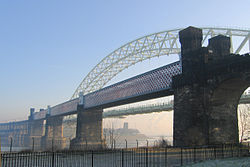
The Runcorn Railway Bridge, Ethelfleda Bridge or Britannia Bridge crosses the River Mersey at Runcorn Gap between Runcorn and Widnes in Cheshire, England. It is alongside the Silver Jubilee Bridge. The bridge is recorded in the National Heritage List for England as a Grade II* Listed building.
In 1861, Parliamentary approval for a railway crossing the Mersey was obtained by the London and North Western Railway (LNWR). The design for a bridge and viaducts was produced by William Baker, the company's chief engineer. In 1863, preparatory work for the bridge and approach viaducts commenced. The bridge was completed in 1868 and was opened for traffic on 10 October. The first goods traffic crossed the bridge on 1 February 1869 and the first passenger train on 1 April.
The bridge has received few alterations. In 1965, the pedestrian footway alongside the railway was closed to the public but retained for maintenance access. The bridge is used by rail traffic on the Liverpool branch of the West Coast Main Line. The lines are electrified and 25 kV AC overhead lines installed. Starting in the 2010s, the bridge has undergone a lengthy maintenance programme that will extend its life for another 150 years.

235 m
Borough of Halton
The Borough of Halton () is a local authority district with borough status in the ceremonial county of Cheshire, North West England. It is administered by Halton Borough Council, a unitary authority since 1998. The borough contains the towns of Runcorn and Widnes and the civil parishes of Daresbury, Hale, Halebank, Moore, Preston Brook, and Sandymoor. Since 2014, it has been part of the Liverpool City Region and the council is a member of the Liverpool City Region Combined Authority.
The neighbouring districts (clockwise from west) are Liverpool, Knowsley and St Helens, which are fellow boroughs of the Liverpool City Region, and Warrington and Cheshire West and Chester in Cheshire.

333 m
St Mary's Church, Widnes
St Mary's Church is in the West Bank area of Widnes, Cheshire, England. The church is recorded in the National Heritage List for England as a designated Grade II* listed building. It is an active Anglican parish church in the diocese of Liverpool, the archdeaconry of Warrington and the deanery of Widnes. Together with the churches of St Paul, Widnes, and St Mary, Hale, it forms the South Widnes Team. It has been described as "the last great church masterpiece" created by the Lancaster architects Austin and Paley.