Castle Clinton ou Fort Clinton est un fort circulaire fait de grès, situé à Battery Park à l'extrémité sud de Manhattan, à New York. Classé monument national américain, le fort doit son nom à DeWitt Clinton, gouverneur de l'État de New York qui fait renforcer les défenses sur la baie.

1. Voir aussi


1. = Articles connexes =

Liste des monuments nationaux américains

1. = Liens externes =

Ressources relatives à la géographie : Geographic Names Information System National Parks Conservation Association NPSpecies Planning, Environment and Public Comment Ressources relatives à l'architecture : Harpers Ferry Center National Park Foundation NPS Stats Registre national des lieux historiques (en) Castle Clinton National Monument sur Natural Atlas Site officiel The Battery Conservancy Castle Garden Immigration Database

Portail de New York Portail du Registre national des lieux historiques

Nearby Places View Menu
Location Image
22 m

Castle Clinton

Castle Clinton (also known as Fort Clinton and Castle Garden) is a restored circular sandstone fort within Battery Park at the southern end of Manhattan in New York City, United States. Built from 1808 to 1811, it was the first American immigration station, predating Ellis Island. More than 7.5 million people arrived in the United States at Fort Clinton between 1855 and 1890. Over its active life, it has also functioned as a beer garden, exhibition hall, theater, and public aquarium. The structure is a New York City designated landmark and a U.S. national monument, and it is listed on the National Register of Historic Places. Fort Clinton was originally known as the West Battery or the Southwest Battery, occupying an artificial island off the shore of Lower Manhattan. Designed by John McComb Jr., with Jonathan Williams as consulting engineer, the fort was garrisoned in 1812 but was never used for warfare. In 1824, the New York City government converted Fort Clinton into a 6,000-seat entertainment venue known as Castle Garden, which operated until 1855. Castle Garden then served as an immigrant processing depot for 35 years. When the processing facilities were moved to Ellis Island in 1892, Castle Garden was converted into the first home of the New York Aquarium, which opened in 1896 and continued operating until 1941. The fort was expanded and renovated several times during this period. In the 1940s, New York City parks commissioner Robert Moses proposed demolishing Fort Clinton as part of the construction of the nearby Brooklyn–Battery Tunnel. This led to a prolonged debate over the fort's preservation, as well as the creation of the Castle Clinton National Monument in 1946. The National Park Service took over the fort in 1950. After several unsuccessful attempts to restore the fort, Castle Clinton reopened in 1975 following an extensive renovation. Since 1986, it has served as a visitor center and a departure point for ferries to the Statue of Liberty National Monument.
Location Image
77 m

The Battery (Manhattan)

The Battery, formerly known as Battery Park, is a 25-acre (10 ha) public park located at the southern tip of Manhattan Island in New York City facing New York Harbor. The park is bounded by Battery Place on the north, with Bowling Green to the northeast, State Street on the east, New York Harbor to the south, and the Hudson River to the west. The park contains attractions such as an early 19th-century fort named Castle Clinton; multiple monuments; and the SeaGlass Carousel. The surrounding area, known as South Ferry, contains multiple ferry terminals, including the Staten Island Ferry's Whitehall Terminal; a boat launch to the Statue of Liberty National Monument (which includes Ellis Island and Liberty Island); and a boat launch to Governors Island. The park and surrounding area are named for the artillery batteries that were built in the late 17th century to protect the fort and settlement behind them. By the 1820s, the Battery had become an entertainment destination and promenade, with the conversion of Castle Clinton into a theater venue. During the mid-19th century, the modern-day Battery Park was laid out and Castle Clinton was converted into an immigration and customs center. The Battery was commonly known as the landing point for immigrants arriving in New York City until 1892, when the immigration center was relocated to Ellis Island in the middle of the harbor. Castle Clinton (sometimes called, Castle Garden) then hosted the New York Aquarium from 1896 to 1941. By the 20th century, the quality of Battery Park had started to decline, and several new structures were proposed within the park, many of which were not built. In 1940, the entirety of Battery Park was closed for twelve years due to the construction of the Brooklyn–Battery Tunnel and the Battery Park Underpass. The park reopened in 1952 after a renovation, but then subsequently went into decline. The Battery Conservancy, founded in 1994 by Warrie Price, underwrote and funded the restoration and improvement of the once-dilapidated park. In 2015, the Conservancy restored the park's historical name, "the Battery".
Location Image
116 m

Battery Park Underpass

The Battery Park Underpass is a vehicular tunnel at the southernmost tip of Manhattan, New York City, near the neighborhoods of South Ferry and Battery Park City. The tunnel connects FDR Drive, which runs along the east side of Manhattan Island, with the West Side Highway (New York State Route 9A, or NY 9A), which runs along the island's west side. Opened in 1951, it was the second section of FDR Drive to be completed. The underpass crosses beneath the Battery (formerly Battery Park) and the approach to the Brooklyn–Battery Tunnel.
Location Image
170 m

City Pier A

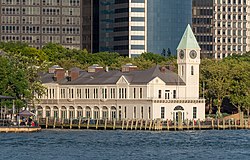
Pier A, also known as City Pier A, is a pier in the Hudson River at Battery Park in Lower Manhattan, New York City. It was built from 1884 to 1886 as the headquarters of the New York City Board of Dock Commissioners (also known as the Docks Department) and the New York City Police Department's (NYPD) Harbor Department. Pier A, the only remaining masonry pier in New York City, contains a two- and three-story structure with a clock tower facing the Hudson River. The pier is a New York City designated landmark and is listed on the National Register of Historic Places (NRHP). The building atop Pier A was designed by George Sears Greene Jr. The original structure is two stories tall and extends west into the Hudson River; the clock tower at the southwestern corner of the building. The eastern, or inshore, end of Pier A was constructed in 1900 and expanded to three stories in 1904. The pier itself is composed of a concrete deck supported by girders. The building originally housed offices for the NYPD and Docks Department, which were subsequently converted into restaurant spaces. The Department of Docks started constructing the pier in July 1884; although the pier deck was completed in 1885, the building was not finished until early 1886. The NYPD occupied Pier A until 1955, while the Department of Docks relocated to the Battery Maritime Building in 1959. The New York City Fire Department (FDNY) used the pier from 1960 to 1992 as a fireboat station. Following a failed attempt to demolish Pier A as part of the development of Battery Park City in the 1970s, the structure was added to the NRHP and became a city landmark. Mayor Ed Koch selected Wings Point Associates to redevelop Pier A in 1988, but the redevelopment was stalled for the next two decades. Pier A was temporarily used as a commuter ferry landing after the September 11 attacks. After the Battery Park City Authority leased Pier A in 2008, it was renovated into a restaurant called Harbor House, which operated from 2014 to 2020.
Location Image
205 m

Statue of John Ericsson

John Ericsson is a Heroic-Scale bronze statue depicting John Ericsson, and is located in Battery Park in New York City