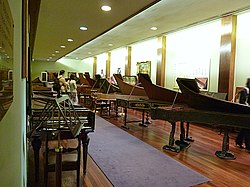
La collection Russell est une importante collection d'instruments à clavier anciens assemblés par le claveciniste et organologue britannique Raymond Russell. Elle fait partie de la collection des musées d'instruments musicaux de l'Université d'Edimbourg et se trouve dans le St Cecilia's Hall. Son nom complet est la Raymond Russell Collection of Early Keyboard Instruments (« Collection Raymond Russell des instruments anciens à clavier »).

1. Histoire

Raymond Russell, un claveciniste et organologue britannique, achète son premier instrument à clavier historique en 1939. Au cours des vingt années suivantes, il rassemble une collection considérable de clavicordes et clavecins du XVIIe et du XVIIIe siècle. Sa collection comprend des instruments de toutes les principales régions européennes de construction de clavecins : un certain nombre d'épinettes anglaises ; les premiers clavecins et virginals d'Italie ; des instruments flamands des Ruckers ; un instrument français tardif de Pascal Taskin ; et un clavicorde et un clavecin du nord de l'Allemagne, tous deux de Johann Adolph Hass. Russell décrit de nombreux instruments en détail dans son livre Le clavecin et le clavicorde : une étude introductive, publié en 1959. En 1960, Russell décide de faire don de sa collection à l'Université d'Édimbourg, où elle devait devenir le noyau d'un centre de recherche sur la pratique d'interprétation au clavier et de l'organologie, mais ce plan n'est pas achevé au moment de sa mort soudaine, à Malte en 1964, à l'âge de quarante et un ans. Plus tard cette année, en sa mémoire et conformément à ses souhaits, sa mère Maud Russell fait don de presque toute sa collection — dix-neuf instruments — à l'université ; le don comprend également ses notes et sa collection de photographies documentaires. La collection est logée dans le St Cecilia's Hall à Édimbourg, qui a ouvert ses portes en tant que musée en 1968 ; le récital d'ouverture ayant été donné par Gustav Leonhardt. L'université achète deux autres instruments de la collection de Russell — un double clavecin anglais de Jacob Kirckman, acheté aux enchères en 1970, et un double clavecin français de Jean Goermans et Taskin, acheté à Maud Russell en 1974 — ce qui porte le nombre total à vingt et un.

1. Instruments

Les 21 instruments de la collection représentent les cinq principales zones géographiques ou écoles nationales de lutherie - Angleterre, Flandre, France, monde germanophone et péninsule italienne — et plus de deux cents ans d'histoire de l'artisanat.

1. = Angleterre =

Les instruments anglais de la collection comprennent :

un virginal rectangulaire fait par Stephen Keene en 1668 une épinette hexagonale attribuée à John Player, réalisée vers 1705 un clavecin à un clavier de Thomas Hancock, fabriqué en 1720 une épinette en noyer de Thomas Hitchcock, datée de 1728 une épinette courbe faite en 1757 par Sir John Harrison Burnett un clavecin à deux claviers finement décoré par Jacob Kirckman, datant de 1755 une épinette courbe écossaise, fabriquée à Édimbourg en 1784 par Neil Stewart un clavecin à un clavier de John Broadwood and Sons, fabriqué en 1793

1. = Flandre =

La collection comprend quatre clavecins flamands, tous fabriqués à Anvers :

un clavecin à deux claviers fabriqué par Andreas Ruckers l'Ancien en 1608 un clavecin à un clavier d'Ioannes Ruckers, daté de 1637 un clavecin transpositeur à deux claviers, également de Ioannes Ruckers, 1638 un clavecin à un clavier d'Ioannes Couchet, fabriqué en 1645

1. = France =

Les deux instruments français sont :

un clavecin à double clavier fabriqué par Jacques Goermans en 1764, ravalé par Pascal Taskin en 1783-1784, anciennement propriété d'Arnold Dolmetsch un clavecin à double clavier de Taskin, fabriqué en 1769. Cet instrument avait appartenu à Alexandre Taskin, baryton à l'Opéra comique, dont la fille Arlette avait épousé Louis Vierne.

1. = Allemagne =

Il y a deux instruments nord-allemands, tous deux fabriqués à Hambourg par Johann Adolph Hass : un clavicorde non fretté datant de 1763 et un clavecin à un seul clavier fabriqué en 1764 Il y a aussi un petit clavicorde allemand à trois frettes, cerca 1700

Les instruments d'Italie comprennent :

1. = Italie =

un virginal pentagonal intérieur-extérieur réalisé en 1586 par Alessandro Bertolotti un clavecin intérieur-extérieur simple clavier anonyme datant d'environ 1620 un clavecin triple clavier de Stefano Bolcioni, fabriqué en 1627 une épinette ottavino fabriquée par Petrus Michael Orlandus en 1710

1. Discographie

John Kitchen, claviers – vol. 1 (15-18 décembre 2000, Delphian DCD 34001) (OCLC 811456176) — permet d'écouter neuf instruments de la collection. John Kitchen, claviers – vol. 2 (13-15 avril 2005, Delphian) (OCLC 921911732) La Paix du parnasse : François Couperin - Lucy Carolan et John Kitchen, clavecins (2-4 septembre 2002, Delphian) (OCLC 56323647) Haendel, Ouvertures - John Kitchen, clavecin Kirckman 1755 (17-18 décembre 2008, Delphian) (OCLC 811456579)

1. Bibliographie

(en) Raymond Russell, The harpsichord and clavichord : an introductory study, Londres, Faber and Faber, 1959, 208+96

1. Références


1. Voir également

Musée des instruments de musique Musée national des instruments de musique Lieux d'exposition de clavecins anciens Histoire du clavecin

1. Liens externes

(en) Page officielle sur le site de l'Université d'Édimbourg, ed.ac.uk (en) Sophie Yates, « The Early Music Show: Rameau and the Harpsichord », BBC Radio 3, 15 juin 2014 Portail de la musique classique Portail du clavecin

Nearby Places View Menu
Location Image
103 m

Lady Yester's Kirk

Lady Yester's Kirk was a parish church of the Church of Scotland and one of the burgh churches of Edinburgh. Founded in 1647, it served the south-eastern part of Edinburgh's Old Town until its union with Greyfriars Kirk in 1938. Margaret, Lady Yester gave a benefaction to establish the church in 1647; though a parish and minister were not allotted to the church until 1655. It was again without a regular congregation between 1662 and 1691. A secession from the congregation in 1764 led to the formation of Edinburgh's first Relief congregation. The church was notable for its close connection to the nearby University of Edinburgh and three of its ministers served as the university's principal. Though the Disruption of 1843 little affected the church, improvement works and population movement in the latter half of the 19th century and the early 20th century depleted the congregation. In 1938, the congregation united with Greyfriars Kirk. The building was sold to the university, which continues to use it as the headquarters of its Estates Department. The church building was completed in 1805 to a Jacobean design by William Sibbald. It incorporates and imitates some features of the original church, which stood slightly to the east. The first church included the burial aisle of Lady Yester. An elaborate Renaissance plaque which stood over her grave is now housed in Greyfriars Kirk.
Location Image
146 m

St Patrick's Church, Edinburgh

St Patrick's Church is a Roman Catholic Parish church in the Cowgate part of Old Town, Edinburgh, Scotland. It was built from 1771 to 1774, and became a Catholic church in 1856. The facade of the church was designed by Reginald Fairlie in 1929. It is situated between South Gray's Close and St Mary's Street north of Cowgate and south of the Royal Mile. It is a category B listed building.
202 m

Institute for the Study of Science, Technology and Innovation

The Institute for the Study of Science, Technology and Innovation (ISSTI) is an interdisciplinary research centre based in the UK. The research network was established in 2001 to bring together groups of academics and individual researchers across the University of Edinburgh, Edinburgh, UK. It consolidates activities in research, teaching and knowledge transfer on social and policy aspects of science, technology and innovation. ISSTI emerged from the interdisciplinary research collaboration established amongst specialist groups and scholars at the University of Edinburgh under the ESRC Programme on Information and Communications Technology, coordinated by the Research Centre for Social Sciences. Other founding members were the Sociology subject group, the Science Studies Unit, the Japanese European Technology Studies Institute (JETS) and the Entrepreneurship and Innovation group in the Business School and Economics, and the Innogen Centre. Over time this collaboration has expanded to include a wider array of scholars and specialist centres across the University including the Schools of Informatics, Law, Public Health, and Edinburgh College of Art with links also to Geosciences, Engineering and Philosophy. Today ISSTI comprises over 100 staff and research students. It constitutes one of the most interdisciplinary groupings in the field of science, technology and innovation studies measured in terms joint publication and publication outliets.
Location Image
210 m

School of GeoSciences, University of Edinburgh

The University of Edinburgh School of GeoSciences is a department within the College of Science and Engineering at the University of Edinburgh in Scotland. It was formed in 2002 by the merger of four departments. It is split between the King's Buildings and the Central Area of the university. The institutes of Ecological Sciences and Earth Science are located at the King's Buildings, whilst the Institute of Geography is located on Drummond Street in the Central Area. In 2013 the department was ranked 8th best place to study geography in the country by The Guardian University Rankings, down from 2nd in 2006. The school is ranked as one of the best in the UK for Earth Sciences. A 2008 Research Assessment Exercise assessment ranked the "Earth Systems and Environmental Science" department as the best in the UK by number of world leading research and staff. Its Geography department was ranked 15th in the world according to the 2015 QS rankings. There are over 1100 undergraduate students and 250 postgraduate students in the School of GeoSciences. There are also around 100 research and teaching staff within the school. The School collaborates with the University of Edinburgh Business School and the School of Economics, to offer a Carbon Management MSc degree, the first in the world, which has students from over 20 countries. The school also has exchange programmes though the Erasmus programme, in addition to universities in Canada, the United States, Australia and New Zealand. The head of the School of GeoSciences is currently Professor Bryne Ngwenya. Famous recent alumni of the School include former BP chief executive Tony Hayward. Former Rector of the university Peter McColl matriculated at one of the predecessors, the Department of Geography. Competition for entry is highly selective, in 2010, the School received 2221 applications, but only 275 offers were made, representing a 16.9% of an applicant receiving an offer. The school currently offers 11 undergraduate courses and a range of postgraduate degrees.
Location Image
224 m

University of Edinburgh

The University of Edinburgh (Scots: University o Edinburgh, Scottish Gaelic: Oilthigh Dhùn Èideann; abbreviated as Edin. in post-nominals) is a public research university based in Edinburgh, Scotland. Founded by the town council under the authority of a royal charter from King James VI in 1582 and officially opened in 1583, it is one of Scotland's four ancient universities and the sixth-oldest university in continuous operation in the English-speaking world. The university played a crucial role in Edinburgh becoming a leading intellectual centre during the Scottish Enlightenment and contributed to the city being nicknamed the "Athens of the North". The three main global university rankings (ARWU, THE, and QS) place the University of Edinburgh within their respective top 40. It is a member of several associations of research-intensive universities, including the Coimbra Group, League of European Research Universities, Russell Group, Una Europa, and Universitas 21. In the fiscal year ending 31 July 2025, the university had a total income of £1.437 billion, with £375.4 million from research grants and contracts. It has the third-largest endowment in the UK, behind only Cambridge and Oxford. The university occupies five main campuses in the city of Edinburgh, which include many buildings of historical and architectural significance, such as those in the Old Town. Edinburgh is the fourth-largest university in the United Kingdom by total enrolment and the largest university in Scotland, receiving over 66,000 undergraduate applications per year, making it the fifth-most popular university in the UK by application volume. In 2021, Edinburgh had the seventh-highest average UCAS points among British universities for new entrants. The university maintains strong links to the royal family, with Prince Philip, Duke of Edinburgh, serving as its chancellor from 1953 to 2010, and Anne, Princess Royal, holding the position since March 2011. Notable alumni of the University of Edinburgh include inventor Alexander Graham Bell, naturalist Charles Darwin, philosopher David Hume, physicist James Clerk Maxwell, and writers such as Oliver Goldsmith, Sir J. M. Barrie, Sir Arthur Conan Doyle, Sir Walter Scott, and Robert Louis Stevenson. The university has produced several heads of state and government, including three British prime ministers. Additionally, three UK Supreme Court justices were educated at Edinburgh. As of October 2024, the university has been affiliated with 20 Nobel Prize laureates, four Pulitzer Prize winners, three Turing Award winners, an Abel Prize laureate, and a Fields Medalist. Edinburgh alumni have also won a total of ten Olympic gold medals.