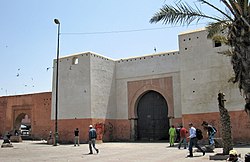
La mosquée Bab Doukkala (en arabe : مسجد باب دكالة) est une importante mosquée de quartier à Marrakech, au Maroc, datant du XVIe siècle. Elle porte le nom de la porte voisine, Bab Doukkala, dans le rempart occidental de la médina. Elle est également connue sous le nom de Mosquée al-Hurra (ou "Mosquée de la Liberté").

1. Histoire

La mosquée a été commandée par Lalla Mas'uda bint Ahmad, Reine du Maroc, épouse de Muhammad al-Sheikh (le fondateur de la dynastie saadienne ) et mère du sultan Ahmad al-Mansur de la dynastie saadienne. La construction de la mosquée a commencé en 1557-58 et s'est probablement terminée vers 1570-71, pendant le règne de Moulay Abdallah al-Ghalib . Le statut de Lalla Ma'suda, femme puissante, "libre" et indépendante, est peut-être à l'origine du surnom de la mosquée Jami 'al-Hurra ("Mosquée de la Liberté"). En 1557-58, le sultan avait ordonné que la population juive de la ville déménage dans une zone plus proche de la Kasbah (citadelle royale), entraînant la création du mellah. La construction du nouveau mellah a probablement été achevée vers 1562-1563 . Le transfert des citadins de confession juive vers le nouveau quartier a libéré une grande quantité d'espace dans la ville, ouvrant la voie à de nombreux réaménagements. La mosquée Bab Doukkala et la mosquée Mouassine, construite à la même époque, semblent avoir fait partie d'un plan plus vaste de construction de nouveaux quartiers "modèles" dans la ville . Il a été conçu dans le cadre d'un complexe religieux et civique cohérent qui comprenait, outre la mosquée elle-même, une madrasa, une bibliothèque, un hammam avec latrines et une fontaine publique pour distribuer l'eau aux habitants . Ce type de complexe architectural était sans précédent au Maroc. Il pourrait avoir été influencé par la tradition de construction de tels complexes en Égypte mamelouke et dans l'Empire ottoman.

1. Galerie


1. Notes et références


1. Voir aussi

Bab Doukkala Marrakech Saâdiens

Portail du Maroc Portail de Marrakech Portail de l'islam

Nearby Places View Menu
Location Image
30 m

Bab Doukkala Mosque

The Bab Doukkala Mosque (Arabic: مسجد باب دكالة) or Mosque of Bab Doukkala is a mosque in Marrakesh, Morocco. It is named after the nearby western city gate, Bab Doukkala. It was built in the 16th century during the Saadian period. It is also known as the al-Hurra Mosque ("Mosque of the Free One"), in reference to its founder, Massa'uda al-Wizkitiya. Like the contemporary Mouassine Mosque to the southeast, it was built as a Friday mosque for what was a newly redevelopped neighbourhood at the time. It formed the main element in a larger religious-charitable complex that also included a madrasa, a hammam, a library, a fountain, and more.
Location Image
338 m

Dar el Bacha

Dar el Bacha (Arabic: دار الباشا, lit. 'House of the Pasha') is a palace situated in the old medina of Marrakesh, Morocco. It currently houses the Museum of Confluences.
Location Image
411 m

Bab Doukkala

Bab Doukkala (Arabic: باب دكالة, lit. 'gate of the Doukkala') is the main northwestern gate of the medina (historic walled city) of Marrakesh, Morocco.
Location Image
601 m

Dar Cherifa

Dar Cherifa, historically known as Dar Ijimi, is a late 16th-century house in the medina (old city) of Marrakesh, Morocco. It is located in the Mouassine neighbourhood and is one of the few well-preserved houses from the Saadian period in the city. In recent years it has been restored and is now used as a café and art gallery.
Location Image
633 m

Walls of Marrakesh

The Walls of Marrakesh are a set of defensive ramparts which enclose the historic medina districts of Marrakesh, Morocco. They were first laid out in the early 12th century by the Almoravid dynasty which founded the city in 1070 CE as their new capital. The walls have since been expanded several times by the addition of the Kasbah to the south at the end of the 12th century and by a later extension to encompass the northern neighbourhood around the Zawiya of Sidi Bel Abbes. The Gates of Marrakesh were for the most part established since the original Almoravid construction of the city walls, but most have been modified during later periods. Other gates were also added when the Almohads created the Kasbah, which itself has been expanded and re-worked many times since.