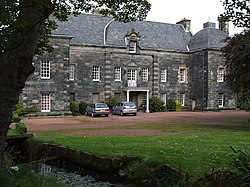
Caroline Park is a 17th-century mansion in the Granton area of Edinburgh. It was constructed between 1683 and 1696 for Sir George Mackenzie, 1st Viscount Tarbat, and his wife Anna. It is protected as a category A listed building for its "sophisticated French-influenced principal (south) elevation and some very fine intact internal features".

1. History

Around 1585, Andrew Logan built a mansion on the site, known as Royston House, it was an L-plan building. Between 1683 and 1696 the house was completely rebuilt by Sir George Mackenzie on a quadrangular plan. In 1739 John Campbell, 2nd Duke of Argyll, purchased the house and renamed it Caroline Park after his daughter. He commissioned William Adam to design an extension, which was built in 1740–1741. By 1793 it had been inherited by Henry Scott, 3rd Duke of Buccleuch. In the 19th century it was leased to tenants including Henry Cockburn and Alicia Scott, composer of the tune Annie Laurie. After undergoing various changes throughout the centuries, during the 1980s the building fell into a state of disrepair having been surrounded by developments since the Industrial Revolution. After years of independent renovation work, the house and its modest grounds have been returned to close to their former state, and are once again in domestic use. The privately owned house features Italian plaster-work and painted ceilings, intricate wrought iron balustrades, wooden panels and carvings.

1. References


1. External links

Media related to Caroline Park House at Wikimedia Commons

Caroline Park, Gazetteer for Scotland

Nearby Places View Menu
Location Image
158 m

Granton Waterfront regeneration

The Granton Waterfront regeneration is a redevelopment of parts of Edinburgh along the shores of the Firth of Forth in Granton. There are three main landowners: Arcus (formerly Forth Ports), National Grid plc and City of Edinburgh Council. Since the area was masterplanned in the early 2000s it has undergone significant change with approximately 1,400 new homes in the Granton area, new food retail stores, the new Telford College at Granton, and approximately 16,000 square metres (170,000 sq ft) of commercial office space. A new road, Waterfront Avenue, has been constructed at Granton along with a 110 acres (45 ha) public park as part of National Grid's Forthquarter development. Following the recession of 2008, a new Area Development Framework has been prepared by the planning authority reflecting a flexible approach to future development. A new waterside promenade has started which will link the river Almond at Cramond to the Esk at Joppa allowing access to 18 kilometres of walkway/cycleway.
Location Image
409 m

Granton Gasworks railway station

Granton Gasworks railway station was a private railway station built to serve the Granton Gasworks in Granton, Edinburgh, Scotland that operated from 1902 to 1942. After laying vacant for decades, the station was brought back into use in 2023 as Granton Station Creative Works, a creative enterprise hub operated by the arts charity Wasps Studios.
458 m

Madelvic Motor Carriage Company

The Madelvic Motor Carriage Company of Granton, Scotland was an early car manufacturing company.
Location Image
606 m

Edinburgh College

Edinburgh College is a further and higher education institution with campuses in Edinburgh and Midlothian, Scotland. It serves the Edinburgh Region, Edinburgh, East Lothian and Midlothian, and is the largest college in Scotland. It was formed on 1 October 2012 as part of the merger of Edinburgh's Jewel and Esk, Telford, and Stevenson colleges. The college has four campuses, all of which were previously the campuses of the constituents of the merger: Jewel and Esk's College Milton Road (Jewel) Campus and Eskbank Campus (Now referred to as "Edinburgh College, Milton Road Campus" and "Edinburgh College, Midlothian Campus"); Edinburgh Telford College (Now referred to as Edinburgh College, Granton Campus); and Stevenson College Edinburgh (Now referred to as Edinburgh College, Sighthill Campus)